It has already been shown that when it is desired to accelerate the engine rapidly, a simple carburettor will not provide the required rich mixture. Rapid opening of the throttle will be immediately followed by an increased airflow, but the inertia of the liquid fuel will cause at least a momentarily lean mixture just when richness is desired for power. To overcome this deficiency, an acceleration pump is provided; an example is shown in Fig. 10.32. The pump consists of a spring-loaded plunger. A linkage mechanism is provided so that when the throttle is rapidly opened the plunger moves into the cylinder and forces an additional jet of fuel into the venturi. The plunger is raised again against the spring force when the throttle is partly closed. Arrangement is provided so that when the throttle is opened slowly, the fuel in the pump cylinder is not forced into the venturi but leaks past plunger or some holes into the float chamber.
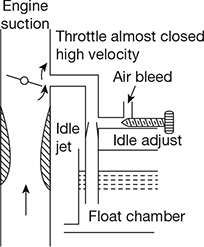
Figure 10.30 Idling jet
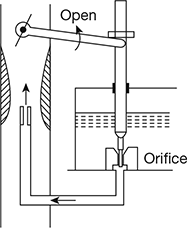
Figure 10.31 Meter rod economiser
Instead of the mechanical linkage shown, some carburettors have a plunger held up by a manifold vacuum. Wherever that vacuum is reduced by the rapid opening of the throttle, a spring forces the plunger down in a pumping action identical to that of the pump illustrated.
Leave a Reply