Basic principles of Dow Theory
Dow Theory has the following basic principles.
- There are certain pieces of information that have the potential to impact the demand and supply of securities in the market. Dow Theory works on the assumption that averages can discount every piece of such information except natural calamities. As soon as any such event occurs, the theory immediately analyze its impact, price in, and reflect it in the average.
- Charles Dow also assumed that averages can move in trends.
There are 3 parts of trends
According to the Dow Theory, a trend has three parts:
Primary trend
The overall trend of the market is the primary trend and it can last anywhere between one year and many years. When each high goes beyond the prior high and each low cannot cross the previous low, it is a primary uptrend. It occurs in the bullish market. The uptrend continues as long as this pattern continues. Similarly, when each low goes down than the prior low and each high fails to go beyond the previous high, it is a primary downtrend. It occurs in a bear market. This downtrend continues as long as this pattern continues.
Secondary trend
Secondary trend is a correction of the primary trend. During a primary uptrend, it is a kind of very crucial downfall resulting in the retracement of the prior up wave. It is known as a bull market correction. On the other hand, during a primary downtrend, it is a kind of crucial uprising resulting in the recoup part of the previous down wave. It is also known as the bear market rally. Anywhere in between, three weeks and three months is the lasting period of the secondary trend and it can retrace between one-third to two-thirds of the previous uptrend or downtrend.
Minor trend
Day to day fluctuations impacting the secondary trend but not the primary trend constitutes a minor trend. Dow Theory assumes that only the minor trend can be manipulated. From an investor’s point of view, it is the least important trend of all the three types of trends. The minor trend has a period of a few days to three weeks.
Trends occur in three distinct phases
Dow Theory proposes that the major trends occur in three distinct phases.
Accumulation phase
Accumulation phase means the phase of a trend where informed buying takes place by the most genius traders or investors. At this point, investors may realize the assimilation of all the so-called bad news if the previous trend was a downtrend.
Public participation phase
The most technical trend-followers join the market in the public participation phase when the business news improves gradually and prices begin to increase rapidly.
Distribution phase
The distribution by the informed traders who once accumulated is the mark of the final phase, the distribution phase. They become the frontrunners to distribute before anyone else starts selling.
Overall Dow Theory assumptions
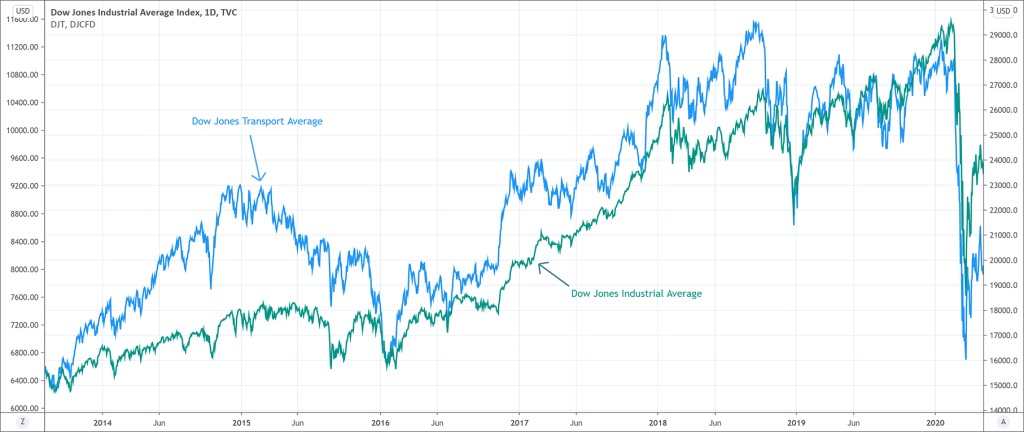
- Dow Theory assumes that no bullish or bearish market signal can appear before the signal of both averages. The theory proposes that both averages have to exceed a previous secondary high to confirm the start or continuation of a bull market. The theory doesn’t require both signals to occur simultaneously. It proposes that a shorter period of time between the two signals provide stronger confirmation. The theory also assumes that the prior trend maintains itself when both averages diverge from one another.
- Dow Theory holds that volume is another very crucial factor for the confirmation of price signals. Volume needs to expand or increase in accordance with the trend. During an uptrend, the volume must increase with rising prices and the volume should decrease as the price falls. During a downtrend, the volume must increase as prices fall and should decrease with rising prices. Volume was a secondary indicator for Dow Jones as he based his actual trading signals on closing prices. Traders have multiple volume indicators nowadays to determine the volume and then traders can analyze this information in accordance with price action to see whether they confirm each other or do not.
- Just like Newton’s law, a trend will continue until it gives clear reversal signals. Dow Theory assumes that current trends should be considered active until it is clear that it has reversed. There are various indicators that can help traders to determine whether a trend is continuing or has it reversed.
How does Dow Theory work?
Dow Theory works on a very simple idea. In Dow’s time, industry and rail were the two averages. Industries manufactured the goods and shipped them through rails. Both of them had to work together to achieve. Similarly, when one average records a new price level, it is important for the other average to do the same to provide a valid signal. The price action is only confirmed when both averages work in harmony with each other and reach highs or lows around the same time period.
Conclusion
Dow Theory is one of the most reliable trading theories despite being more than 100 years old. Dow Theory and its underlying principles are still applicable and crucial today. Many astute traders and technical analysts consider Dow Theory a very valuable trading strategy. It is interesting as well as astonishing to realize that many ideas we currently know about the technical analysis have its origin from Dow Theory. That is the prime reason that all financial technical analysts need to have in-depth knowledge of the Theory or at least, they must know about the basic principles of the Theory.
Leave a Reply