While astronomers study the universe’s beginnings through creative measures and mathematical simulations, they’ve also sought proof of its rapid inflation. They have done this by observing gravitational waves, tiny perturbations in space-time that ripple outwards from great disturbances like, for instance, two colliding black holes or the universe’s birth.
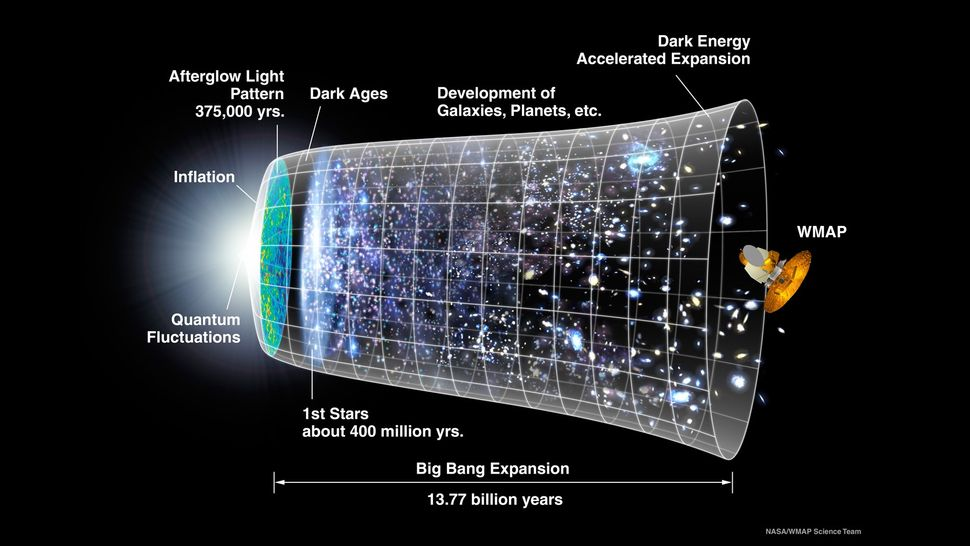
According to leading theories, in the first second after the universe was born, our cosmos ballooned faster than the speed of light. (That, by the way, does not violate Albert Einstein’s speed limit. He once said that light speed is the fastest anything can travel within the universe — but that statement did not apply to the inflation of the universe itself.)
As the universe expanded, it created the CMB and a similar “background noise” made up of gravitational waves that, like the CMB, were a sort of static, detectable from all parts of the sky. Those gravitational waves, according to the LIGO Scientific Collaboration, produced a theorized barely-detectable polarization, one type of which is called “B-modes.”
In 2014, astronomers said they had found evidence of B-modes using an Antarctic telescope called “Background Imaging of Cosmic Extragalactic Polarization,” or BICEP2.
“We’re very confident that the signal that we’re seeing is real, and it’s on the sky,” lead researcher John Kovac, of the Harvard-Smithsonian Center for Astrophysics told Space.com in March 2014.
But by June, the same team said that their findings could have been altered by galactic dust getting in the way of their field of view. That hypothesis was supported by new results from the Planck satellite.
However, since then gravitational waves have not only been confirmed to exist, they have been observed multiple times.
These waves, which are not B-modes from the birth of the universe but rather from more recent collisions of black holes, have been detected multiple times by the Laser Interferometer Gravitational-Wave Observatory (LIGO), with the first-ever gravitational wave detection taking place in 2016.
A major gravitational wave breakthrough was announced on June 28, 2023 when teams of scientists around the world reported the discovery of a “low-pitch hum” of these cosmic ripples flowing through the Milky Way. While astronomers don’t definitively know what’s causing the hum, the detected signal is “compelling evidence” and consistent with theoretical expectations of gravitational waves emerging from copious pairs of “the most massive black holes in the entire universe” weighing as much as billions of suns, said Stephen Taylor, a gravitational wave astrophysicist at Vanderbilt University in Tennessee who co-led the research.
Leave a Reply