Internal combustion heat engines can be understood by thinking carefully about the ideal gas law: . Raising the temperature of a gas increases the pressure that makes the gas want to expand. An internal combustion engine has a chamber, which has fuel added to it which ignites in order to raise the temperature of the gas.
When heat is added to the system, it forces gas inside to expand. With a piston engine, this causes the piston to rise . By attaching the piston to a crankshaft, the engine is able to convert a portion of the energy input to the system into useful work. To compress the piston in an intermittent combustion engine, the engine exhausts the gas. A heat sink is then used to keep the system running at a consistent temperature. A gas turbine, which uses continuous combustion, simply exhausts its gas continuously rather than in a cycle. Heat engines with gas turbines work on a similar principle, the hot air is forced into the turbine chamber, turning the turbine (Figure 1).
Pistons vs turbines
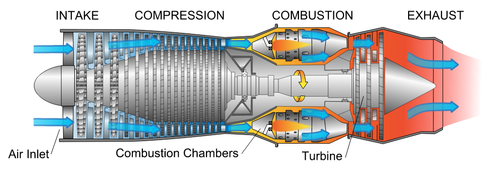

Figure 1. A diagram of a gas turbine engine.
An engine that uses a piston is called an intermittent combustion engine, whereas one that uses a turbine is called a continuous combustion engine. The difference in mechanics is obvious due to the names, but difference in use is less obvious.
A piston engine is extremely responsive, in comparison to a turbine, as well as more fuel-efficient at low outputs. This makes them ideal for use in vehicles, as they also start up more quickly. Conversely, a turbine has superior power-to-weight ratio compared to a piston engine, and its design is more reliable for continuous high outputs. A turbine also works better than a naturally-aspirated piston engine at high altitudes and cold temperatures. Its light weight build, reliability, and high altitude capability makes turbines the engine of choice for airplanes. Turbines are also commonly used at power plants for electrical generation.
Leave a Reply