1. Heat Engine:
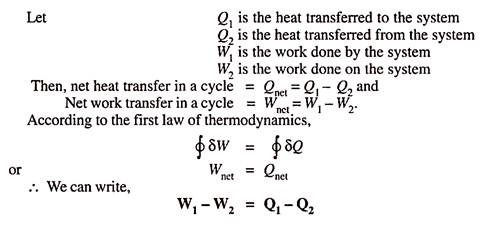
Heat engine converts heat energy into mechanical energy. Heat engine works on thermodynamic cycle like Otto, Diesel, Rankine in which there is a net heat transfer to the system and a network transfer from the system.
Heat engines are broadly classified into two types:
(i) External combustion engines.
(ii) Internal combustion engines.
In a simple steam power plant an amount of heat Q1 is supplied from the furnace (Also called as high temperature reservoir) to the water in the boiler drum. An amount of heat Q2 is rejected to the low temperature reservoir, like a coolant in the condenser and in doing so, an amount of work W will be produced.
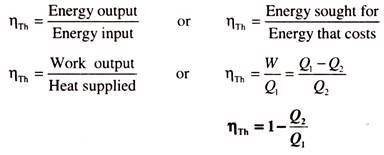
The thermal efficiency ηTh of the heat engine is defined as,

In case of IC engines combustion of air and fuel takes place inside the engine cylinder. The products of combustion will be directly acting on the pistons of the IC engines for producing the power – Now consider an IC engine.

2. Heat Reservoirs:
“Heat reservoir is a body of infinite heat capacity, which is capable of absorbing or rejecting any quantity of heat without suffering any change in any of its thermodynamic properties”.
A heat reservoir which supplies an amount of heat Q1 to the heat engine operating in heat engine cycle is called the High Temperature Reservoir (HTR) or Source.
The heat reservoir to which an amount of heat Q2 is rejected by the heat engine is called the Low Temperature Reservoir (LTR) or Sink.
3. Refrigerator:
“It is a device, which produces and maintains the temperature below atmospheric temperature” or
“It is a device which operating in cycle, maintains an enclosed space at a temperature lower than the temperature of the surroundings”.
Let a body A is to be maintained at a temperature t2, which is lower than the atmospheric temperature t1. Even though the body, A is insulated, there will be a heat leakage Q2, into the body because of the temperature difference between the body and the surroundings. In order to maintain the body A at constant temperature t2, same amount of heat is to be removed at the same rate, at which it is leaking into the body.
A refrigerator is a device which operating in a cycle, removes heat Q2 from the body a t2 and transfers this heat to the atmosphere at t1 by consuming an amount of work W.
In the refrigeration cycle, body A, Q2 and W are of prime importance. Just like the efficiency of heat engine cycle, here a parameter called co-efficient of performance is important. The copies defined by,


4. Heat Pump:
It is just opposite to the refrigerator i.e., “It is a device operating in a cycle, maintains a body say B at a temperature higher than the temperature of the surroundings”.
Because of the temperature difference between the body and the surroundings there will be a heat leakage Q1 from the body. The body will be maintained at constant temperature t1, if heat is supplied into the body at the same rate at which heat leaking out of the body.
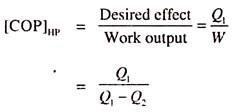
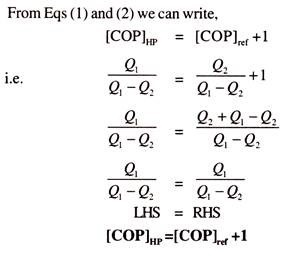
A heat pump is a device which operates in a cycle extracts heat from the atmosphere and transfers an amount of heat Q1 to the body B and maintains the body B at constant temperature t1 in a heat pump, body B, Q1 and W are of prime importance.


Leave a Reply