- Surging: The delivery pressure v’s mass flow rate in an axial flow compressor is shown in Fig. 15.7. The mass flow is zero when the discharge valve is closed, but the air entrapped in the blade area is compressed and pressure of air increases. The condition is represented by point ‘a’ in Fig. 15.7. As the valve is opened, the flow of air starts and the pressure rises upon point ‘b’.Any increase in air mass flow rate after point ‘b’ is accompanied by a decrease in delivery pressure. This happens because the rate of increase in pressure loss due to friction is more than the rate of increase in pressure rise due to diffuser. Theoretically, the decrease in delivery pressure is continued up to point ‘e’. In practice, the maximum mass flow rate is limited by point ‘c’ because beyond point ‘c’, the mass flow exceeds design mass flow, the air angles are widely different from vane angles, and choking takes place.If the compressor is working between points ‘a’ and ‘b’, as the mass flow is decreased, the delivery pressure also decreases. However, the pressure in the downstream side of the compressor does not fall quickly, resulting in reversal of flow from downstream side towards the resulting pressure gradient. When this occurs, the pressure to the downstream side of the compressor falls and the compressor will start delivering air and the cycle would be repeated continuously. Thus, the flow would be pulsating between point ‘a’ and ‘b’. This pulsating air flow phenomena is known as ‘surging’. The surging causes overheating and stress reversal in the blades and damages the compressor. Within the region bc, the flow is stable. A fall in mass flow rate will result in rise in delivery pressure to restore to fall.
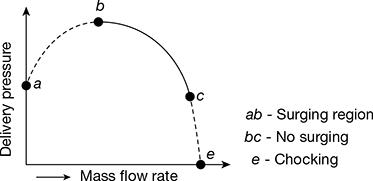 Figure 15.7 Characteristic curve
 - Choking: The maximum mass flow rate possible in a compressor is known as choking. The point ‘e’ in Fig. 15.7 represents the choking of the compressor.
- Stalling: It is a phenomena which occurs on the suction side of the compressor in which the flow breaks away from the aerofoil blading. It may be due to lesser flow rate than the designed value or due to non-uniformity in the profile of the blades. Thus, stalling precedes surging. Stalling is a local phenomenon, whereas surging is a complete system phenomenon.
SURGING, CHOKING, AND STALLING
by
Tags:
Leave a Reply