A four-stroke diesel engine of 3000 cc capacity develops 14 kW per m3 of free air induced per minute. When running at 3500 rev/min, it has a volumetric efficiency of 85% referred to free air-conditions of 1.013 bar and 27°C. It is proposed to boost the power of the engine by supercharging by a blower (driven mechanically from the engine) of pressure ratio 1.7 and isentropic efficiency of 80%. Assuming that at the end of induction, the cylinders contain a volume of charge equal to the swept volume, at the pressure and temperature of the delivery from the blower, estimate the increase in brake power to be expected from the engine. Take overall mechanical efficiency as 80%, γ for air = 1.4, R = 0.287 kJ/kg K.
Solution
The schematic arrangement is shown in Fig. 11.18(a).
Swept volume of engine per minute,

Unsupercharged inducted volume
= Vs × ηvol = 5.25 × 0.85 = 4.4625 m3/min
The actual and isentropic compression processes of supercharger are shown in Fig. 11.18(b).

Isentropic efficiency of supercharger.
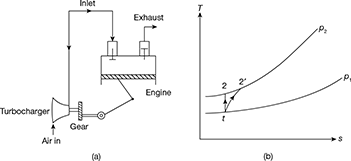
Figure 11.18 Supercharger: (a) Schematic arrangement, (b) Processes on T-s diagram
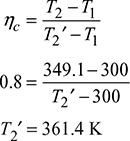
The supercharger delivers 5.25 m3/min at p2 = 1.013 × 1.7 = 1.72 bar and 361.4 K to the engine. This volume referred to 1.013 bar and 300 K is,

Increase in inducted volume = V − Vs = 7.41 − 4.4625 = 2.95 m3/min
As indicated power (I.P.) is directly proportional to induced volume, therefore, increase in I.P. due to increase in inducted volume of air
= 14 × 2.95 = 41.3 kW
Increase in IP due to increase in inducted air pressure because of supercharger

Total increase in IP because of supercharger
= 41.3 + 6.186 = 47.486 kW
Increase in BP = Increase in IP × ηmech
= 47.486 × 0.8 = 38 kW
Power required to run the supercharger.
Psup = ṁa ⋅ cpa (T2′ − T1)
where ṁa = mass of air delivered by the supercharger per second.

Psup = 0.145 × 1.005 × (361.4 − 300) = 8.95 kW
Net increase in BP = 38 − 8.95 = 29.05 kW
Percentage increase in 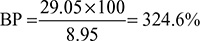
Leave a Reply