At the end of the expansion stroke, the combustion chamber of a two-stroke engine is left full of products of combustion as there is no exhaust stroke available to clear the cylinder of burnt gases. The process of clearing the cylinder, after the expansion stroke, is called scavenging process. The scavenging process is the replacement of the products of combustion in the cylinder from the previous power stroke with fresh-air charge to be burned in the next cycle.
There are three types of scavenging systems as follows:
- Uniflow scavenging system: In this system, as shown in Figs 10.13(a) and (b), air enters the cylinder from one end and leaves from the other end. Air acts like an ideal piston and pushes out the residual gas in the cylinder and replaces it with fresh charge. Due to absence of any eddies or turbulence, in a uni-flow scavenging system, it is easier to push the products of combustion out of the cylinder without mixing with it and short circuiting. Thus, this system has the highest scavenging efficiency.
- Cross scavenging: This process shown in Fig. 10.14. It employs inlet and exhaust ports placed in the opposite sides of the cylinder wall. The air moves up to combustion chamber on one side of the cylinder and then down on the other side to flow out of the exhaust ports. This process requires that air should be guided by the use of either a suitably shaped detector formed on piston top or by the use of inclined ports. The main disadvantage of this system is that the scavenging air is not able to get rid of the layer of exhaust gas near the wall, resulting in poor scavenging. Some of the fresh charge also goes directly in the exhaust port.
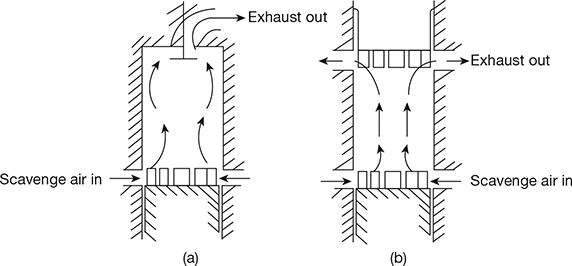 Figure 10.13 Uni-flow scavenging system: (a) Exhaust valve, (b) Opposed piston
 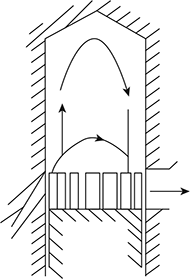 Figure 10.14 Cross scavenging
 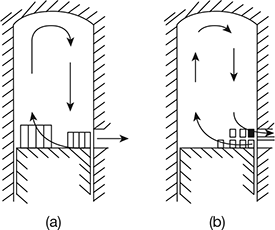 Figure 10.15 Loop or reverse scavenging
 - Loop or Reverse Scavenging: Figures 10.15(a) and (b) show the loop or reverse scavenging system. This avoids the short-circuiting of the cross-scavenged engine and improves upon the scavenging efficiency. The inlet and exhaust ports are placed on the same side of the cylinder wall. The major mechanical problem with this system is that of obtaining an adequate oil supply to the cylinder wall consistent with reasonable lubricating oil consumption and cylinder wear.
Leave a Reply