The function of the air pump is to maintain a desired vacuum in the condenser by removing air and condensed steam. Edward’s air pump is commonly used for this purpose.
1 Edward’s Air Pump
This pump is shown in Fig. 8.11. It consists of a plunger or piston D having a conical head E which slides inside a barrel or cylinder liner C having a cover B which has a number of delivery valves A. The passage G is connected to the condenser. The barrel has a number of parts, F pierced in the cylinder liner C. These parts communicate to the air pump suction pipe. H is the water weir where the discharged condensate collects and overflows to the hot well. This retention of sufficient water above the cylinder head acts as a water seal against leakage of air. J is the relief valve.
On the downward stroke of the piston, partial vacuum is created above the piston because the head valves are closed and sealed by water. As soon as the ports are uncovered, the water vapour and air push into the space above the piston. The condensate collected at the piston is displaced by further motion of the piston with conical head and pushed rapidly through the ports to the top of the piston. On the upward stroke, the water, air, and water vapour above the piston are compressed to pressure above the atmospheric pressure and discharged outside through the head valves.
Capacity of the pump, 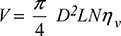
where D = piston diameter, L = stroke length, N = rpm, ηv = volumetric efficiency.

Figure 8.11 Edward’s air pump
Leave a Reply