From the continuity equation, we have


Substituting Eq. (6.17) in Eq. (6.22), the flow per unit area can be expressed in terms of stagnation pressure, stagnation temperature, Mach number, and gas properties.

At the throat, M = 1, and therefore, the flow per unit area at the throat,  can be found by setting M = 1 in Eq. (6.23).

The area ratio  can be obtained by dividing Eq. (6.24) by Eq. (6.23).

Figure 6.13 Area ratio as a function of Mach number for isentropic nozzle

The values of A/A* as a function of M are given in Table 6.1. Fig. 6.13 depicts the variation of A/A* with M, which shows that a subsonic nozzle is converging and a supersonic nozzle is diverging.
1 Effect of Varying the Back Pressure on Mass Flow Rate
Consider first a convergent nozzle as shown in Fig. 6.14, which also shows the pressure ratio p/p0 along the length of the nozzle. The conditions upstream are the stagnation conditions, which are assumed to be constant. The pressure at the exit plane of the nozzle is designated pE and the back pressure (the pressure outside the nozzle exit) pB. As the back pressure pB is decreased, the variation of the mass flow rate and the exit plane pressure pE/p0 are plotted in Fig. 6.15.
Where pB/p0 = 1, there is, of course, no flow, and pE/p0 = 1 as designated by point ‘a‘. Next, let the back pressure pB be lowered to point b, so that pB/p0 is greater than the critical pressure ratio. The mass flow rate has a certain value and pE = pB. The exit Mach number is less than one. Next, let pB be lowered to the critical pressure at point c. The Mach number at the exit is now unity and pE = pB. When pB is decreased below the critical pressure, designated by point d, there is no further increase in the mass rate of flow, and pE remains constant at a value equal to the critical pressure, and the exit Mach number is unity. The drop in pressure from pE to pB takes place outside the nozzle exit. Under these conditions, the nozzle is said to be choked, which means that for given stagnation conditions, the nozzle is passing the maximum possible mass flow.

Figure 6.14 Pressure ratio as a function of back pressure for a convergent nozzle

Figure 6.15 Mass rate of flow and exit pressure as a function of back pressure for a convergent nozzle

Figure 6.16 Nozzle pressure ratio as a function of back pressure for a convergent–divergent nozzle
Consider next a convergent–divergent nozzle as shown in Fig. 6.16. Point ‘a’ designated the condition when pB = p0 and there is no flow. When pB is decreased to the pressure indicated by point b, so that pB/p0 is less than unity but considerably greater than that the critical pressure ratio, the velocity increases in the convergent section, but M < 1 at the throat. Therefore, the diverging section acts as a subsonic diffuser in which the pressure increases and velocity decreases. Point ‘c’ designated the back pressure at which M = 1 at the throat, but the diverging section acts as a subsonic diffuser (with M = 1 at the inlet) in which the pressure increases and velocity decreases. Point ‘d’ designates one other back pressure that permits isentropic flow, and in this case, the diverging section acts as a supersonic nozzle with a decrease in pressure and an increase in velocity. Between the back pressure designated by points c and d, an isentropic solution is not possible, and shock waves will be present. When the back pressure is decreased below that designated by point d, the exit pressure pE remains constant, and the drop in pressure from pE to pB takes place outside the nozzle. This is designated by point e.
Example 6.7
A convergent nozzle has an exit area of 500 mm2. Air enters the nozzle with a stagnation pressure of 1000 kPa and a stagnation temperature of 360 K. Determine the mass rate of flow for back pressures of 800 kPa, 528 kPa, and 300 kPa, assuming isentropic flow. For air, k = 1.4.
Solution
Critical pressure ratio,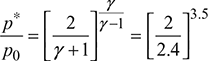 = 0.528
Therefore, for a back pressure of 528 kPa, M = 1 at the nozzle exit and the nozzle is choked.
Decreasing the back pressure below 528 kPa will not increase the flow.
For a back pressure of 528 kPa,

At the exit, c = cs =  = 347.2 m/s

Discharge at the exit section,
ṁ = ρ*Ac = 6.1324 × 500 × 10–6 × 347.2 = 1.0646 kg/s
For a back pressure of 800 kPa,  = 0.8
= 0.8
From Table 6.1 for  by interpolation
TE = 360 × 0.9381 = 337.7 K
Sonic velocity at exit,

Velocity at exit,

Density of air at exit,

ṁ = ρEAEcE = 8.2542 × 500 × 10−6 × 211.1 = 0.8712 kg/s
For a back pressure less than the critical pressure (528 kPa), the nozzle is choked and the mass rate of flow is the same as that for the critical pressure. Therefore, for an exhaust pressure of 300 kPa, the mass flow rate is 1.0646 kg/s.
Example 6.8
A converging–diverging nozzle has an exit area to throat area ratio of 2. Air enters this nozzle with a stagnation pressure of 1000 kPa and a stagnation temperature of 360 K. The throat area is 500 mm2. Determine the mass rate of flow, exit pressure, exit temperature, exit Mach number, and exit velocity for the following conditions:
- Sonic velocity at the throat, diverging section acting as a nozzle.
- Sonic velocity at the throat, diverging section acting as a diffuser.
Solution
- From Table 6.1, we haveFor
 = 2, M*E = 2.197,
  = 0.0939, =
  = 0.5089Therefore, pE = 0.0939 × 1000 = 93.9 kPaTE = 0.5089 × 360 = 183.2 K
 cE = ME* csE = 2.197 × 271.3 = 596.1 m/sCritical pressure at throat, p* = p0 × 0.528 = 1000 × 0.528 = 528 kPaCritical temperature, T * = 0.8333 × 360 = 300 KAt throat,

- From Table 6.1, we haveFor
 = 2, ME = 0.308,
  = 0.936,
  = 0.9812Therefore, pE = 0.936 × 1000 = 936 kPaTE = 0.9812 × 360 = 353.3 K
 cE = MCsE = 0.308 × 376.8 = 116 m/sSince M = 1 at the throat, mass rate of flow is the same as in (a).
Leave a Reply