One of the major environmental noise problems throughout the world is the noise associated with civil aircraft operations nearby airports. In the US, the Federal Aviation Administration (FAA) recognizes that airport noise issues can be highly technical and complex. The European Union (EU) has also recognized the problem and noise emission limitations from civil aircraft have been in force in European legislation since 1980. Currently Directive 2002/30/EC [37] of the EU provides guidance on “the establishment of rules and procedures with regard to the introduction of noise‐related operating restrictions at community airports.” Noise metrics or indicators must be used to analyze aircraft operations noise and its effect on noise‐sensitive land use. In the US, the primary metric for airport assessment is the A‐weighted day–night average sound pressure level, DNL, in which a penalty of 10 dB is added to noise made at night. The Community Noise Equivalent Level, CNEL, metric is sometimes used to assess aircraft noise exposure in communities surrounding airports located in California. The EU uses the day–evening–night sound level, DENL, and penalties of 5 dB are applied to noise in the evening and 10 dB at night (see Chapter 6 in this book for a discussion on these descriptors). However, both the EU and the US legislation recognized that some cases may benefit from the use of supplementary noise indicators, in particular for measuring single‐events shorter than 24 hours.
Most airports in the world have noise abatement programs. Approaches to mitigate perceived noise problems associated with civil aircraft operations in airports include specific noise control approaches to reduce noise at the source and specific airport noise control measures.
15.6.1 Noise Control at the Source
Reducing the noise at the aircraft source requires that for all aircraft, specific noise testing or certification procedures and associated limits must be defined. In addition, louder aircraft must be phased out of operation over time [38].
In 1969 the FAA published a regulation establishing noise certification standards for most airplane types, generally requiring newly designed and manufactured aircraft to be significantly quieter than older aircraft. In this Federal Aviation Regulation (FAR) Part 36, noise limits were defined in terms of the EPNL descriptor (see Chapter 6). In an amendment of 1977 [39], FAR Part 36 established three stages (called Chapters by the International Civil Aviation Organization, ICAO [40]) of aircraft noise levels for subsonic large transport aircraft and subsonic turbojets. Stage 1 aircraft were those that did not meet current noise standards and hence must be modified or replaced according to a previously established schedule of 1976. Stage 2 aircraft met the current standards, while stage 3 aircraft were able to meet the more rigorous noise standards for the next generation of jet transports prescribed by the rule. For helicopters, two different stages exist: stage 1 and stage 2. As with civil turbojet aircraft, stage 2 is quieter than stage 1. The FAA has been working to adopt the latest international standards for helicopters, which are to be called stage 3 and to be quieter than stage 2.
It is recognized that FAR Part 36 has produced major improvements in the noise radiated from civil aircraft. In fact, the noise output of the larger and more powerful jet engines has not increased with the increased mechanical power of the jet engines themselves. Although air traffic has been on the increase, aircraft noise exposure in communities around airports has been on the decrease as quieter aircraft become more prevalent. Figure 15.9 presents the limits that define FAA’s stage 1, stage 2, and stage 3 aircraft [38].
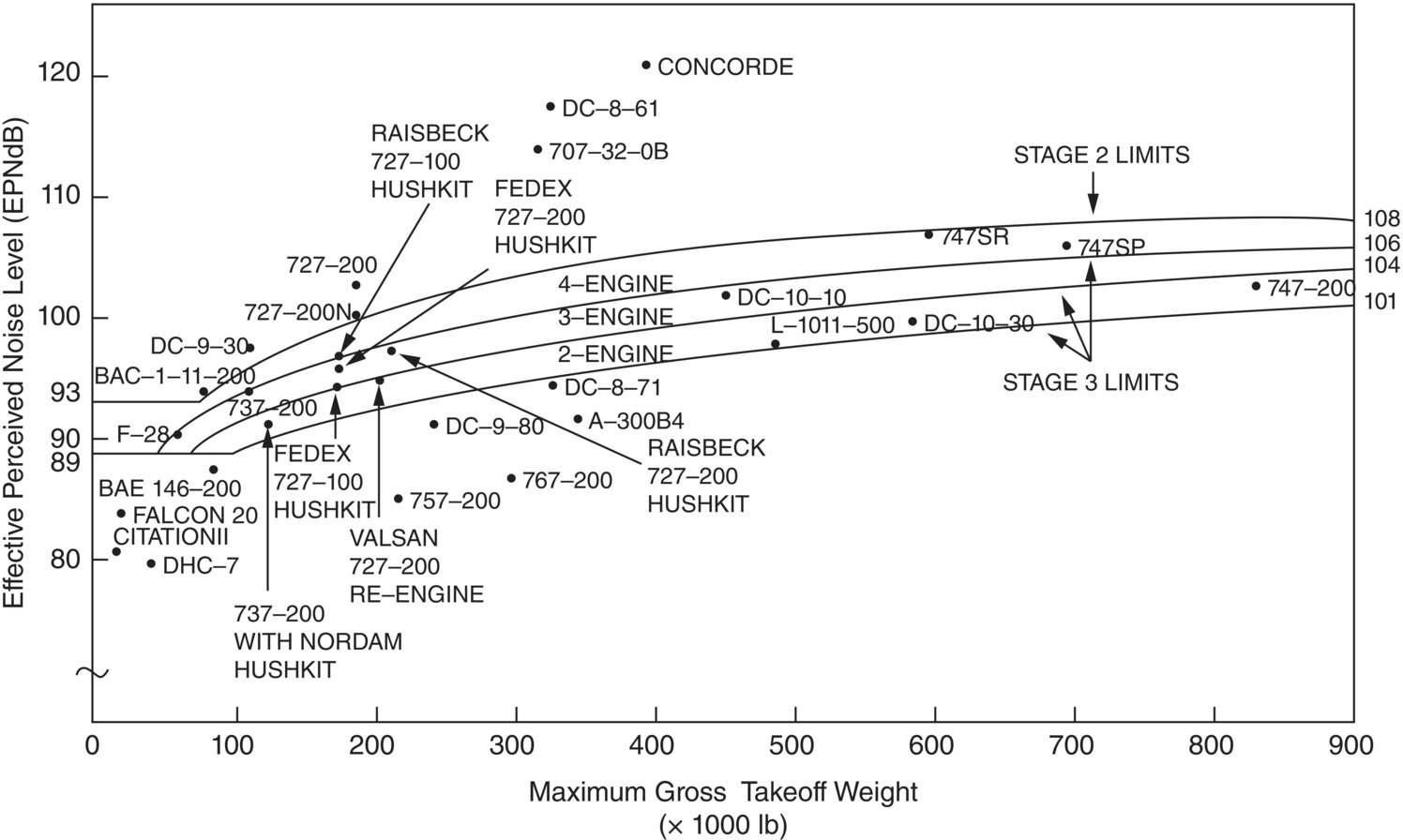
Currently, a new certification limit for jet aircraft has been adopted by the FAA, called stage 4 (Chapter 4 internationally) and has been applied since 2013 and has resulted in quieter aircraft. The international community has been looking to approve a more stringent aircraft noise standard which the FAA will call Stage 5, which will be effective for new type designs submitted after December 31, 2017 and/or December 31, 2020, depending on the aircraft weight.
15.6.2 Airport‐specific Noise Control Measures
The FAA has developed a number of programs aimed to increase the knowledge about noise impacts, advice on solutions to reduce those impacts, and to educate the public on the noise‐related issues. One of these programs is called FAR Part 150 [41, 42] which is a comprehensive FAA program of airport planning for noise compatibility that works as a compliment to Part 36. Eldred [43] has summarized the principal actions that can be taken to abate noise and its perceived problems (see Table 15.1).
Table 15.1 Possible airport actions to abate noise [43].
| Flight tracks | Get aircraft away from people |
| Preferential runways | Increase use of runways with least impact |
| Restrict noisy aircraft | Minimize operations in day or night |
| Noise abatement flight procedures | Require use of noise abatement throttle and flap management procedures for take‐off and/or approach |
| Airport layout | Extend or build new runways and taxiways to make best use of compatible land and water |
| Shielding barriers | Shield people from noise of ground operations |
| Soundproof | Soundproof schools, homes, and churches |
| Land use control | Assure compatible land use through acquisition of property or other rights |
| Monitor and model | Monitor airport noise and flight tracks to provide data for the public and for evaluating proposed alternatives |
| Communication | Listen to complaints and suggestions; develop and institutionalize continuing effective dialog and information transfer among all concerned parties. |
When developing noise reduction at a specific airport, one of the first factors to consider is the location of its flight tracks with respect to land use. Thus, flight tracks that use noise compatible land (water, industrial, commercial, and agriculture) must be preferred. In this sense, preferential runways with least noise impact must be defined and further extension or building of new runways should consider the best use of compatible land by improving airport layout [43].
Restriction on the use of noisy aircraft is another possible action to abate noise in airports. Such restrictions should be employed only after consideration of other alternatives and after thorough consultation with the affected parties to avoid uneven economic consequences. Some of the forms that such restrictions might take are: (i) based on cumulative impact, (ii) based upon certificated noise levels, and (iii) based upon estimated single‐event noise levels. A restriction placed upon all or certain classes of aircraft by time of day appears to have considerable potential to reduce airport noise impact. Curfews during nighttime when most people are resting and are most sensitive to noise intrusions are common in modern airports. However, curfews have economic impacts upon airport users, upon those providing airport‐related services, and upon the community as a whole. Therefore, curfews should only be considered after careful consideration of other alternatives [42].
Landing fees based on noise have also been suggested as a strategy for noise mitigation. The strategy encourages the use of quieter aircraft while producing additional revenue to offset airport noise‐induced expenses. Some airports have implemented reverse strategies, such as rewarding air carriers who reduce noise generated by their aircraft by providing a discount or a reduction in landing fees.
Another noise mitigation strategy is the use of noise abatement take‐off and landing procedures. There are a number of alternatives within this strategy that include runway selection, take‐off and landing profiles and power settings, and approach or departure paths. Take‐off and landing profiles and their attendant throttle and aircraft configuration techniques can be adjusted so as to offer relief to nearby noise‐sensitive areas.
Soundproofing and noise barriers are noise reduction techniques that can be implemented in airport noise problems. Ground‐level noise sources on an airport include run‐up and maintenance areas, taxiways and freight warehouse areas. Because the noise is generated on the ground, its impact is usually confined to those areas immediately adjacent to the source. An effective method of mitigating this type of noise impact is use of sound barriers or berms (see Chapter 9 in this book). New hangar or terminal structures placed strategically in the airport may also shield adjacent neighborhoods. Movement of run‐up and maintenance operations to an area of the airport away from the community might also do the work.
Acquisition of full or partial interest in compatible land may be the only way the airport can be assured of long‐term protection, although purchase of sufficient land area to totally contain the significant noise impacts of an airport is usually impractical [42].
The implementation of continuous airport monitoring systems is essential to provide important input to the process of refining airport noise contours and supply data for public discussion. In brief, any FAA approved noise monitoring system should have the following minimum capabilities: (i) Provide continuous measurement of A‐weighted noise levels at each site, (ii) Provide hourly Leq data, (iii) Provide daily Ldn data, and (iv) Provide single‐event maximum A‐weighted sound pressure level data. Monitoring of data can be used to develop a statistical data base of noise levels for each aircraft type category and to the further examination of alternatives that might provide future mitigation of noise.
Airport noise and mitigation measures are discussed in detail in Refs. [38] and [43]. Research on airport noise assessment and airport‐specific noise control continues [44–59].
EXAMPLE 15.1
Consider an aircraft noise event that has a duration of five seconds (with a maximum A‐weighted sound pressure level of 65 dB) according to Table 15.2. Determine the sound exposure level (SEL) of the noise event.
Table 15.2 Data for an aircraft noise event of five seconds.
| Seconds | A‐weighted noise level, dB |
|---|---|
| 1 | 60 |
| 2 | 63 |
| 3 | 65 |
| 4 | 63 |
| 5 | 60 |
SOLUTION
The SEL is calculated according to the definitions discussed in Chapter 6, Section 6.9. Then, the A‐weighted

EXAMPLE 15.2
Suppose there are 10 aircraft noise events in a period of 24 hours at a small airport, according to the schedule shown in Table 15.3.
- Determine the day‐night equivalent level, DNL.
- Consider now a curfew that restricts all nighttime aircraft operations for the airport. Determine the change in DNL.
Table 15.3 A‐weighted aircraft noise level events in an airport.
| Hour | SEL, dB |
|---|---|
| 12:00 a.m. | 86.1 |
| 01:00 a.m. | |
| 02:00 a.m. | |
| 03:00 a.m. | |
| 04:00 a.m. | |
| 05:00 a.m. | 90.0 |
| 06:00 a.m. | 86.1 |
| 07:00 a.m. | |
| 08:00 a.m. | 93.6 |
| 09:00 a.m. | |
| 10:00 a.m. | 82.6 |
| 11:00 a.m. | |
| 12:00 p.m. | 90.3 |
| 01:00 p.m. | |
| 02:00 p.m. | |
| 03:00 p.m. | |
| 04:00 p.m. | |
| 05:00 p.m. | 94.8 |
| 06:00 p.m. | |
| 07:00 p.m. | |
| 08:00 p.m. | |
| 09:00 p.m. | 86.1 |
| 10:00 p.m. | 85.2 |
| 11:00 p.m. | 89.5 |
SOLUTION
- Five A‐weighted noise level events occur during daytime (from 07:00 a.m. to 10:00 p.m.) and five A‐weighted noise level events during nighttime (from 10:00 p.m. to 07:00 a.m.). We determine the day‐night equivalent level for 24 hours (86 400 seconds) applying the 10‐dB penalty to the five nighttime aircraft noise events:

- The new A‐weighted DNL is calculated now without considering the aircraft events affected by the curfew between 10:00 p.m. and 07:00 a.m.:

Therefore, the curfew reduces the DNL by 7.4 dB.
Leave a Reply