15.5.1 Passive Noise and Vibration Control
Low interior cabin noise is important for passenger and crew comfort [13]. High cabin noise levels experienced in passenger jet aircraft in the 1960s and 1970s have now been considerably reduced by the use of turbofan engines instead of noisy pure jet engines. Obtaining satisfactory cabin noise environments, which satisfy both speech interference and speech privacy criteria, remains a difficult problem since there is a large variety of noise sources that become dominant during different aircraft operating conditions. As is the case with surface transportation vehicles, with aircraft there are many different noise sources that contribute to the acoustical environments inside aircraft cabins.
The dominant cabin noise sources are mainly those exterior to the aircraft cabin and include power plant noise and vibration and turbulent boundary level excitation. The relative strength of the sources depends upon the aircraft operating conditions and flight speed. Internal cabin noise sources include air‐conditioning systems, hydraulic systems, and electrical and mechanical equipment. These sources are mainly of concern with aircraft during ground operations before take‐off. Power plant noise tends to be dominant at low flight speeds during take‐off and landing, while the noise generated by turbulent boundary layer excitation of the cabin walls is dominant at higher speeds, after take‐off and during subsequent climb, during landing descent, and in cruise conditions.
In the front of the cabin, turbulent boundary layer noise tends to peak at high frequency. While, in the middle to rear of the cabin, the boundary layer noise peaks at a much lower frequency. This is because the turbulent eddies in the thick boundary layer at the rear of the aircraft are larger than those in the thinner boundary layer at the front of the cabin. Jet noise is likewise more pronounced at the rear of the aircraft cabin for wing‐mounted engines since jet noise is predominantly radiated downstream [4, 14]. For passenger aircraft with rear‐mounted jet engines, the engine noise is mainly experienced at the rear part of the cabin. In cruise conditions, the noise from the engines is mostly structure‐borne and is caused by small out‐of‐balance forces created by minor aircraft engine manufacturing imperfections.
To reduce interior cabin noise caused by engine noise and boundary layer noise, it has been normal practice to make use of lightweight damping materials. In the case of propeller aircraft, passive dampers are sometimes used, which are tuned to the blade passing frequency and/or the second and third multiples and that are attached to the fuselage interior skin panels.
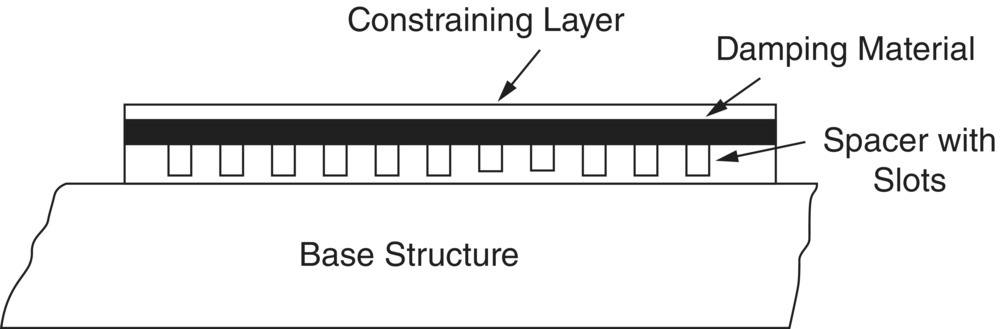
In the case of jet passenger aircraft, constrained layer dampers are normally used and are placed at the center of skin pockets between the stringers and ring frames. Figure 15.5 shows a typical “stacked” damper system, and Figure 15.6 shows the skin pockets of a passenger jet aircraft where they are usually located. In most designs, a layer of viscoelastic damping material is constrained by a thin metal constraining layer of metal or Kevlar. A spacer is located between the base structure (airplane fuselage skin) to move the viscoelastic damping material as far as possible away from the neutral axis of the fuselage skin. The spacer is normally slotted to reduce its weight and minimize its bending stiffness. Ideally, the spacer should also have high shear stiffness. By this means, the shear distortion in the viscoelastic damping layer is magnified as the aircraft skin flexes in bending, and the damping effectiveness of the stacked damper is increased. Since the aircraft fuselage skin gets very cold at cruising altitude and the stacked damper is in close contact with the aircraft skin, special viscoelastic material must be used that has a maximum damping loss factor at the skin temperature during normal cruise conditions.
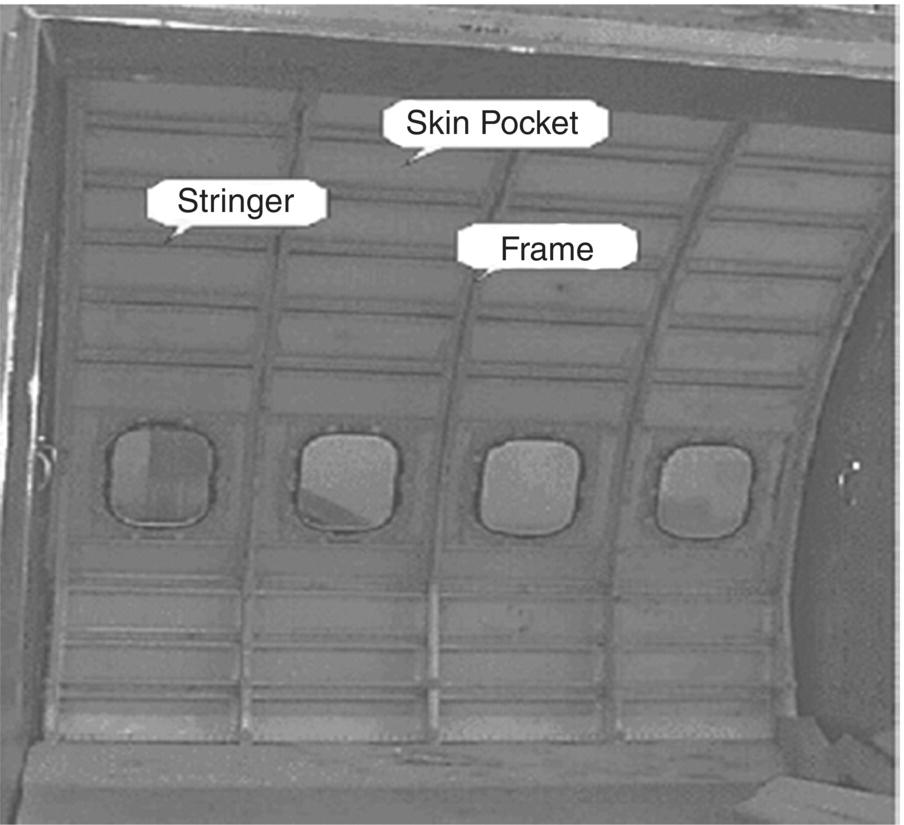
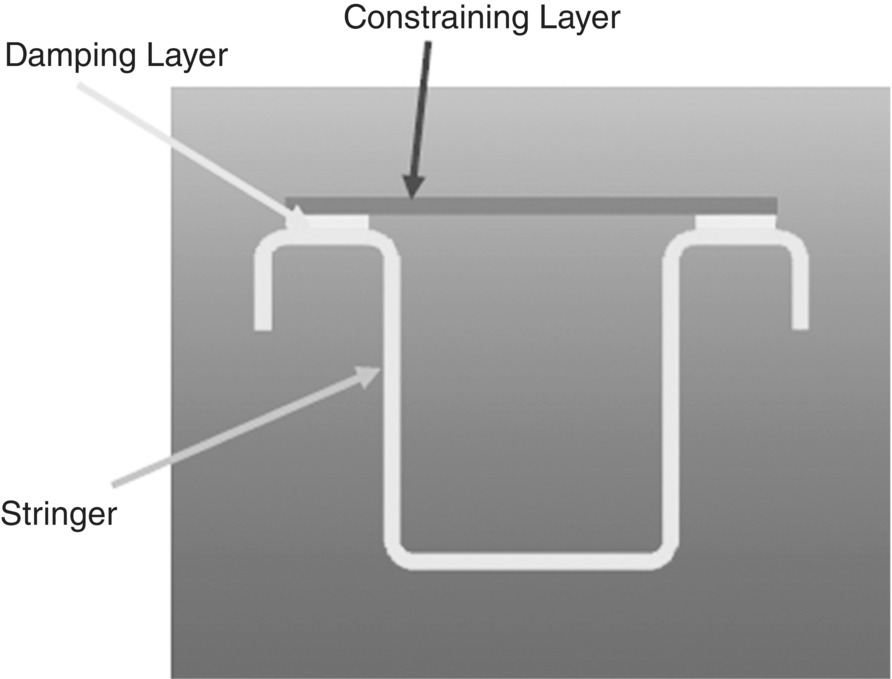
Viscous constrained damping layers are often used on aircraft stringers. Figure 15.6 shows the location of stringers on an aircraft fuselage skin. Figure 15.7 shows how the damping material is constrained between an aircraft stringer and the fuselage skin, which in this case acts as the constraining layer. Damping layers are also often applied to ring frames. Since the ring frames are in contact with the cabin air, they are not as cold as the fuselage skin and the viscoelastic material used is normally selected to have a maximum damping loss factor closer to the normal cabin air temperature.
On some parts of the aircraft cabin, separated flow and shock waves can occur near abrupt changes in the airplane geometry. For example, such geometric changes usually occur near the cockpit and can cause intense noise to be experienced nearby in the cabin. Cabin noise in propeller‐driven aircraft poses a special problem, which is somewhat different from the interior noise of passenger jet aircraft. The interior noise from the power plants of propeller‐driven aircraft is dominant over the entire flight regime, not just during take‐off and landing. Propeller noise occurs at the fundamental BPF and the first few integer multiples, and for wing‐mounted engines this noise can be intense if the propellers pass close to the passenger cabin fuselage. The propeller noise, being predominantly low frequency, is difficult to control using passive methods. There is obviously a limit to the amount of mass which can be added to reduce airborne sound transmission. Sound‐absorbing materials are not very effective either at low frequency. The cabin noise levels can be reduced to some extent by the use of damping materials, which will also improve speech intelligibility. However, vibration transmitted from the engines to the airframe and thus resulting in cabin noise is also a matter of concern [16, 17]. Research on aircraft noise reduction techniques continues [18–24].
15.5.2 Active Noise and Vibration Control
Although passive noise source and path control methods have been improved considerably in recent years, in some cases aircraft cabin noise environments are still unsatisfactory. This is particularly true in the case of propeller‐powered aircraft, and active control methods have been successfully employed to reduce the low‐frequency cabin noise at the fundamental blade passing frequency and the first few multiples.
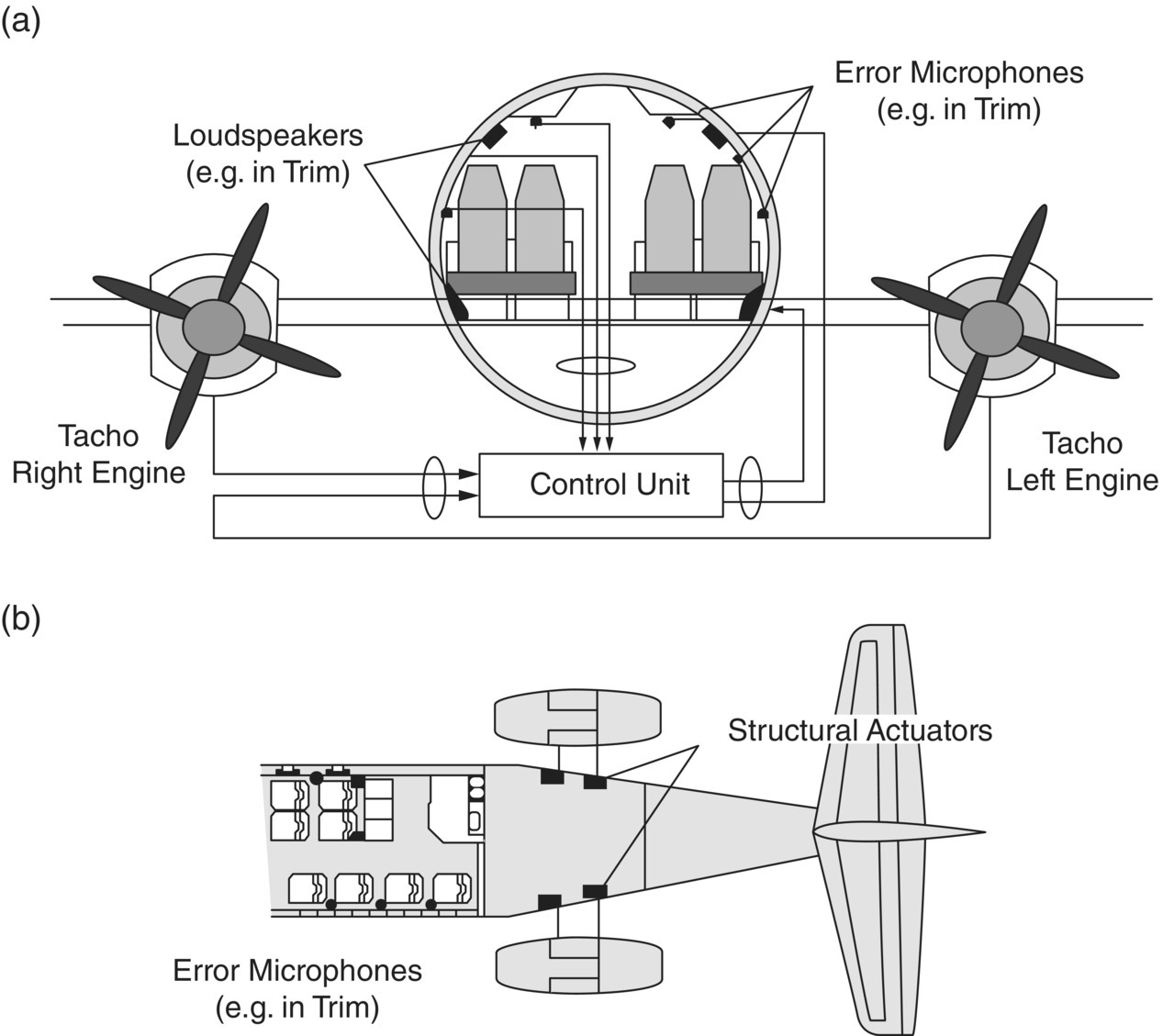
Active noise control systems are particularly successful in the low‐frequency region in which the cabin sidewall sound transmission loss is poor and at which the blade passing frequency occurs. The active control is achieved by introducing multiple secondary sources in the cabin and the use of active headsets or “silent” seats. In the case of silent seats, small secondary sources are located in the top of the passenger seats in order to create a zone of “silence” near to the passenger’s head. Structure‐borne noise is also reduced on some aircraft by locating active 180° out‐of‐phase vibration sources near to aircraft engine mounts. Figure 15.8a shows an illustration of an active noise control system synchronized with both engines. In situations where the aim is to reduce the sound radiation from the fuselage, the loudspeakers are replaced with structural actuators controlling the fuselage vibrations as shown in Figure 15.8b [25–27].
Attenuation of broadband cabin noise is a more difficult task but can be undertaken, provided sufficient numbers of secondary 180° out‐of‐phase noise sources are located inside the cabin. Since jet power plant noise has been successfully reduced in recent years, and in any case is minimal during cruise conditions, broadband turbulent boundary layer noise is becoming recognized as an increasing problem during cruise conditions. Active noise control of aircraft cabins is discussed in Ref. [8]. Active control of the structure close to the engine can also be undertaken to reduce structure‐borne noise reaching the passenger cabin [28]. See Ref. [29] for further discussion on active vibration control, and Ref. [30] for further discussion on active noise control. Research on aircraft active noise and vibration control continues
Leave a Reply