With each intake stroke, ICE engine noise is generated by an unsteady airflow produced by the volume of air that each cylinder draws in. Ducted sources are found in many different mechanical systems. Common ducted‐source systems include engines and mufflers (also known as silencers), fans, and air‐moving devices (including flow ducts and fluid machines and associated piping). Silencers (also known as mufflers) are used as well on some other machines including compressors, pumps, and air‐conditioning systems. In these systems, the source is the active component and the load is the path, which consists of elements such as mufflers, ducts, and end terminations. The acoustical performance of the system depends on the source–load interactions. Models based on electrical analogies have been found useful in predicting the acoustical performance of systems. Various methods exist for determining the internal impedance of ducted sources. The acoustical performance of a system with a muffler as a path element is usually best described in terms of the muffler insertion loss (IL) and the sound pressure radiated from the outlet of the system [4, 13].
There are two main types of mufflers that are fitted to the intake (inlet) and exhaust (outlet) pipes of machinery ductwork. Reactive mufflers function by reflecting sound back to the source and also to some extent by interacting with the source and thereby modifying the source’s sound generation. Absorptive silencers on the other hand reduce the sound waves by the use of sound‐absorbing material packed into the silencer. The exhaust and intake noise of ICEs is so intense that they need to be “muffled” or “silenced.” ICE pressure pulsations are very intense and nonlinear effects should be included. Exhaust gas is very hot and flows rapidly through the exhaust system. The gas stream has a temperature gradient along the exhaust system, and the gas pressure pulsations are of sufficiently high amplitude that they may be regarded almost as shock waves. Some of these conditions violate normal acoustical assumptions. Modeling of an engine exhaust system in the time domain has been attempted by some researchers to account for the nonlinear effects. But such approaches have proved to be challenging. Most modeling techniques have used the transmission matrix approach in the frequency domain and have been found to be sufficiently effective.
The acoustical performance of a ducted‐source system depends on the impedances of the source and load and the four‐pole parameters of the path. This complete description of the system performance is termed insertion loss (IL). The IL is the difference between the SPLs measured at the same reference point (from the termination) without and with the path element, such as a muffler, in place. (See Figure 14.5a.)
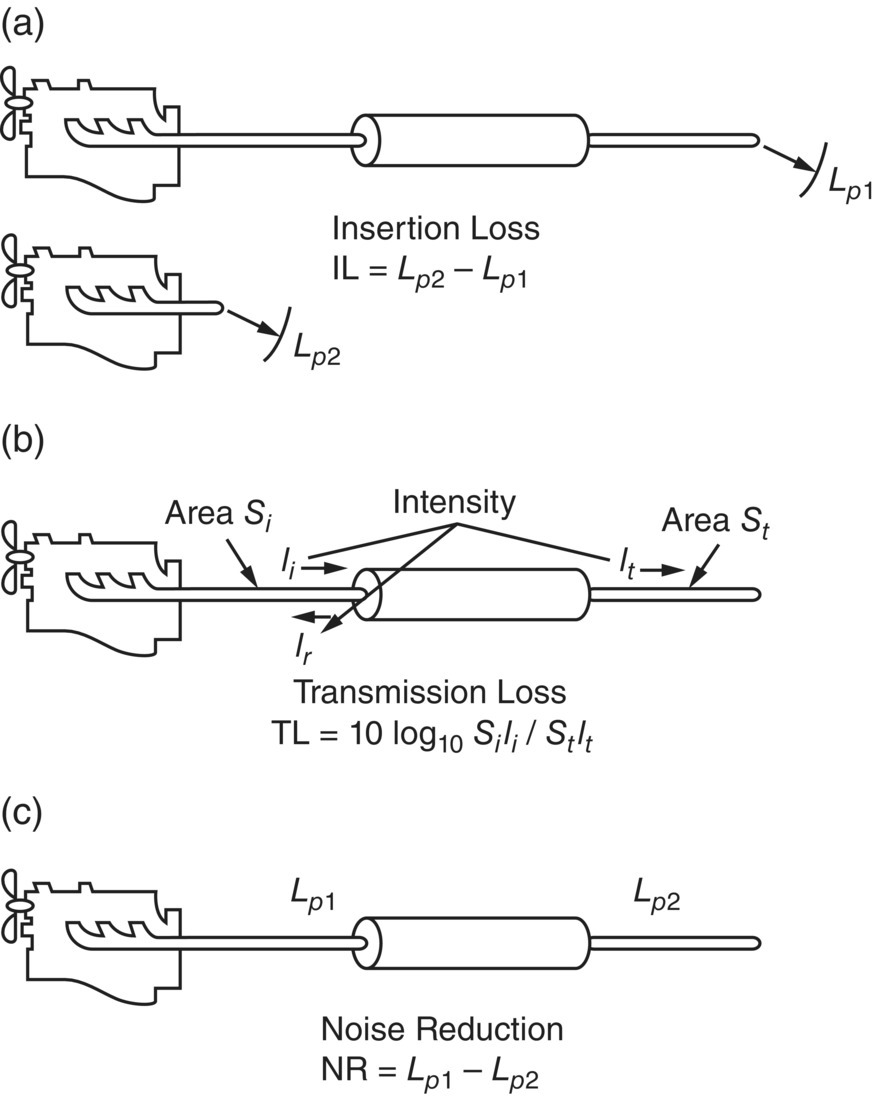
Another useful description of the path element is given by the transmission loss ( TL ). The TL is the logarithmic ratio of the incident to transmitted sound powers (Si Ii)/(St It). (See Figure 14.5b.)
The noise reduction (NR) is another descriptor used to measure the effect of the path element and is given by the difference in the measured SPLs upstream and downstream of the path element (such as the muffler), respectively. (See Figure 14.5c.)
The insertion loss (IL) is the most useful description for the user since it gives the net performance of the path element (muffler) and includes the interaction of the source and termination impedances with the muffler element. It can be shown that the IL depends on the source impedance. It is easier to measure IL than to predict it because the characteristics of most sources are not known.
The TL is easier to predict than to measure. The TL is defined so that it depends only on the path geometry and not on the source and termination impedances.
The TL is a very useful quantity for the acoustical design of a muffler system path geometry. However, it is difficult to measure since it requires two transducers to separate the incident and transmitted intensities. The description of the system performance in terms of the NR requires knowledge of both the path element and of the termination.
Figure 14.5 shows various acoustical performance descriptors used for ducted‐source systems. It should be noted that similar system terminology to that described here and shown in Figure 14.5 is commonly used for the acoustical performance of air‐conditioning system components, machinery enclosures, and partition walls in buildings. The terminology used for the acoustical performance of barriers is also similar, although the additional descriptor “attenuation” is also introduced for barriers. Note that with barriers the IL descriptor can have a slightly different meaning. (See Chapter 9 in this app.)
Work on muffler design and modeling continues with approaches varying from completely experimental to mostly theoretical [14–18]. The acoustical design of reactive and absorptive mufflers and silencers is discussed in more detail in Chapter 10.
Leave a Reply