Although hybrid vehicles (HVs), which partially use relatively quiet electric motors, are increasing in use, the internal combustion engine (ICE) remains a major source of noise in transportation and industry. ICE intake and exhaust noise can be effectively silenced [4]. The noise radiated by vibrating engine surfaces, however, is more difficult to control. In gasoline engines a fuel–air mixture is compressed to about one‐eighth to one‐tenth of its original volume and ignited by a spark. In diesel engines air is compressed to about one‐sixteenth to one‐twentieth of its original volume, liquid fuel is injected in the form of a spray, then spontaneous ignition and combustion occurs. Because the rate of cylinder pressure rise is initially more abrupt with a diesel engine than with a gasoline engine, diesel engines tend to be noisier than gasoline engines. The noise of internal combustion engine (ICE) diesel engines has consequently received the most attention from both manufacturers and researchers. The noise of engines can be divided into two main parts: combustion noise and mechanical noise. The combustion noise is caused mostly by the rapid pressure rise created by ignition, and the mechanical noise is caused by a number of mechanisms with perhaps piston slap being one of the most important, particularly in diesel engines.
The noise radiated from the engine structure has been found to be almost independent of load, although it is dependent on cylinder volume and even more dependent on engine speed. Measurements of engine noise over a wide range of cylinder capacities have suggested that the A‐weighted sound pressure level (SPL) of engine noise increases by about 17 dB for a 10‐fold increase in cylinder capacity [6]. A‐weighted engine noise levels have been found to increase at an even greater rate with speed than with capacity (at least at twice the rate) with about 35 dB for a 10‐fold increase in speed. Engine noise can be reduced by attention to details of construction. In particular, stiffer engine structures have been shown to reduce radiated noise. Partial add‐on shields and complete enclosures have been demonstrated to reduce the A‐weighted noise level of a diesel engine of the order of 3–10 dB.
Although engine noise may be separated into two main parts – combustion noise and mechanical noise – there is some interaction between the two noise sources. The mechanical noise may be considered to be the noise produced by an engine that is motored without the burning of fuel. Piston slap occurs as the piston travels up toward top dead center and is one of the mechanical sources that results in engine structural vibration and radiated noise. But piston slap is not strictly an independent mechanical process since the process is affected by the extra forces on the piston generated by the combustion process. The opening and closing of the inlet and exhaust valves, the forces on the bearings caused by the system rotation, and the out of balance of the engine system are other mechanical vibration sources that result in noise. The mechanical forces are repeated each time the crankshaft rotates, and, if the engine is multicylinder, then the number of force repetitions per revolution is multiplied by the number of cylinders. Theoretically, this behavior gives rise to forces at a discrete frequency, f, which is related to R, the number of engine revolutions/minute (rpm), and N, the number of cylinders:
(14.1)
Since the mechanical forces are not purely sinusoidal in nature, harmonic distortion occurs. Thus, mechanical forces occur at integer multiples of f given by the frequencies fn = nf, where n is an integer, 1, 2, 3, 4,…. Assuming that the engine behaves as a linear system, these mechanical forces result in forced vibration and mechanical noise at these discrete frequencies. Combustion noise is likewise partly periodic in nature, and this part is related to the engine rpm because it occurs each time a cylinder fires. This periodic combustion noise frequency, fp, is different for a two‐stroke than for a four‐stroke engine and is, of course, related to the number of cylinders, N, multiplied by the number of firing strokes each makes per revolution, m. Some of the low‐frequency combustion noise is periodic and coherent from cylinder to cylinder. Some of the combustion noise is not periodic because it is caused by the unsteady burning of the fuel–air mixture. This burning is not exactly the same from cycle to cycle of the engine revolution, and so combustion noise, particularly at the higher frequencies, is random in nature.
EXAMPLE 14.1
Determine the frequencies of mechanical forces in a four‐cylinder engine operated at 2000 rpm.
SOLUTION
First we determine the fundamental frequency from Eq. (14.1) as

Then, the mechanical forces occur at n × f = n × 133.3 with n = 1,2,3,…, i.e.

As mentioned above, engine noise varies with engine size, speed, and combustion system. Usually, noise is predicted from these parameters using empirical relationships. Although it is probable that changes in emissions regulations have caused a new forcing function, gear train rattle, to become the dominant noise forcing function in many heavy‐duty diesel engines. A study [7] showed that the average A‐weighted SPL at 1 m from the engine, for an engine running at full load is given by
for naturally aspirated (NA) direct injection (DI) diesels:
(14.2)
for turbocharged diesels:
(14.3)
for indirect injection (IDI) diesels:
(14.4)
for gasoline:
(14.5)
where N is the speed in rpm, B is the bore in mm, and S is the stroke in mm. NA refers to natural aspiration, DI to direct injection, and IDI to indirect injection. The bore is the diameter of the circular chambers cut into the cylinder block and the stroke is the distance the piston travels.
EXAMPLE 14.2
Consider a Chevrolet 153‐cubic‐inch (2.5 L) gasoline four‐cylinder engine. The bore and stroke of each cylinder are 3.875 and 3.25 in., respectively. Determine the average A‐weighted SPL at 1 m from the engine running at full load at 3000 rpm.
SOLUTION
We must use Eq. (14.5) for a gasoline engine. First we transform inches into mm. Then we have a bore of 3.875 in. = 98.4 mm and a stroke of 3.25 in. = 82.6 mm. Substituting the values into Eq. (14.5) we obtain the A‐weighted SPL at 1 m:


Larger engines tend to have a lower maximum speed than small engines, and inherently loud diesel engines have a lower maximum speed than quieter gasoline engines. The net result is that many engines have similar noise levels at maximum speed and load, although noise levels compared at a given speed can vary by up to 30 dB [5]. Research continues on understanding engine noise sources and how the noise energy is transmitted to the exterior and interior of vehicles [8, 9].
Mechanical noise reduction (NR) in an engine has been mostly aimed at piston slap and valve train noise, although NRs of accessories, reduction of structural response to force inputs, and use of noise shields and enclosures are often considered.
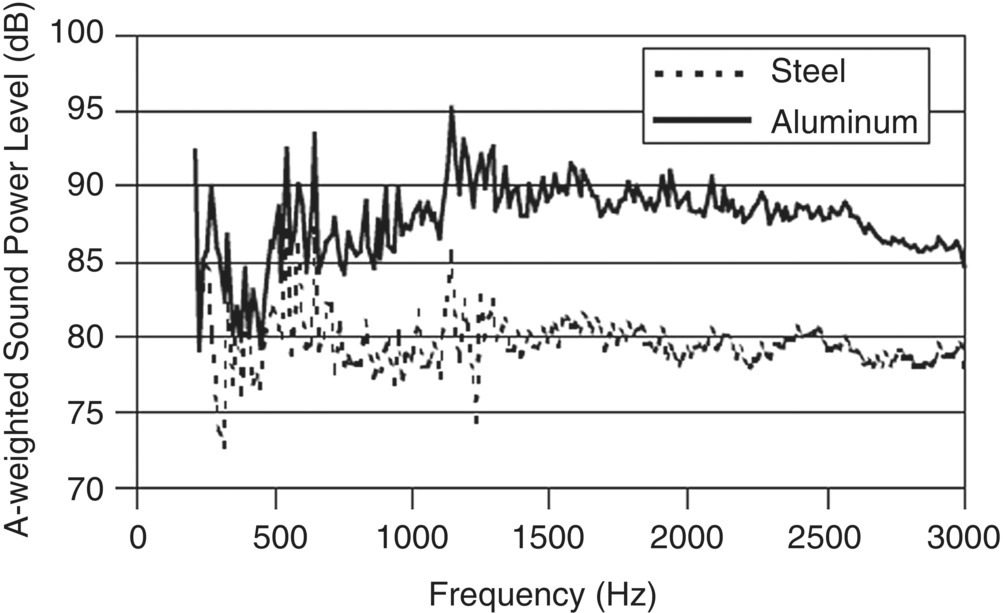
A number of options are available to reduce radiated noise from the exterior surfaces of engines. They include stiffening of exterior surfaces, reducing the stiffness of surfaces, adding damping treatments, or isolating the connection between the structure and covers [5]. However, these options have to be carefully designed. Figure 14.4 shows the radiated sound power level by a heavy‐duty diesel engine for two different oil pans. It is observed that, although stiffer, the aluminum pan is about 10 dB louder than the flexible stamped oil pan at many frequencies. This difference is due to the higher radiation efficiency of the stiffer aluminum oil pan. The stamped steel pan has a 7‐dB lower overall A‐weighted sound power level than the much stiffer cast‐aluminum pan [5].
In recent years, the number of electric vehicles continues to increase worldwide. Even though electric cars are mainly intended to reduce CO2 emissions, there is also a possibility that they can help to reduce environmental noise, since electric vehicles in general are found to be very quiet at low speed. This is particularly important in congested streets where low traffic flow is prevalent and tire/road noise becomes less important than power plant noise. However, there is some concern about the effects of the low noise emission from electric vehicles on traffic safety. Some studies have discussed the importance of implementing artificial sound warning signals in electric vehicles, in particular to protect blind or visually impaired pedestrians [10].
A Japanese study measured the noise emissions from two electric vehicles, one hybrid vehicle (HV), and two ICE vehicles [11]. The measurements also included noise artificially added to the electric and HVs following the Japanese guidelines that recommend sounds which simulate the sound of ICE vehicles. The results are shown in Table 14.2 when the cars were driven at 10 and 20 km/h. The results show that for 10 km/h, there is a 6–9 dB difference between the noise of ICE and electric vehicles without the artificially added sound. At 20 km/h the difference is 5 dB between EV‐2 and the ICE cars, and for EV‐1 there is no apparent difference. With the artificially added noise there is no difference in SPL for either of the electric cars and the ICE cars, although a difference of 2 dB between the ICE cars and the hybrid car is observed.
Table 14.2 A‐weighted sound pressure levels from pass‐by measurements of two electric cars (EV), one hybrid vehicle (HV), and two ICE cars. The microphone was placed 2 m from the center of the track and 1.2 m above the ground.
Source: Data from Ref. [11].
| Vehicle | 10 km/h | 20 km/h |
|---|---|---|
| EV‐1 | 50 dB | 62 dB |
| EV‐1 with artificial sound | 55 dB | 62 dB |
| EV‐2 | 47 dB | 57 dB |
| EV‐2 with artificial sound | 56 dB | 62 dB |
| HV‐1 | 50 dB | 60 dB |
| HV‐1 with artificial sound | 54 dB | 60 dB |
| ICE‐1 | 56 dB | 62 dB |
| ICE‐2 | 58 dB | 62 dB |
A recent Danish report has presented a literature survey on the noise from electric vehicles [12]. The report concluded that electric cars are quieter than ICE vehicles only at low speeds. At speeds between 25 and 50 km/h, no difference is found between ICE and electric car noise. Several studies in the frequency domain have reported that the noise of electric vehicles can have some peaks at middle frequencies, which may be perceived as annoying [12].
Leave a Reply