The U.S. search volumes of the following two keywords are nearly equal:
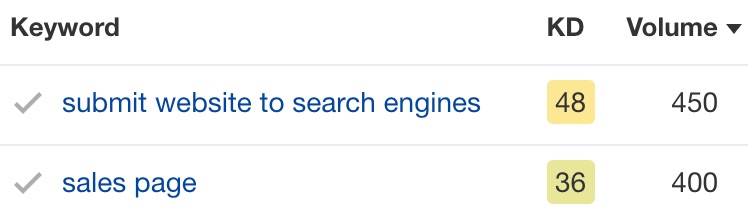
Which means that the amount of search traffic that you may get from targeting each of them should also be nearly equal, right?
Well, not quite.
Let’s take the top-ranking pages for each of these keywords and compare how much search traffic they get in the U.S.
And it turns out that one of these pages is actually getting nearly 5X more search traffic than the other.
How can that be?
Well, webpages don’t rank in Google for just a single keyword. If you look at the two screenshots above attentively, you’ll see that the top-ranking page for “sales page” is ranking in Google for 55 keywords (check the “Organic keywords” tile). While the top-ranking page for “submit website to search engines” ranks in Google for a total of 406 different keywords.
Here are some of them (as seen in the Organic keywords report in Site Explorer):
Whatever search query you have in mind, different people will phrase it differently while, essentially, looking for the same thing. Google is smart enough to understand that. And it, therefore, ranks the same page for all these similar search queries.
We studied this “phenomenon” back in the day, and it turned out that the average top-ranking page would also rank for about a thousand similar keywords.
This means that you should not blindly rely on the search volume of a single keyword when estimating the search traffic that your page is going to get if it ranks for it. What you need to do instead is examine the top-ranking pages for that keyword and see how much search traffic they get in total from all the variations of that keyword, which they rank for.
Here at Ahrefs, we thought it was such an important thing to consider when analyzing keywords that we have developed a dedicated metric to address it.
It’s called “Traffic Potential,” and it shows how much search traffic the top-ranking page for your keyword gets.
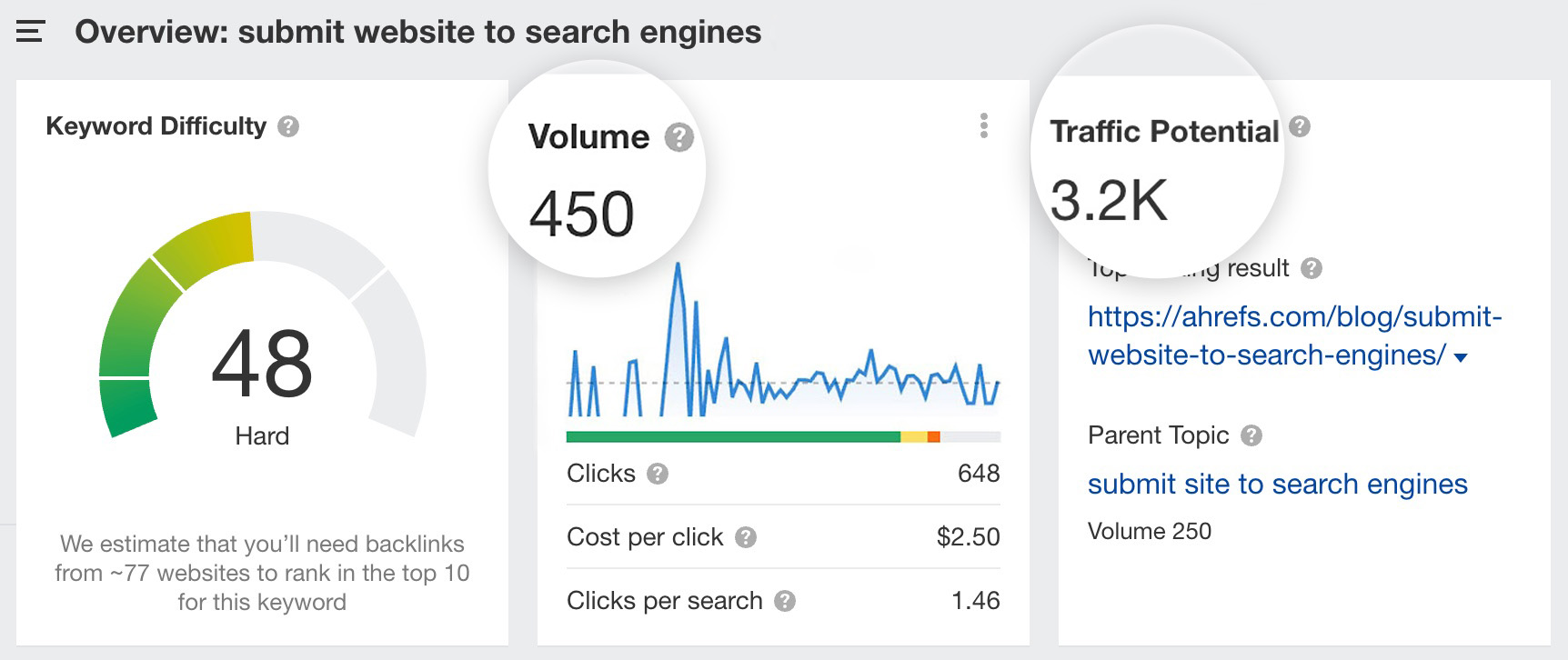
In Ahrefs’ Keywords Explorer, the Traffic Potential metric is located right next to the search volume. This saves you lots of time looking up what page ranks #1 for that keyword and how much search traffic it gets in total.
Both the search volume and Traffic Potential metrics are country-specific, though. So if you need to gauge the worldwide search traffic of a top-ranking page, you’ll need to use Site Explorer with “All countries” mode selected.
Keyword Difficulty
Experienced SEO professionals typically gauge the ranking difficulty of each keyword manually. That is, by looking at the search results for each keyword and analyzing them. They account for many different factors to judge how hard or easy it’ll be to rank:
- Search intent
- Content depth, relevance, freshness, authority
- Number (and quality) of backlinks
- Domain Rating
- SERP features
- Etc
This process varies from person to person, and there’s no consensus on precisely what is and isn’t important here.
One person might believe that Domain Rating is important, and another might think that relevance plays more of a role.
The opinions might also vary depending on the type of search query that they’re analyzing, because for different kinds of queries Google gives preference to different things.
All of that makes life a little difficult for SEO tool creators, who try to distill the complex and intricate concept of ranking difficulty down to a simple two-digit number.
But after talking to many professional SEOs about the signals that an actionable Keyword Difficulty (KD) score should factor in, we realized that everyone agreed on at least one thing: Backlinks are very important for ranking.
So, in the end, we decided to base our Keyword Difficulty (KD) score on the number of unique websites linking to the top 10 ranking pages.
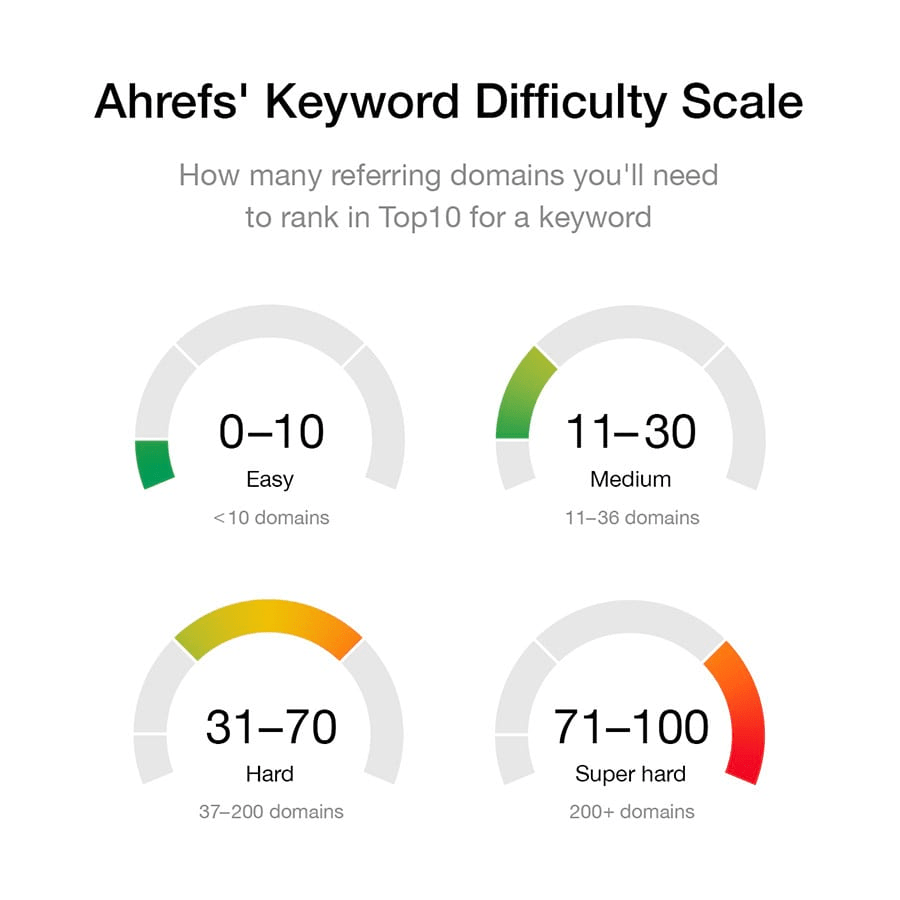
As you can see in the image above, KD relates to the estimated number of linking websites your page needs to rank in the top 10.
Did you get that? It’s not the estimated number of linking websites you need to rank #1. It’s the estimated number you need to rank in the top 10. Getting to #1 is an entirely different battle.
Many people misuse the KD metric by setting the filter from 0 to 10 and focusing solely on the easy keyword ideas. But here’s why avoiding high-KD keywords might be a mistake:
- You should go after high-KD keywords sooner, not later – You’ll need lots of backlinks to rank for high-KD keywords, which takes a lot of time and resources. So it pays to create your page and begin promoting it as soon as possible. The sooner you start, the sooner you’ll get there.
- Look at high-KD keywords as link opportunities – The fact that the top-ranking pages for some keywords have lots of backlinks is a sign of a “link-worthy” topic. If you create something original on that topic, there’s a good chance lots of people will link to you.
The bottom line is this: KD is not there to deter you from targeting specific keywords. It’s there to help you understand what it’ll take to rank for a given query (as well as the “link-worthiness” of a given topic).
Just know that you should always manually assess keywords before going after them and not rely solely on any tool’s difficulty score to make your final decision. No single score can distill the complexity of Google’s ranking algorithm into a single number. Be wary of tool creators who suggest otherwise.
Cost Per Click (CPC)
Cost Per Click (CPC) shows how much advertisers are willing to pay for a click on an ad displayed on top of search results for a given keyword. It’s more a metric for advertisers than SEOs, but it can serve as a useful proxy for a keyword’s value.
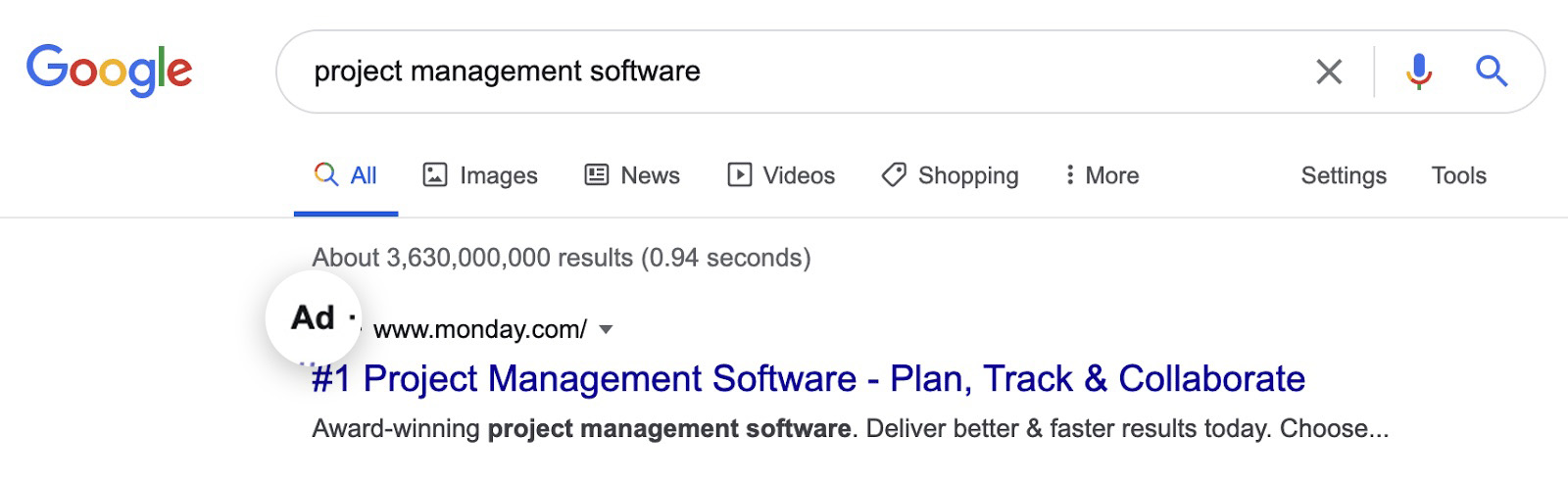
For example, the keyword “project management software” has a pretty high CPC of $30. That’s because people searching for it seem to be looking for a product to buy.
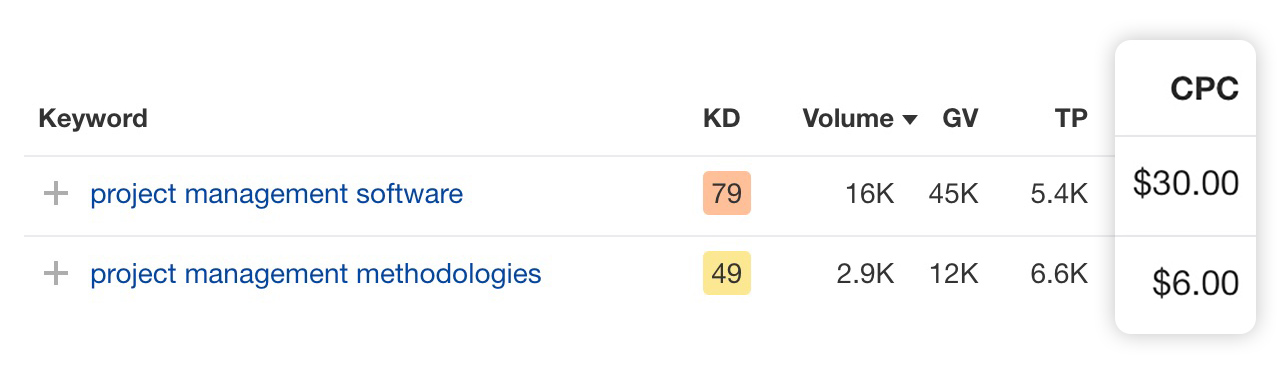
But it’s a different story for “project management methodologies.” This is clearly an informational search query, and the odds of selling your project management software to these people are not as high—hence, the much lower CPC of $6.
One important thing to know about CPC is that it’s much more volatile than search volume. While the search demand for most keywords stays roughly the same from month to month, their CPC can change any minute as more companies display ads for them.
This means that the CPC values that you see in various SEO tools are merely snapshots in time and aren’t particularly precise. If you want to get real-time CPC data, it is recommended that you use AdWords.
Leave a Reply