Leaks in a wall frequently occur in practice and are very serious. Unless great care is taken in construction, leaks will occur and the theoretical TL of a wall will not be achieved. This effect is particularly noticeable at high frequency where the TL of a wall would be expected to be high. In this region, a leak can reduce the TL by over 10 dB. Air leaks can be caused by poorly mortared masonry joints, unsealed holes around pipes, ducts and conduits which penetrate walls, unsealed room partitions, cracks, clearance around doors, partly opened windows, etc. The leak provides an air path for the transmission of sound energy.
It is often assumed that all of the sound energy striking a leak is transmitted (so that τ = 1 for the leak and TL = 0). This assumption is approximate only, but gives a starting point for discussion. Under this assumption, Eqs. (12.60) and (12.61) can be used to calculate the TL of the wall including the leak. If the τ for the leak is more accurately known, then this may be incorporated into Eq. (12.60) to obtain better accuracy for TL0. Under the assumption that τ2 = 1 for the leak and the sound energy it transmits is much greater than that through the wall, then Eq. (12.63) becomes
(12.65)
where k is now the ratio of leak to total wall area, percent.
EXAMPLE 12.16
The space under a very heavy solid door of TL = 50 dB is 1/100 of the total area of the door. If the noise level outside the room is 80 dB, determine the noise level inside the room with the door closed.
SOLUTION
The transmission coefficients of the door and the open space under the door are 10−5 and 1, respectively. If the area of the door is S, then
 dB. The noise level inside the room with the door closed is 80−20 = 60 dB. Thus, the leak produced by the small space under the door significantly reduces the noise insulation of the heavy door.
It has been shown that assuming τ = 1 (TL = 0) for a slit is a very drastic assumption. Gomperts [62] showed that τ can fluctuate from much less to much more than 1. In addition, in the region of resonances, viscous energy losses in the slit must be included in the calculation [63].
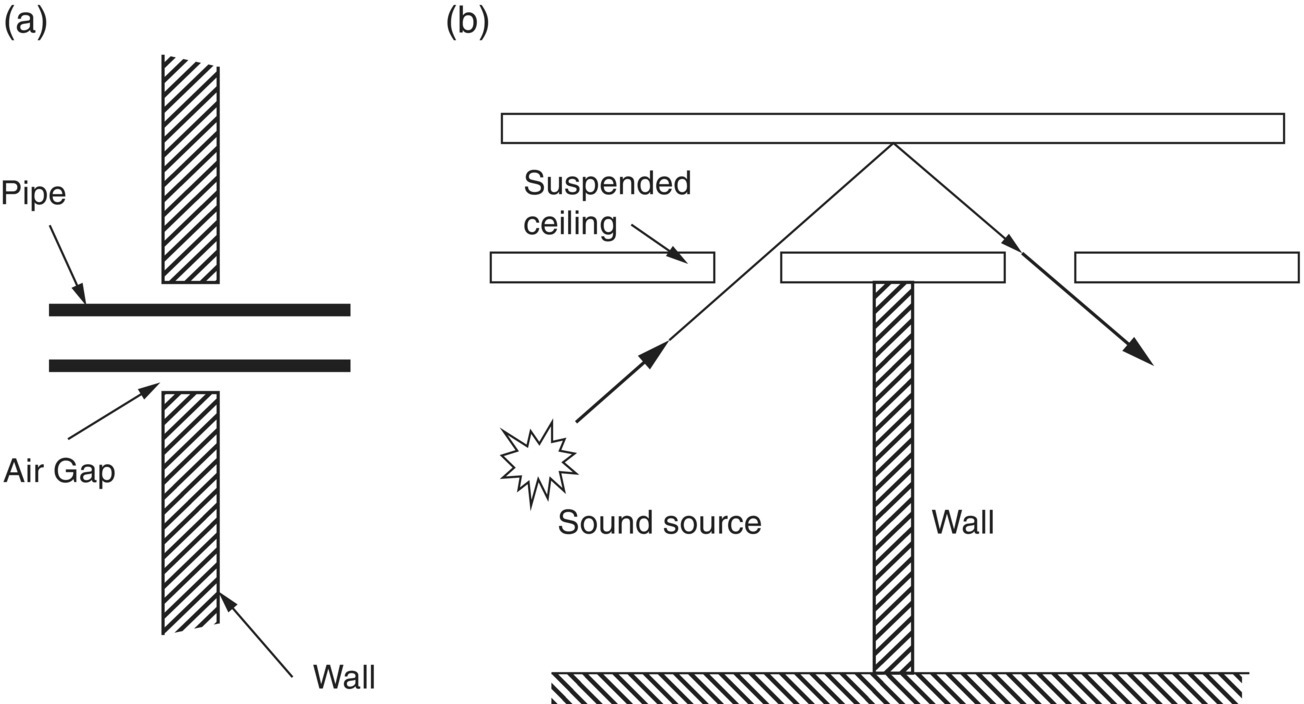
Figure 12.39 gives two common examples of an acoustical leak or air path. This air path is much more efficient than the mechanical path through the panel. Only 645 mm2 (one square inch) of hole can transmit as much energy as a 9.3 m2 (100 ft2) wall. Note that a crack 0.25 mm wide × 2.6 m long has an area of 6.5 cm2. Such a crack, then, might be expected to reduce the TL, on average, of such a wall by 3 dB. If this wall is now made much thicker (say, four times), the effect will be still more serious. The energy transmitted through the crack will remain the same, while the energy transmitted through the wall will be 1/16 of that through the thicker wall or 12 dB less than before. The TL, then, of this thicker wall will be decreased by just over 12 dB by the existence of the crack. This discussion shows why the clearance provided around a door seriously degrades the TL. The area of such gaps is quite large. Grilles and louvers in doors very seriously impair their performance. Likewise, in the construction of industrial buildings, similar care should be taken to avoid leaks where possible. If air must be supplied for cooling purposes, inlet and outlet mufflers or sound traps should be used which have attenuations (transmission losses) equivalent to the walls.
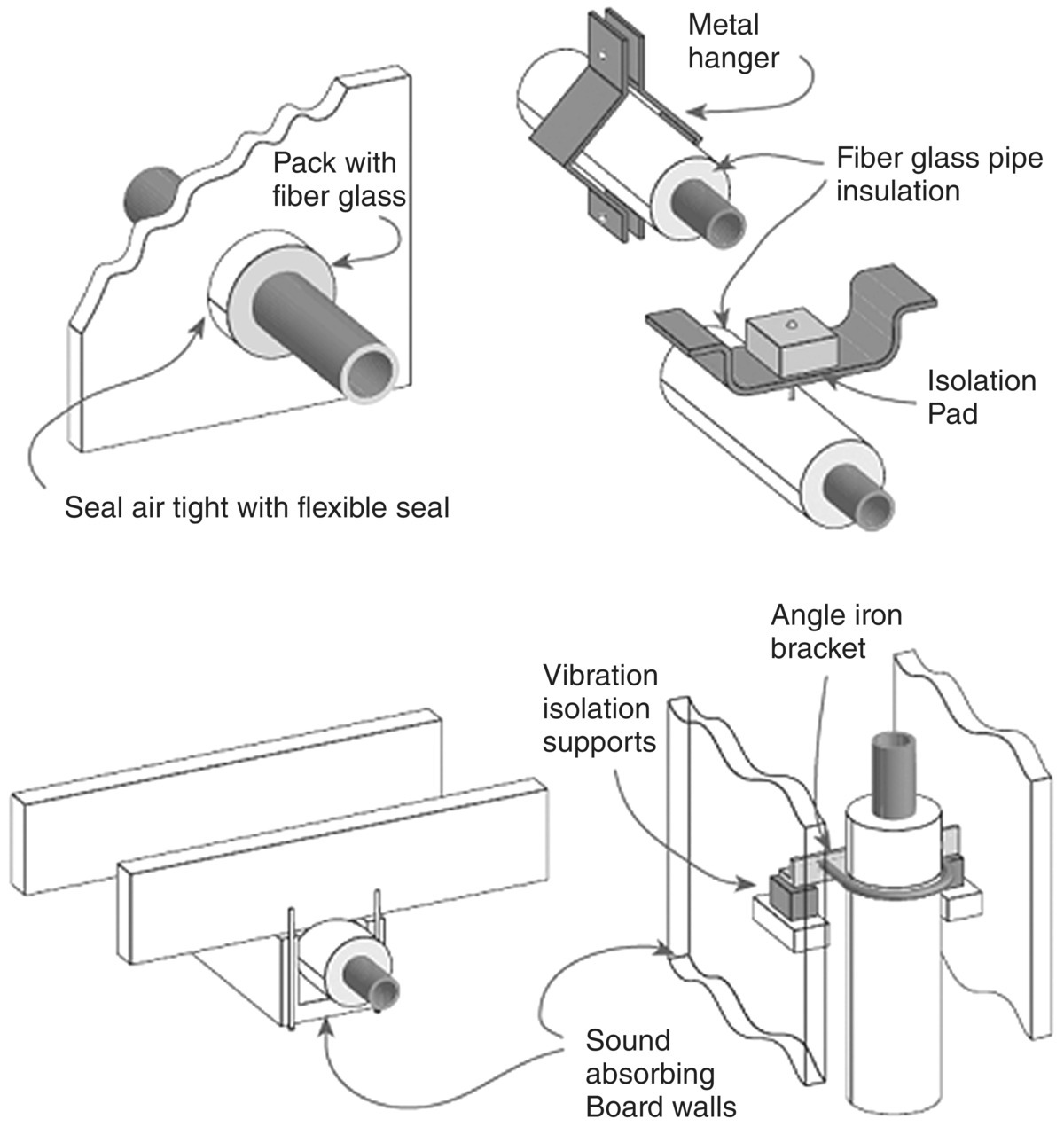
Plumbing is a very important source of noise in buildings for several reasons including: (i) bends in the pipe and coupling between bending, longitudinal, and other motions of the pipe add vibrational complications, (ii) poorly fitting pipes provide an air path for the transmission of energy, and (iii) the fluid in the pipe can flow in such a way that excites the walls with turbulent pressure fluctuations, in addition to sound waves. It is a common practice to wrap a noisy pipe with an acoustical absorbing material and then to cover this with a thin massive septum (layer) of material such as lead or lead‐loaded vinyl. Such an approach is known as wrapping or lagging. The sound radiated from the pipe passes through the absorbing material and is reflected back and forth between the septum and pipe wall. Each time the sound is reflected by the septum some is transmitted through the surrounding space. Thus, a more massive septum should be more effective in reducing the pipe noise to the surroundings, particularly at high frequency, according to the mass law discussed in this chapter. The sound is absorbed during the multiple reflection process between the septum and the pipe wall, and thus thicker acoustical absorbing linings should be more effective.
The layer of acoustical material can consist of fiberglass or open‐celled acoustical foam and acts both as an absorbing material and as a vibration isolator to decouple the pipe vibration from that of the septum. The layer of absorbing material can also be used as thermal insulator. In addition, piping must be isolated from structures, such as walls, to avoid structure‐borne noise transmission. Resilient pads and vibration‐isolation hangers are often very effective in reducing the amount of such vibration being transmitted into the building structure from pipes and ducts. Figure 12.40 shows some examples of noise control measures for pipes in buildings.
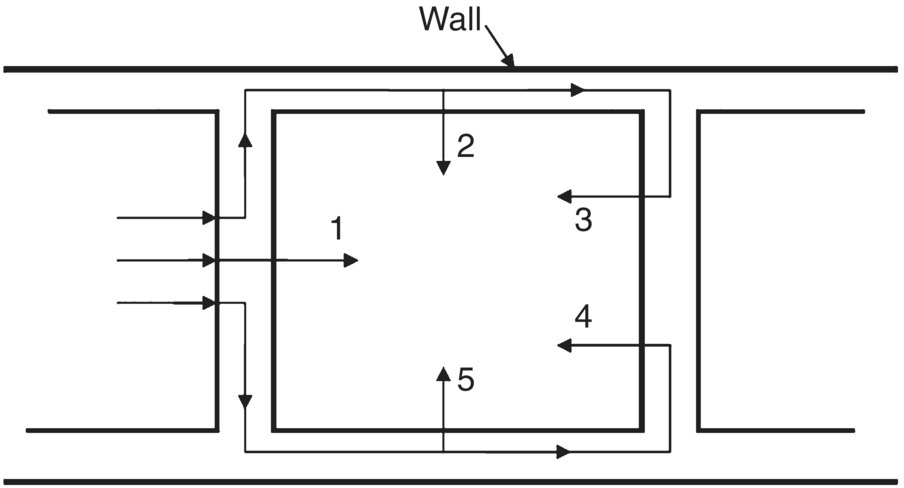
We have just discussed “air flanking.” It is also common to find that mechanical paths will “flank” energy around a wall and thus reduce its effectiveness (see Figure 12.41). Sound will be transmitted through the wall by the direct path 1. However, energy will also be flanked around the wall by the indirect paths 2, 3, 4, and 5. There will also be indirect paths through the ceiling and floor, as well as the walls. Even more complicated flanking paths are possible, although they have not been shown. The problem is seen to occur at wall‐to‐wall junctions and wall‐to‐floor junctions. The solution to this problem is to vibration‐isolate the junctions in some way. Several different methods may be used. Breaks can be used in floor slabs at a junction, instead of making them continuous, and these are found to be particularly useful.
Other ways of avoiding flanking transmission in buildings include the use of floating floors and suspended ceilings. See also Chapter 13, Section 13.6.1 and Figure 13.33. Air flanking, through direct air paths at junctions or weak links (i.e. where only a thin wall is presented to a potential air path) at the junction should also be avoided. Sound traps may be used to cut the air paths at such junctions. Caulking should be used wherever cracks may occur. These practical recommendations are of course also valid for the construction of enclosures for machines where similar flanking problems exist (see Section 9.6 of this book). It is possible to estimate the contribution of each flanking transmission to the total insulation provided by a partition [65]. A comprehensive discussion of one of such methods is given in a guide published by the National Research Council in Canada
Leave a Reply