Often partitions are composed of several different elements, such as a brick wall having windows and doors. The average transmission loss TLav of this composite structure can be calculated as follows: suppose τ1 is the transmission coefficient of element of area S1, etc. and that a diffuse reverberant sound field of intensity εc/4 (where ε is the energy density in the incident field and c is the speed of sound) strikes the partition, then
(12.59)
where W0, W1, W2, W3, etc. are the powers transmitted by the overall partition and elements 1, 2, 3, etc. Then, from Eq. (12.59) since W0 = (εc/4)τ0 (S1 + S2 + S3 + …), and W1 = (εc/4)τ1 S1, W2 = (εc/4)τ2 S2, etc.,
(12.60)
and from Eq. (12.11a) the overall TL of the composite wall is
(12.61)
EXAMPLE 12.13
Compute the overall partition TL at 1000 Hz of a 100 mm thick brick veneer wall measuring 2.3 × 4.6 m penetrated by a 0.9 × 1.2 m single‐ pane window (glass thickness 5 mm). For brick M1 = 210 kg/m2 and for glass M2 = 12.5 kg/m2.
SOLUTION
We can estimate the TL for each material using the empirical equation (see Section 12.2.2) TL = 20log(Mf) − 47. Thus, for brick TL1 = 20log(210 × 1000) − 47 = 59 dB and for glass TL2 = 20log(12.5 × 1000) − 47 = 35 dB. Now, for brick S1 = 2.3 × 4.6–0.9 × 1.2 = 9.5 m2 and τ1 = 10−5.9 = 1.26 × 10⁻⁶; for glass, S2 = 1.08 m2 and τ2 = 10−3.5 = 3.16 × 10⁻⁴. Therefore,
 ; and the overall transmission loss of the partition is TLav = 10 log(1/3.4 × 10−5) = 44.8 dB.
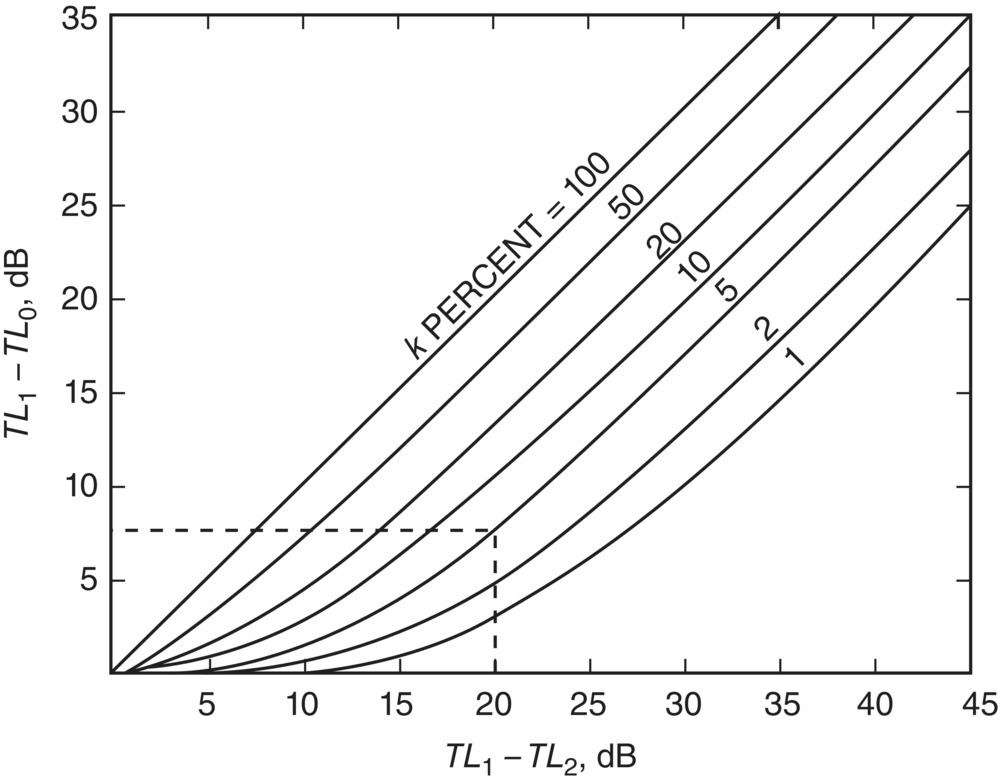
Equations (12.60) and (12.61), after some manipulation, have been presented by different authors as various plots to save us the bother of making the calculations; see, e.g. Figure 12.38. In the previous example TL1 − TL2 = 59–35 = 24. The penetration k percent = (1.08/10.58) × 100 = 10.2%. Interpolating for the value of k gives TL1 − TL0 ≈ 14 dB. Thus TL0 = 59–14 = 45 dB, which agrees with the numerical calculation in the example.
It is interesting to note in the example just calculated that the sound energy transmission through the window was dominating (even though the window area was only about 10% of the total) since 3.41 × 10⁻⁴ ≫ 11.97 × 10⁻⁶, i.e. τ2 S2 ≫ τ1 S1. This is frequently the case found in practice. Except perhaps where the wall is made of a lightweight material, sound transmission through a window normally gives the situation τ2 S2 ≫ τ1 S1 and thus Eq. (12.60) becomes
(12.62)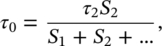
and the overall TL of the composite partition is
(12.63)
where k is the ratio of window per total area percent, k = 100 S2/(S1 + S2 + …) = 100 S2/S and TL2 is the TL of the window. The upper right part of Figure 12.38 in which the curves are straight lines corresponds to the case where nearly all the energy goes through element S2, and the curves obey Eq. (12.63). This is easily shown by rearranging Eq. (12.63) in the form:
(12.64)
which is the result for a straight line of ordinate TL1 − TL0, plotted against abscissa TL1 − TL2, where the constant −10log (100/k) represents the value of TL1 − TL0, when TL1 − TL2 is zero.
That this result is correct for the case where the transmission through a window dominates is easily checked from the previous example. Since k = 10.7%, then 10log (100/k) = 10log(100/10.7) = 10log(9.35) = 9.7 dB; from Eq. (12.63): TL0 = 35 + 9.7 = 44.7 dB. This result agrees with the two previous calculations. The reader may also care to check that Eq. (12.64) is also exactly satisfied by this example, where 10log (100/k) = 9.7 dB.
The above example represents a specimen calculation at the frequency of 1000 Hz. This calculation would have to be repeated at each frequency of interest to obtain a curve of TL, against frequency. That such calculations for composite walls agree well with experimental measurements on composite walls has been demonstrated in practice [61].
EXAMPLE 12.14
Calculate the overall transmission loss at 250 Hz of a wall of total area 15 m2 constructed from a material that has a transmission loss of 40 dB, if the wall contains a panel of area 5 m2, constructed of a material having a transmission loss of 15 dB.
SOLUTION
For the main wall, the transmission coefficient is: τ1 = 1/[10(40/10)] = 0.0001, while for the panel: τ2 = 1/[10(15/10)] = 0.032. Therefore, using Eq. (12.60):
 , and the overall TL of the composite wall is TL0 = 10log(1/0.0107) = 19.7 dB.
EXAMPLE 12.15
A wall 10 × 20 m has an initial TL = 50 dB. Four windows are added to the wall. The area of each window is 5 m2 and its τ = 0.01. What will be the new TL of the wall with windows?
SOLUTION
For the wall, the surface is 200 m2 and its τ1 = 1/[10(50/10)] = 10−5. Hence
 . Thus, the overall transmission loss of the wall with windows is TL0 = 10log(1/0.001) = 30 dB.
Leave a Reply