Figure 10.72 shows that it is very important to have knowledge of the source impedance if narrow‐band predictions of the IL of an automobile muffler are desired. In many cases, such as automobile engines, compressors and blowers, the mechanical sound source is not constant, but varies over restricted frequency range. Figure 10.73 shows that the IL is largely independent of the source impedance if frequency‐averaged results over a bandwidth of such as 25 Hz are sufficient. If frequency averaging over a 200 Hz bandwidth is acceptable, then the IL results can be approximated by the TL results.
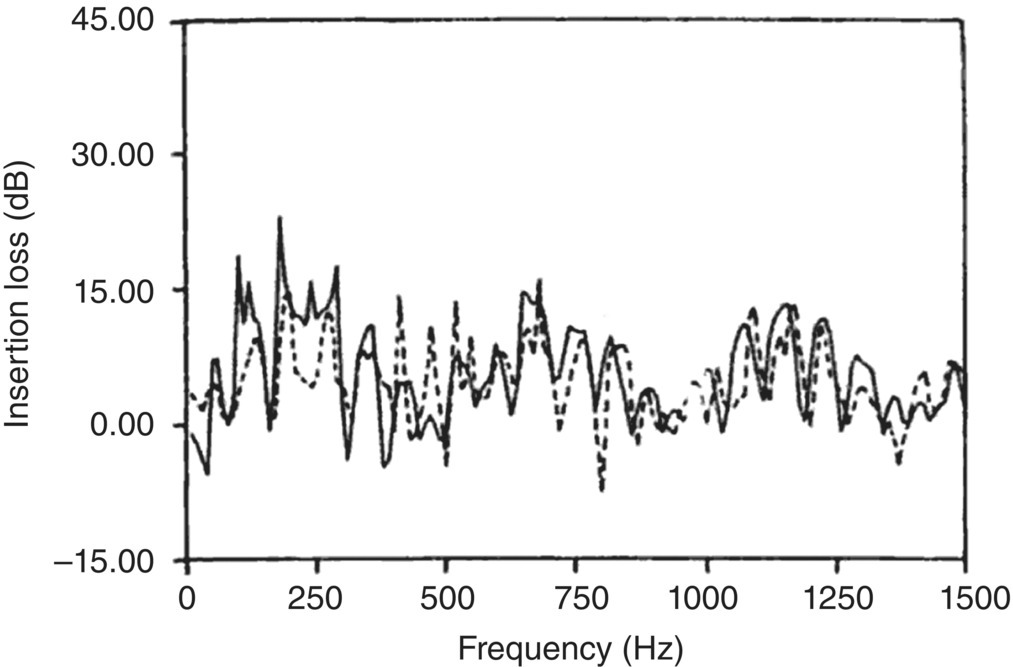
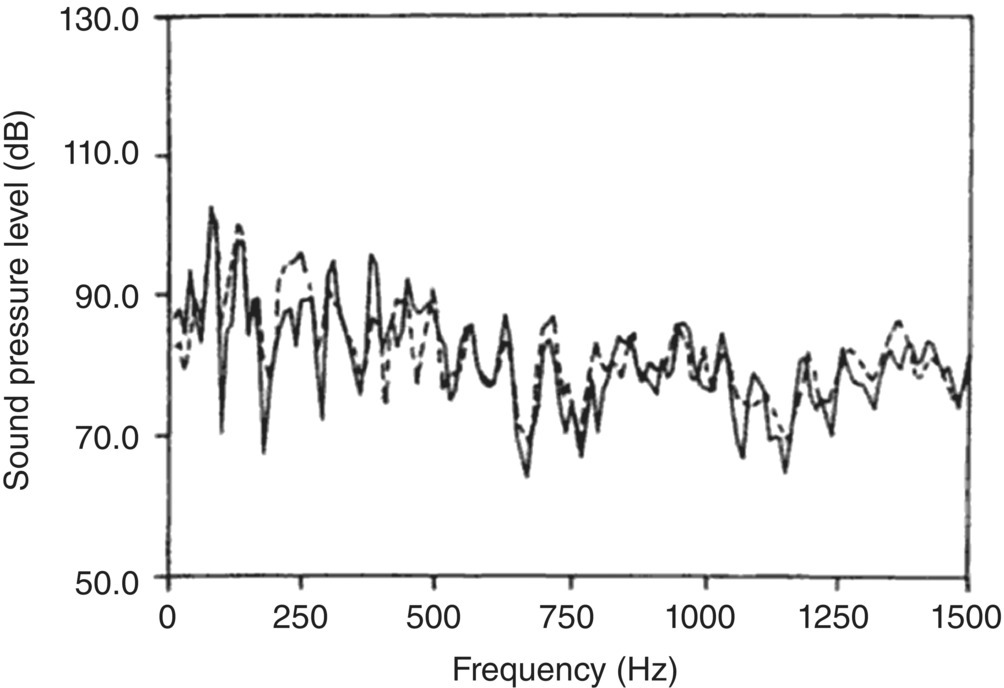
In some cases, it is important to have detailed information of muffler IL (for instance when the source operates at a fixed speed.) Various approaches have been used to determine the impedance of mechanical sources. The termination of a duct system represents one of the impedance boundary conditions. It is more difficult to characterize the impedance of a mechanical source compared to the impedance of the termination because of the dynamic nature of the source [98, 99].
Direct methods for the measurement of source impedance are based on either the standing‐wave technique or the transfer function technique [99]. These techniques have been successfully used to measure the impedance of primary active mechanical sources such as engines, compressors, fans, and blowers [100, 101]. In this context, the signal refers to the SPL of the secondary measurement source and noise refers to the SPL of the primary source in operation. A minimum signal‐to‐noise ratio of 10 dB of the secondary source above the primary one is required. Pneumatic and/or electroacoustic drivers are usually needed to achieve a sufficient signal‐to‐noise ratio. In direct methods, the microphones are placed inside the duct. A modified transfer function method for a low signal‐to‐noise ratio has been developed that only requires an additional measurement of a calibration transfer function [102].
The advantages of indirect methods are that no secondary source is required as the response is measured from the test source and the microphone can be placed outside the duct. However, the methods are sensitive even to slight errors in the measured response, which strongly influences the numerical aspects. The direct and indirect methods are essentially experimental methods based on frequency domain analysis [98].
Indirect methods are based on the use of different loads and their corresponding responses [103–105]. The pressure response is measured for a known load of impedance ZL. Assuming that the source pressure is invariant, the system of equations for two, three, four, or more load impedances is solved to calculate the source impedance. With two and three loads, the complex pressure response needs to be used; whereas with four loads only the SPL response is needed [98].
There has been extensive work in recent years continuing determination of the source characteristics of internal combustion engines [106–111]. Desmons and Auregan used several calibrated loads [106]. Liu and Herrin used a two‐load wave decomposition approach to measure source impedance [109]. Other researchers have concentrated on evaluating the complete exhaust systems [112–116]. Munjal provided an extensive review in 2004 [115]. Others have made in‐depth studies of the exhaust and intake systems of particular engines [117–119]. Hynninen produced a useful review in 2015 as part of a doctoral thesis [120]. Whether linear acoustics theory is adequate for engine exhaust system design continues to be under discussion [121–123]. Hynninen has suggested use of capsules to identify source characteristics of large engines in situ [124].
Leave a Reply