Load‐bearing and non‐load‐bearing structures of a machine (panels) are excited into motion by mechanical machine forces resulting in radiated noise. Also, the sound field inside an enclosure excites its walls into vibration. When resonant motion dominates the vibration, the use of damping materials can result in significant noise reduction. In the case of machinery enclosures, the motion of the enclosure walls is normally mass‐controlled (except in the coincidence frequency region), and the use of damping materials is often disappointing. Damping materials are often effectively employed in machinery in which there are impacting parts since these impacts excite resonant motion. A structure that vibrates in flexure can be damped by the appropriate addition of a layer of damping material.
Damping involves the conversion of mechanical energy into heat. Damping mechanisms include friction (rubbing) of parts, air pumping at joints, sound radiation, viscous effects, eddy currents, and magnetic and mechanical hysteresis. Rubbery, plastic, and tarry materials usually possess high damping. During compression, expansion, or shear, these materials store elastic energy, but some of it is converted into heat as well. The damping properties of such materials are temperature dependent. Damping materials can be applied to structures in a variety of ways, for example by the application of coatings made of some viscoelastic material usually marketed in the form of tapes, sheets or sprays which may be applied like paint.
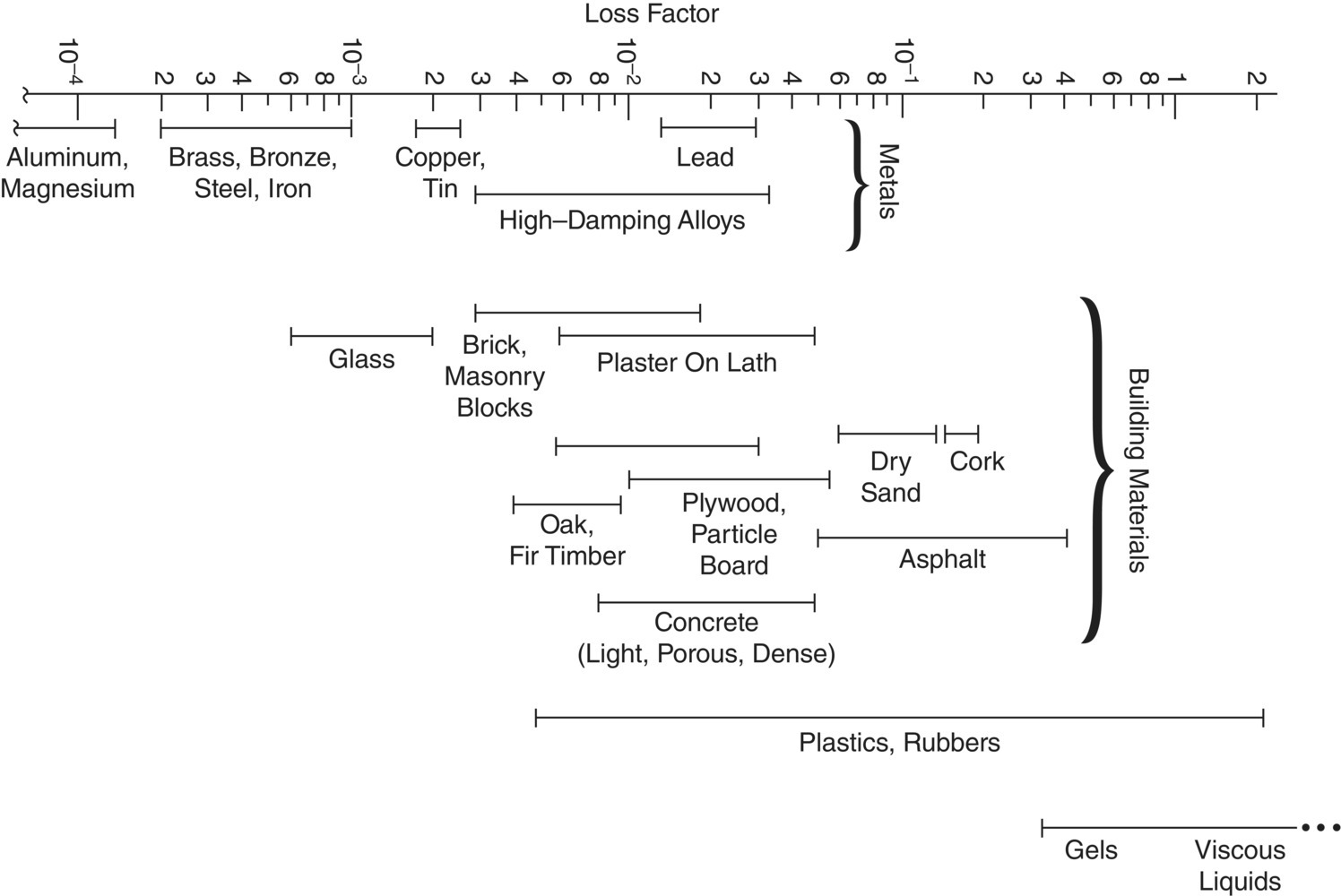
An essential parameter for measuring the amount of damping energy lost in a harmonically vibrating structure is the system damping loss factor, η, which is defined as the ratio between the energy dissipated within the damping layer and the energy stored in the whole structure, per cycle of vibration. Figure 9.9 shows typical ranges of the loss factors reported for materials at small strains, near room temperature, and at audio and lower frequencies. The range indicated for plastics and rubbers is large because it includes many different materials and because the properties of individual materials of this type may vary considerably with both frequency and temperature. On the other hand, since measurement of Poisson’s ratio of viscoelastic materials is very difficult to obtain experimentally, data are not available for most damping materials. Often, viscoelastic materials are assumed to be incompressible in regions of rubbery behavior and about 0.3 in regions of glassy behavior [52]. In general, the damping loss factors of high‐strength materials (e.g. metals) tend to be much smaller than those of plastics and rubbers, which are of lower strength [51].
The viscoelastic materials of greatest practical interest for damping applications are plastics and elastomers. An elastomer is a soft substance that exhibits thermo‐viscoelastic behavior. Viscoelastic materials possess both elastic and viscous properties. For a purely elastic material, all the energy stored in a sample during loading is returned when the load is removed. Furthermore, the displacement of the sample responds immediately, and in‐phase, to the cyclic load. Conversely, for a purely viscous material, no energy is returned after the load is removed. The input stress is lost to pure damping as the vibration energy is transferred to internal heat energy. All the materials that do not fall into one of the above extreme classifications are called viscoelastic materials. Some of the energy stored in a viscoelastic system is recovered upon removal of the load, and the remaining energy is dissipated by the material in the form of heat [53].
Undamped metal structures normally have a very low loss factor, typically in the range 0.001–0.01. Using a viscoelastic layer can increase this loss factor. This means that the amplitude of the resonant vibration when the structure is subjected to structure‐borne sound or vibration will be much lower than for an undamped structure. Reduced amplitude of vibration means less radiation of sound, and also a reduced risk of fatigue failure. In addition, use of a viscoelastic coating method for damping the vibration of plates has proven to significantly reduce dynamic stresses in the structure as a whole.
A characteristic of viscoelastic materials is that their Young’s modulus is a complex quantity, having both a real and imaginary component. Furthermore, this complex modulus varies as a function of many parameters, the most important of which are the frequency and temperature of a given application. Consequently, this results in a corresponding eigenvalue problem in which the stiffness matrix depends on both the frequency and the temperature. The moduli typically possess relatively high values at low temperatures and/or high frequencies (rubbery behavior regions) but take on comparatively small values at high temperatures and/or low frequencies (glassy behavior regions) [54].
In general, the vibration analysis of a system that is frequency independent can be accurately achieved by classical techniques. It is much more difficult to obtain accurate predictions when the equations of motion are frequency‐dependent. This is because the solution of the corresponding eigenvalue problem is difficult to compute. Methods based on the modal strain energy have been used to approximate the solution of the problem [55]. However, they are not accurate when the frequency and temperature ranges are increased, and when they include the transition region, where the variations of the dissipation and the stiffness of the viscoelastic material are quite pronounced. The greatest loss factors occur in the transition region at intermediate frequencies and temperatures [53].
Although there are several ways of applying damping materials to structures, the use of unconstrained and constrained damping layers are the most common.
9.4.1 Unconstrained Damping Layer
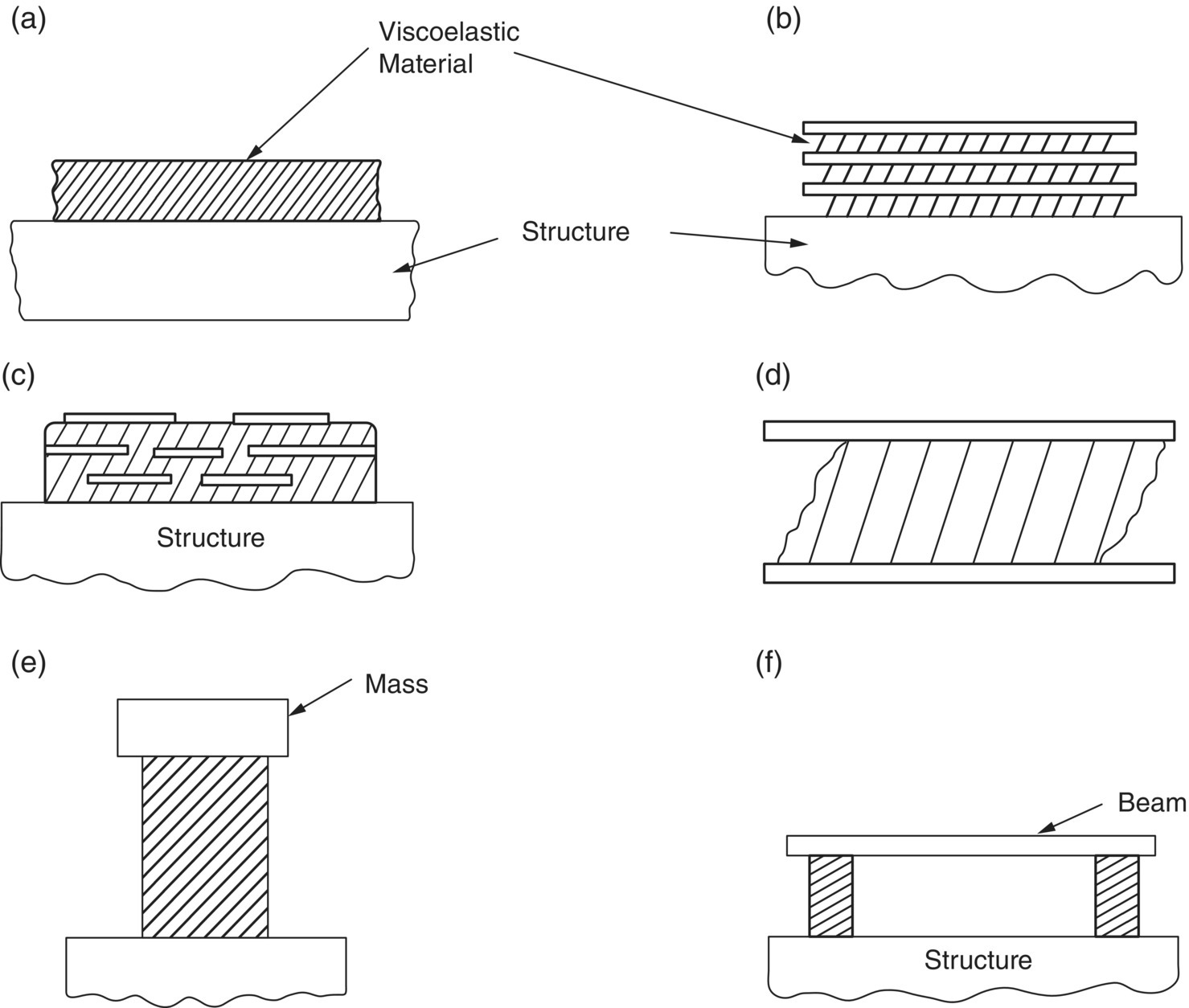
If a free viscoelastic layer is attached to a panel (glued on one or two faces of the panel), which otherwise has a very small damping, then bending produces both flexure and extension of the two layers. As one of the faces of the coating material is free, the added rigidity is due to bending deformation of the material. In this case, shear has little effect on energy storage of the composite panel since the viscoelastic layer is unconstrained. This treatment is usually called extensional damping (see Figure 9.10a).
Unconstrained metal‐elastomer composite structures are an important tool for the reduction of mechanical vibrations. Since the first successful modeling of a metal‐elastomer composite presented by Ross et al. [56], (known as RUK theory), considerable attention has been paid to the prediction of the dynamic behavior of such structures. The damping properties of a plate are influenced by the stiffness of the unconstrained viscoelastic coating, its dissipation loss factor, and by the thickness of the dissipating layer. These properties of a two‐layer plate may be represented by an equivalent plate accounting for mass, stiffness and viscoelastic damping added on the plate by means of the RUK theory [57, 58]. Unconstrained free layer coating treatment is sometimes preferred since it is economic, stable and easy to apply for in situ corrective measures.
9.4.2 Constrained Damping Layer
More efficient and effective damping can be achieved by using a laminated composite (sandwich plate) made of one or more sheet metal layers each separated by a viscoelastic layer and the whole being bonded together. Many practical applications operate on the principle of constrained layer damping. The bending of the composite produces not only bending and extensional strains in all layers but also shears. The shear‐strain energy storage tends to dominate the damping action of the constrained viscoelastic layers. Therefore, it is possible to use very thin layers of viscoelastic material achieving very high values of total damping [58] (see Figure 9.10b). This treatment is called shear damping and, for example, it has been used in the design of vehicle windscreens and to improve sound insulation of windows in buildings. Constrained metal‐vicoelastic‐metal structures have been widely used to provide vibration reduction in structures. In general, finite element methods have been used to model their behavior [53, 55].
Figure 9.10 shows some common ways of applying damping materials and systems to structures. Reference [51] describes damping mechanisms in more detail and how damping materials can be used to reduce vibration in some practical situations.
Leave a Reply