Noise and vibration control should always be incorporated at the design stage wherever possible because there are more low‐cost options and possibilities then to make completed machines or installations quieter [1–3]. After machines are built or installations completed, noise control approaches can still be achieved through various modifications and add‐on treatments, but these are frequently more difficult and expensive to implement. Several books deal with the fundamentals of noise control and with practical applications of noise control techniques [4–12]. Other books deal with acoustics and noise theory [13, 14].
Noise and vibration problems can be described using the simple source–path–receiver model [4] shown in Figure 9.1. The sources are of two main types: (i) airborne sound sources caused by gas fluctuations (as in the fluctuating release of gas from an engine exhaust) or (ii) structure‐borne machinery vibration sources that in turn create sound fields (e.g. engine surface vibrations). Moreover, these sound pressure and vibration sources are of two types: (i) steady‐state and (ii) impulsive. Both steady‐state and impulsive vibrations (caused by impacting parts) are commonly encountered in machines. The paths may also be airborne or structure‐borne in nature.

Source modifications are the best practice but are sometimes difficult to accomplish. Often changes in the path or at the receiver may be the only real options available. The model shown in Figure 9.1 is very simple. In reality there will be many sources and paths. The dominant source should be treated first, then the secondary one, and so on. The same procedure can also be applied to the paths. Finally, when all other possibilities are exhausted, the receiver can be treated. If, as in most noise problems, the receiver is the human ear, earplugs or earmuffs or even complete personnel enclosures can be used.
Measurements, calculations, and experience all play a part in determining the dominant noise and vibration sources and paths. The dominant sources (and paths) can sometimes be determined from careful experiments. In some cases, parts of a machine can be turned off or disconnected to help identify sources. In other cases, parts of a machine can be enclosed, and then sequential exposure of machine parts can be used to identify major sources. Frequency analysis of machines can also be used as a guide to the causes of noise, as with the case of the firing frequency in engines, the pumping frequency of pumps and compressors, and the blade passing frequency of fans. More sophisticated methods are also available involving the use of coherence, cepstrum, and sound intensity methods. Methods for determining the sources of noise and vibration in machinery are discussed in Section 9.2.1.
9.2.1 Noise and Vibration Source Identification
In most machinery noise and vibration control problems, knowledge of the dominant noise and vibration sources in order of importance is very desirable, so that suitable modifications can be made. In a complicated machine, such information is often difficult to obtain, and many noise and vibration reduction attempts are made based on inadequate data so that frequently expensive or ineffective noise and vibration reduction methods are employed. Machine noise and vibration can also be used to diagnose increased wear. The methods used to identify noise and vibration sources will depend on the particular problem and the time and resources (personnel, instrumentation, and financial resources) and expertise available and on the accuracy required. In most noise and vibration source identification problems, it is usually the best practice to use more than one method in parallel to ensure greater confidence in the results of the identification procedure.
Noise and vibration source and path identification methods of differing sophistication have been in use for many years [15]. In recent years, a considerable amount of effort has been devoted in the automobile industry to devise better methods of noise and vibration source and path identification [16–32]. Most effort has been expended on interior cabin noise and separating airborne [16–20] and structure‐borne [20–23] paths. Engine and power train noise and vibration sources and paths [24–26] and tire noise [27, 28] have also received attention. This effort has been expended not only to make the vehicles quieter but to give them a distinctive manufacturer sound quality [33]. More recently these methods have been extended and adapted in a variety of ways to produce improved methods for source and path identification [34–49]. One example is the so‐called transfer path analysis (TPA) approach [43] and variations of it, which to some extent are based on an elaborated version of the earlier coherence approach for source and path modeling [15]. Commercial softwares are now available using the TPA and other related approaches for noise and vibration source and path identification. Pass‐by exterior noise sources of automobiles and railroad vehicles have also been studied [35].
Noise and vibration energy must flow from a source through one or more paths to a receiver (usually the human ear). Figure 9.1 shows the simplest model of a source–path–receiver system. Noise sources may be mechanical in nature (caused by impacts, out‐of‐balance forces in machines, vibration of structural parts) or aerodynamic in nature (caused by pulsating flows, flow–structure interactions, jet noise, turbulence). Noise and vibration energy can flow through a variety of airborne and structure‐borne paths to the receiver.
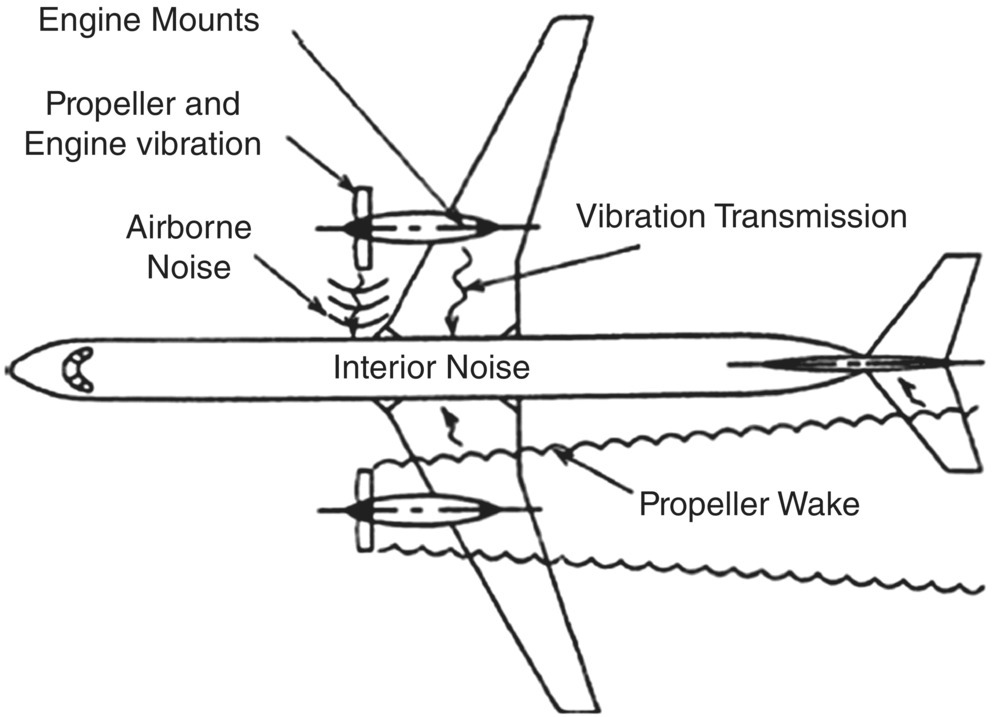
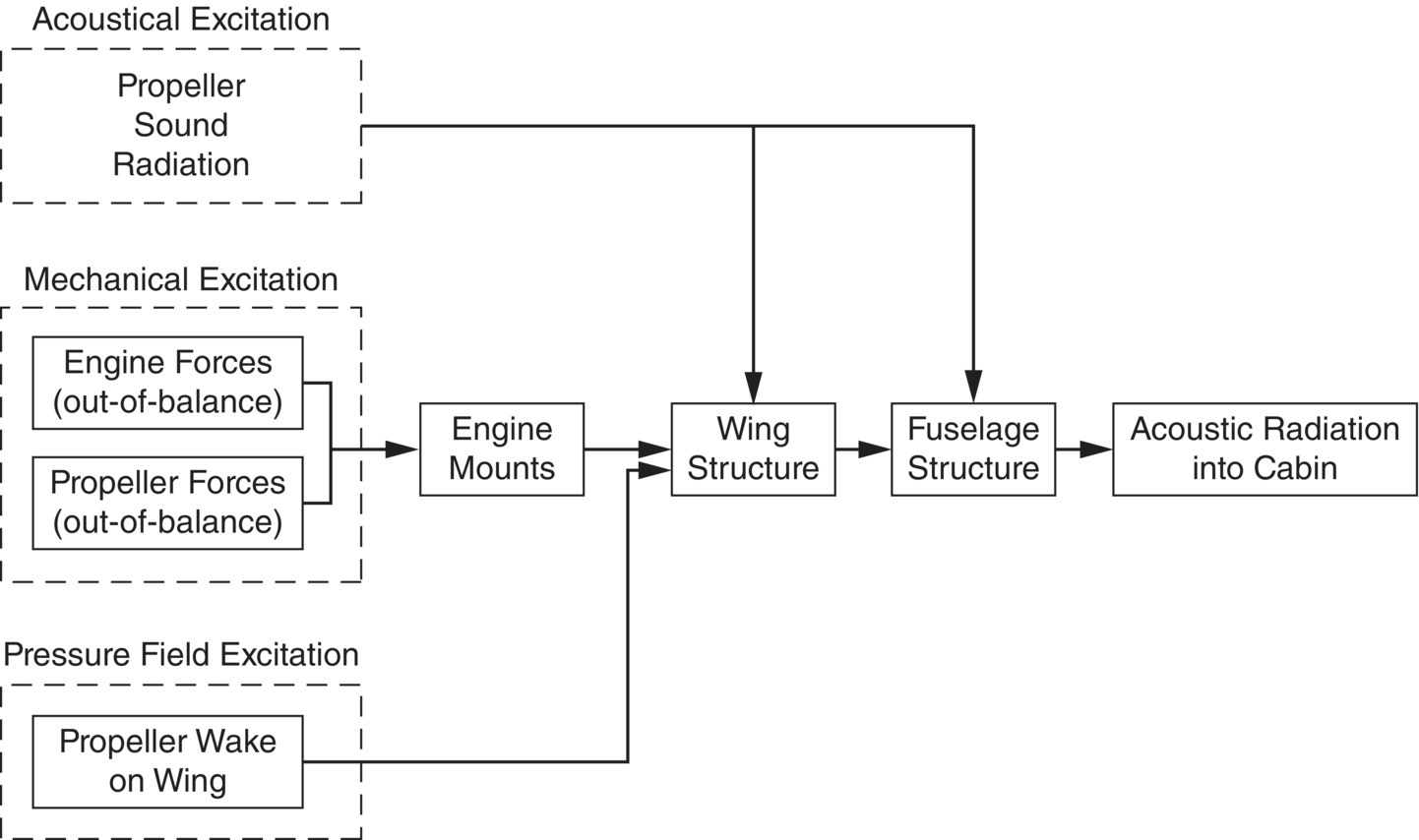
Figure 9.2 shows an example of a propeller‐driven airplane. This airplane situation can be idealized as the much more complicated source–path–receiver system shown in Figure 9.3. In some cases the distinction between the source(s) and path(s) is not completely clear, and it is not easy to neatly separate the sources from the paths. In such cases, the sources and paths must be considered in conjunction. However, despite some obvious complications, the source–path–receiver model is a useful concept that is widely used. In this chapter we will mainly concern ourselves with machinery noise sources. We note that cutting or blocking one or more noise and/or vibration path often gives invaluable information about the noise sources. Reference [15] provides a comprehensive discussion on the methods for noise and vibration source identification.
9.2.2 Noise Reduction Techniques
A study of the literature reveals many successful well‐documented methods used to reduce the noise of machines. These can be classified using the source–path–receiver model. Some of the most useful approaches can generally be used only at the source or in the path. Others, such as enclosure, can be adapted for use at any location. For instance, a small enclosure can be built inside a machine around a gear or bearing, or a larger enclosure or room can be built around a complete machine. Finally, an enclosure or personnel booth can be built for the use of a machine operator. Table 9.1 summarizes a large number of approaches that have been found useful in practice.
Table 9.1 Passive noise control approaches that may be considered for source, path, or receiver.
| Source | Choose quietest machine source available Reduce force amplitudes Apply forces more slowly Use softer materials for impacting surfaces Balance moving parts Use better lubrication Improve bearing alignment Use dynamic absorbers Change natural frequencies of machine elements Increase damping of machine elements Isolate machine panels from forces Reduce radiating surface areas (by adding holes) Stagger time of machine operations in a plant |
| Path | Install vibration isolators Use barriers Install enclosures Use absorbing materials Install reactive or dissipative mufflers Use vibration breaks in ductwork Mismatch impedances of materials Use lined ducts and plenum chambers Use flexible ductwork Use damping materials |
| Receiver | Provide earplugs or earmuffs for personnel Construct personnel enclosures Rotate personnel to reduce exposure time Locate personnel remotely from sources |
The main passive noise control approaches are discussed in the following sections. These include the use of (i) vibration isolators, (ii) vibration damping materials (iii) sound absorption, (iv) enclosures, and (v) barriers. The use of mufflers and silencers is discussed in Chapter 10.
Leave a Reply