During the 1980s and early 1990s, extensive efforts were made in North America by an ANSI committee and in Europe by an ISO committee to develop a standard for the determination of the sound power of sources using sound intensity measurements. The ANSI Committee was concerned with developing an engineering grade standard to assist users in industrial situations. This ANSI standard, published in 1992, allows either scans or fixed points to be used on a surface around the source. The standard requires either the number of scans or the number of fixed points to be doubled until the sound power estimates in each one‐third octave band does not differ from the previous estimate by more than a given tolerance.
On the other hand, the ISO committee initially concentrated on developing a standard requiring measurements of sound intensity made at fixed points. During the ISO committee’s work, studies were made on the number of fixed points needed to give certain grades of accuracy in complicated sound fields with extraneous noise present. Crocker and Fahy reviewed the progress with these standards in that period [102, 103].
Unfortunately, during some of the ISO studies it was assumed that the error in the sound power estimate is inversely proportional to the square root of the number of measurement points, N; that is the error in the true power W is
(8.74)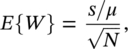
where s2 is the sample variance of the measured intensity components and μ is the sample mean. Jacobsen states categorically that this reasoning is “specious” and “fallacious” and moreover can lead to the requirement of a prohibitively large number of discrete measurement points [104]. Jacobsen states that “point measurements cannot possibly be modeled as independent repeated trials (in a probabilistic sense) and therefore (such) results cannot be regarded as independent random variables” [104]. In fact, Jacobsen states that the sample values become progressively more correlated as N increases, and the suggestion by Hubner [105] on reducing the number of measurement positions does not sufficiently address the fundamental problem with Eq. (8.74). Jacobsen also states that the modification suggested by Hubner [105] of bisecting the enveloping surface to reduce the number of measurement points, or the similar modification suggested by Bockhoff and Taillifet [106] do not overcome the fundamental problem with Eq. (8.74). Jacobsen concludes that the “scanning technique is at least as accurate as sampling at discrete points, or indeed more accurate” [104].
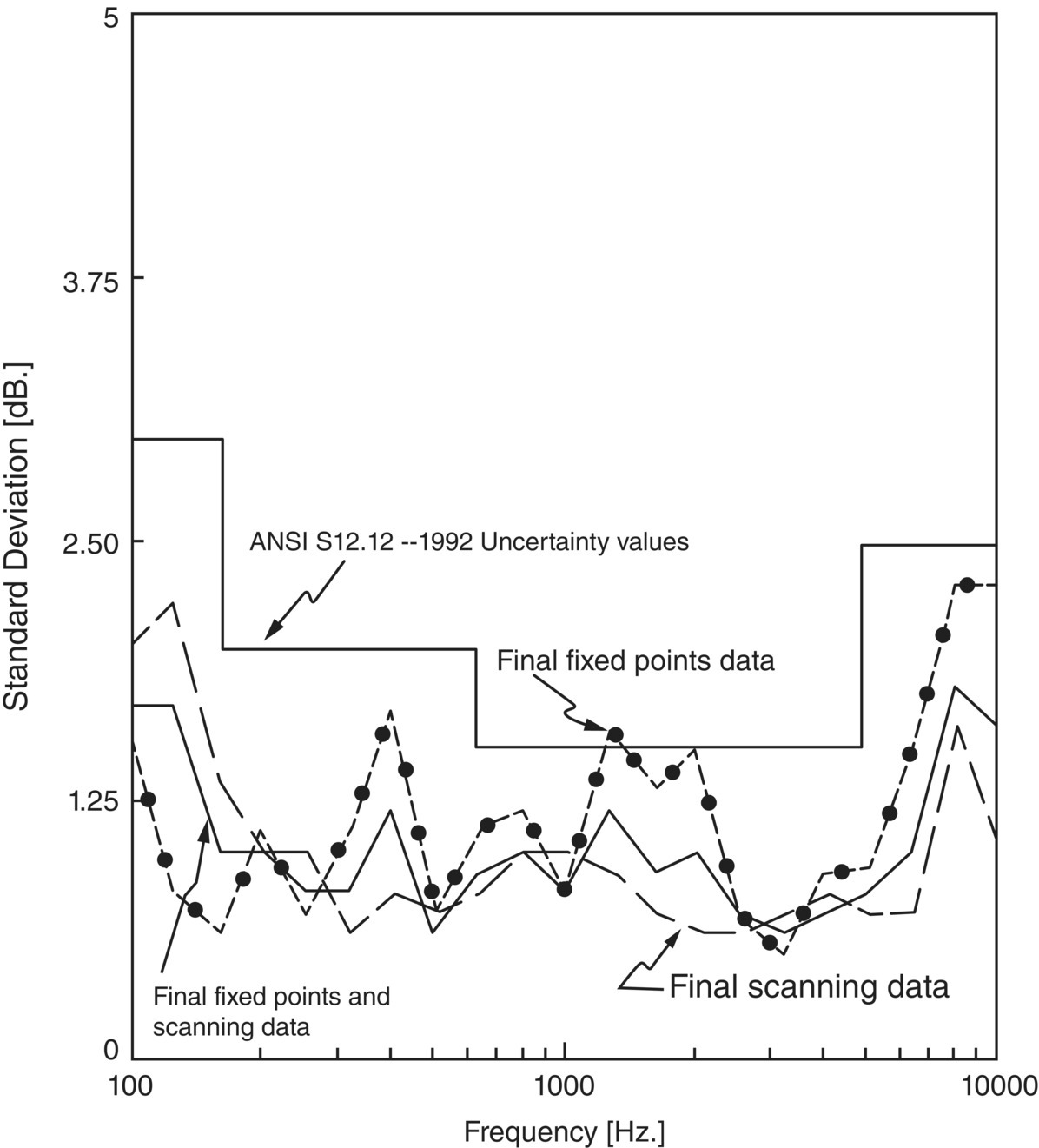
The ANSI S12.12 Committee initiated a round robin of its draft standard ANSI S12.12‐198X in 1988. Measurements were made of the sound power of a reference sound power source (Acculab RSS‐101) by 16 different laboratories [107]. The standard deviation results are plotted in Figure 8.70. In general, it was found that the estimates of sound power obtained from scanning had a smaller standard deviation that these obtained with fixed points in most one-third octave bands, except those below 200 Hz. It is also observed that the standard deviations in the final scanning sound power results are less than the uncertainty values stated in the ANSI standard. Also, the standard deviation in the A‐weighted sound power level determinations was 0.4 dB using both fixed points and scanning measurements [105].
The ANSI S12.12 standard allowing both scanning and fixed point measurements was published in 1992. The ISO 9614‐1 standard for fixed point measurements was published in 1993 and the ISO 9614‐2 standard for scanning was published in 1996.
Several international and national standards for the measurement of sound intensity have been completed:
- ISO (International Organization for Standardization) 9614‐1 Acoustics – Determination of Sound Power Levels of Noise Sources Using Sound Intensity – Part 1: Measurement at Discrete Points, 1993.
- ISO (International Organization for Standardization) 9614‐2 Acoustics – Determination of Sound Power Levels of Noise Sources Using Sound Intensity – Part 2: Measurement by Scanning, 1996.
- ISO (International Organization for Standardization) 9614‐3 Acoustics – Determination of Sound Power Levels of Noise Sources Using Sound Intensity – Part 3: Precision Method foe Measurements by Scanning, 2002.
- IEC (International Electrotechnical Commission) 1043 Electroacoustics – Instruments for the Measurement of Sound Intensity, 1993.
- ISO (International Organization for Standardization) 15 186 – 1 Acoustics‐Measurements of Sound Insulation in Buildings and Building Elements Using Sound Intensity – Part 1: Laboratory Measurements, 2000
- ISO (International Organization for Standardization) 15 186 – 2 Acoustics‐Measurements of Sound Insulation in Buildings and Building Elements Using Sound Intensity – Part 2: Field Measurements, 2003.
- ANSI (American National Standards Institute) S12.12‐1992 Engineering Method for the Determination of Sound Power Levels of Noise Sources Using Sound Intensity.
- ANSI (American National Standards Institute). S1‐12‐1994 Instruments for the Measurement of Sound Intensity.
- ASTM International Standard Test Method for Laboratory measurement of Airborne Transmission Loss of Building partitions and Elements using Sound Intensity – ASTM E2249‐02 (2008), 2009.
Leave a Reply