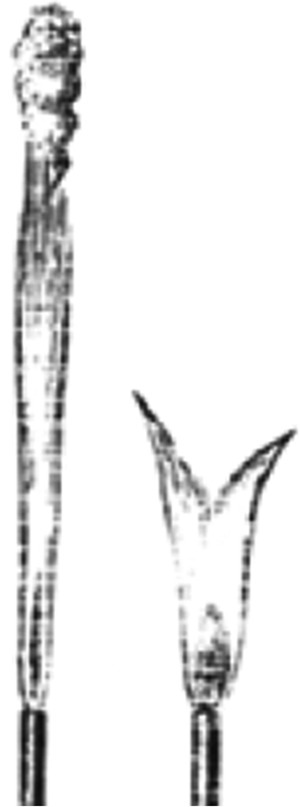
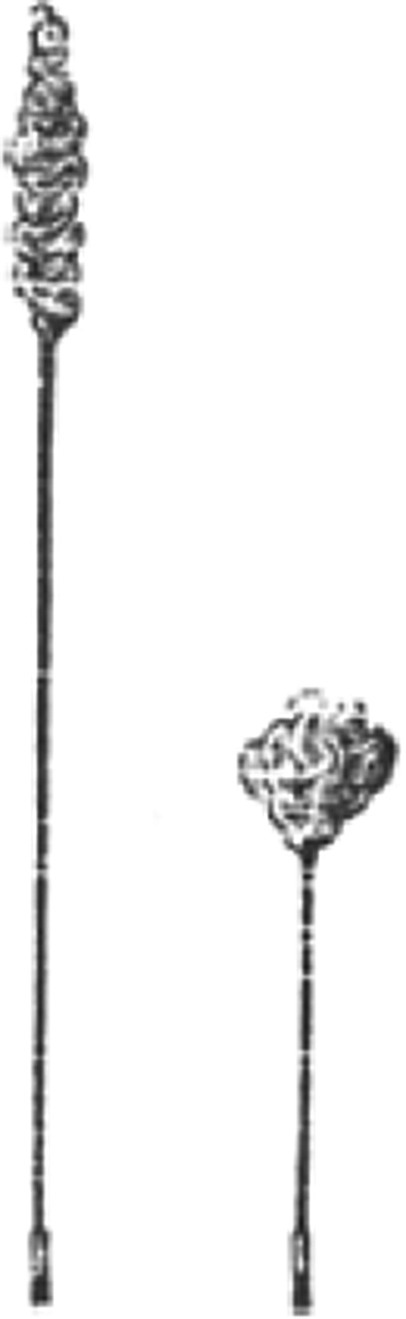
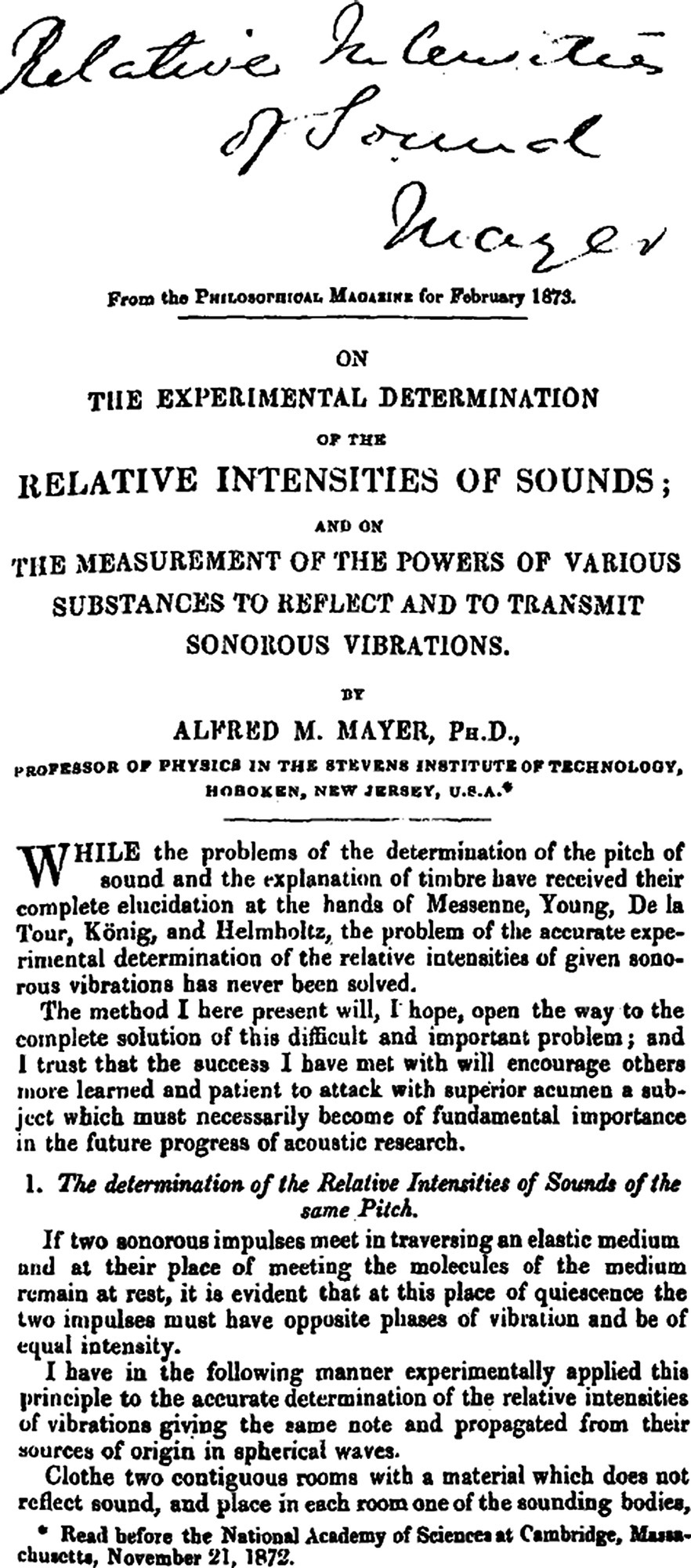
It is hard to realize that engineers and scientists have only been able to make quantitative acoustical field measurements with transducers for the last century. It is true that many scientists had previously been making qualitative acoustical studies. Osborne Reynolds describes the use of bells, the human voice and ear in his studies of acoustical reciprocity in 1875 [1]. Soon after in 1876 Lord Rayleigh used such devices as Tyndall’s sensitive flames and smoke jets [2] in his acoustical reciprocity studies [3], (see Figures 8.1 and 8.2). We know that several scientists including Mayer, Koenig, Helmholtz, and Rayleigh were concerned with the development of methods to measure the intensity of sound (throughout the 1870s). (See Figure 8.3, the first page of Rayleigh’s copy of a paper by Mayer on which Rayleigh inscribed the title himself.) Mayer in this paper clearly describes experimental studies concerning the cancelation of sound waves of the opposite direction and phase with the same sound intensity. It is not until 1882 that we see the birth of the first quantitative acoustical transducer with the arrival of the now famous Rayleigh disk [3]. (See Figure 8.4.) Surprisingly enough, the design of the disk was conceived accidently during Rayleigh’s work on the absolute measurement of the ohm [4, 5].
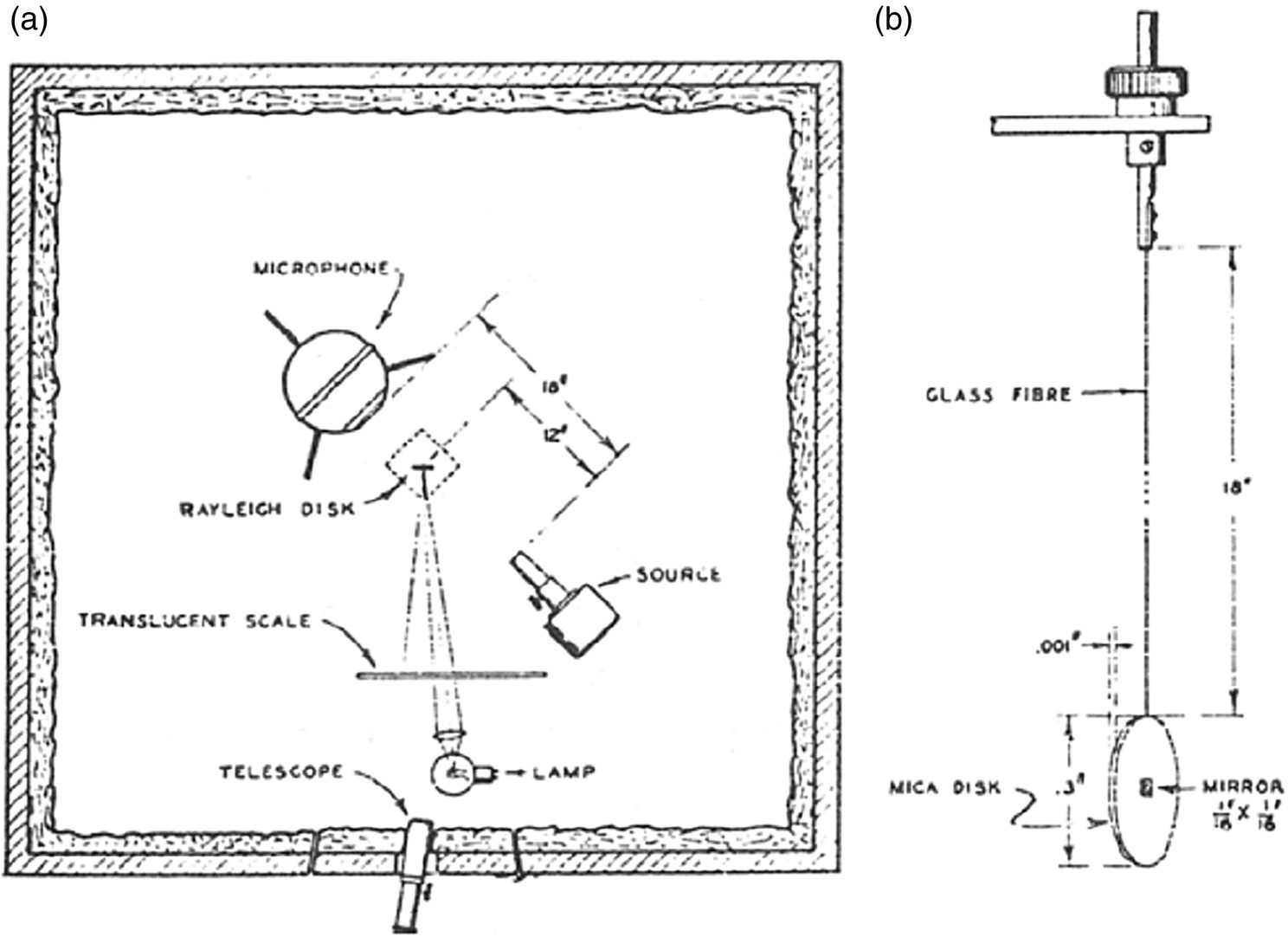
Although the title of Rayleigh’s paper suggests that the Rayleigh disk measures sound intensity, it is actually a device for measuring the mean square acoustic particle velocity, as has been shown by Koenig. Rayleigh’s disk was a great step forward, in quantitative acoustical measurement, and was for many years the standard instrument for acoustical calibration – however it is hardly a practical instrument for “field” measurements.
The next important advance was the development of the telephone transmitter into a reliable electroacoustic transducer (microphone) [6]. Several researchers assisted in this development including Wente, Arnold, Crandall, and Fletcher [7]. Wente’s papers in 1917 and 1922 describe a sophisticated device which he called a condenser transmitter or electrostatic transmitter from which modern condenser microphones are descended [8, 9]. Although Wente suggests in his titles and text that the condenser microphone measures sound intensity, it is actually a device for measuring sound pressure (a scalar quantity). The sound intensity is of course a vector quantity and may be defined to be the time average rate of flow of sound energy through unit area (with the vector directed perpendicular to the area). Most intensity devices which have been proposed have required the use of two or more similar or different acoustical transducers. Unfortunately until the early 1980s, these intensity devices appear to have suffered from calibration or other problems.
Olson in 1932 was probably the first to describe a device designed to measure the real sound intensity vector [10, 11]. Olson’s device consisted of two closely‐spaced pressure microphones. In 1941 Clapp and Firestone used a device consisting of two crystal pressure microphones combined with a ribbon velocity microphone [12]. Their device appeared to suffer from temperature instability and internal resonances of the ribbon. Bolt and Petrauskas in 1943 described an acoustic impedance meter using two microphones to measure the sound pressure sum and sound pressure difference [13]. This principle of operation is much the same as that used in most sound intensity devices today. In 1955 Baker described an acoustic intensity meter consisting of a hot‐wire anemometer (to measure particle velocity) and a pressure microphone [14]. Because this device requires a steady air flow and is sensitive to undesired air movements it appears unsuitable for practical applications. In 1956 Schultz used an intensity probe made from two electrostatic microphones mounted back‐to‐back and later discussed problems with intensity measurements in reverberant enclosures [15, 16]. In 1973 Burger et al. and van Zyl and Anderson described sound intensity measurements with a probe made from a pressure sensitive microphone and a velocity‐sensitive microphone [17, 18]. Credit for first demonstrating in 1979 the reliability of the two microphone intensity technique for directly measuring sound power of a large machine such as a diesel engine should perhaps go to Chung, Pope, and Feldmaier [19]. Reinhart and Crocker published similar results in 1980 [20]. Also in 1980, Crocker et al. first demonstrated the use of the sound intensity method to measure the sound transmission loss of structures [21, 22].
Leave a Reply