Since the human hearing range extends from about 20 to 20 000 Hz, it is desirable that the frequency response of microphones and noise measurement systems should be “flat” between these limits as shown in Figure 7.6. For certain types of measurements (e.g. for measurement of sonic booms or explosive blasts), it may be necessary to measure sounds that contain frequencies lower than about 20 Hz. For scale‐model studies or for the measurement of noise environments or structures subject to fatigue, it may be necessary to measure to frequencies higher than 20 000 Hz. We will first discuss the different types of microphones used in noise measurements and their acoustical properties and then methods by which microphones are calibrated. More details about microphones are given in Ref. [2] and of their calibration in Ref. [7]. Chapter 57 in Ref. [8] also has detailed information about microphone calibration.
7.4.1 Types of Microphones for Noise Measurements
An acoustical transducer is a device that converts some property of a sound field into an electrical signal. The most common device is the microphone designed to measure sound pressure. Some transducers have been designed, however, to measure sound particle velocity, sound pressure gradient, and sound intensity.
Microphones may be divided into three main classes: communication, studio, and measurement microphones [2]. The discussion here mainly concerns noise measurement microphones. There are three main types of microphone used for noise measurements: (i) polarized condenser microphones, (ii) prepolarized condenser microphones (sometimes called electret microphones), and (iii) piezoelectric microphones. The polarized condenser microphone possesses a thin diaphragm under tension and must be provided with an external polarizing voltage that is applied between the diaphragm and the backplate. On the other hand, the prepolarized condenser (electret) microphone avoids the need for a polarizing voltage by the provision of a thin layer of electrically charged material, which is normally deposited on the backplate during manufacture.
Condenser microphones, because of their stability and well‐defined mechanical impedance, are the ones mostly preferred for noise measurements. They do have drawbacks of fragility and sensitivity to humidity, however. Piezoelectric microphones are more robust than condenser microphones. They possess a stiff diaphragm that is coupled to a piezoelectric crystal or ceramic element.
Microphones may be divided into directional and nondirectional (or omnidirectional) types. In some cases, directional microphones may be useful, such as in the localization of noise sources. Most noise measurements are made with nominally omnidirectional microphones, although even these types become somewhat directional at high frequency, at which the dimensions of the microphone become comparable with the acoustic wavelength.
Microphones may be further subdivided into three main types: (i) free‐field, (ii) pressure‐field, and (iii) diffuse‐field microphones. The frequency responses of these microphones are adjusted so that they have an essentially flat frequency response when placed in these different sound fields. Today TEDS (transducer electronic data sheet) microphones with built‐in sensitivity are also available. These microphones have built‐in information about the response required in different sound fields. So such TEDS microphones can be used in all of the three sound fields described above if they are used in conjunction with information loaded into the operating system of the associated analyzer. Reference [2] describes the design and principles of operation of the main types of microphones and furthermore explains how the microphone parameters, physical properties, and design may be chosen to obtain the required microphone sensitivity, frequency response, and dynamic range. Reference [1] also addresses some of the same considerations with respect to noise measurements.
a) Condenser Microphones
Because of its uniform sensitivity, low distortion, and portability, the invention of the condenser microphone in 1917 by E.C. Wente revolutionized electroacoustics, and it soon became an integral part of any high‐quality sound system. However, although the polarized condenser microphone has significant advantages, it also suffers from some disadvantages: specifically its rather low sensitivity, high internal impedance, and the need for a polarizing voltage. The very large, almost distortionless electronic signal amplification that can now be achieved has made the lack of sensitivity of the condenser microphone unimportant, and, because of its smooth sensitivity over a very wide frequency range and its well‐defined geometry, the condenser microphone is still preferred for use in many noise measurement applications [9].
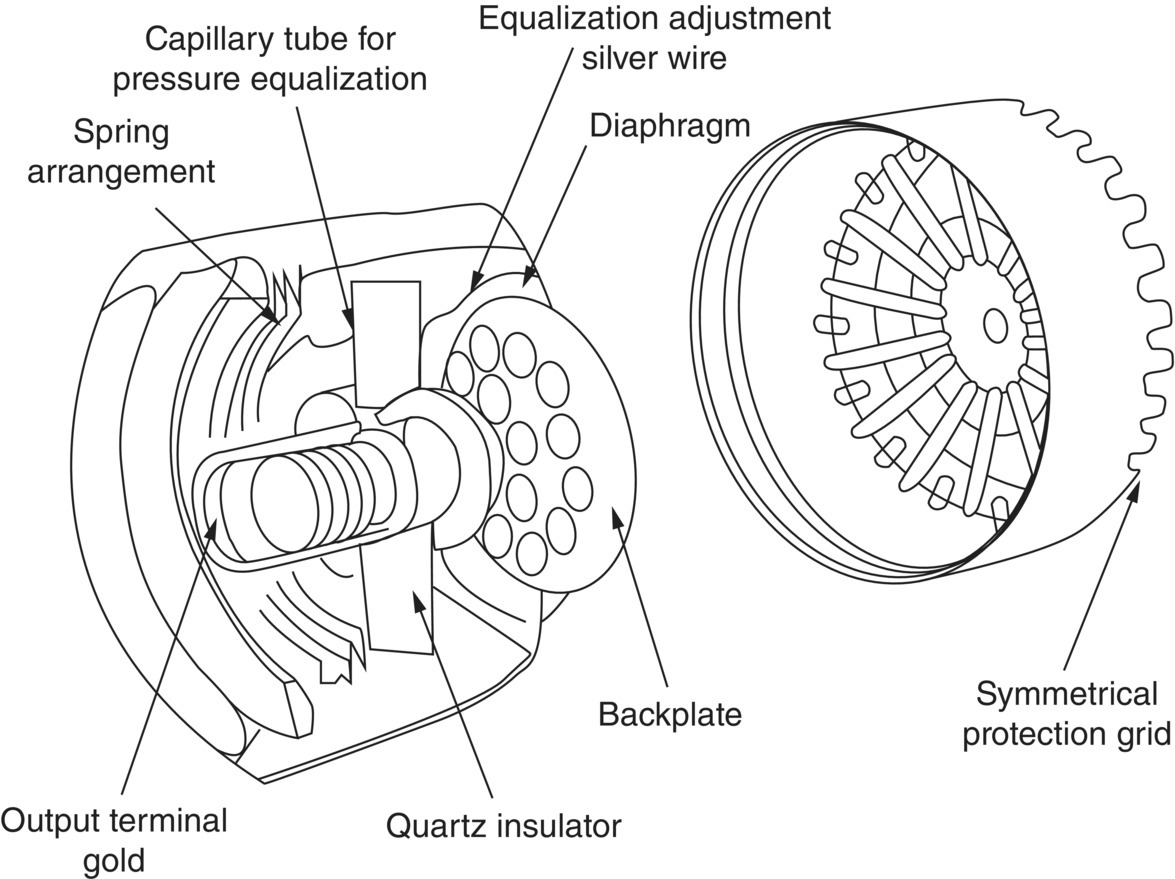
Figure 7.8 shows a diagram of a 1‐in. condenser microphone. The condenser microphone consists of a thin metal diaphragm stretched under tension and spaced a short distance from an insulated backplate. The diaphragm and backplate constitute the electrodes of the condenser. Holes are drilled in the backplate to provide the required air damping for the diaphragm. A small hole is provided to equalize the static pressure across the diaphragm, provided that it changes slowly. This hole usually determines the lower cutoff frequency of the microphone. Some discussion of the electrical circuit of the system and the theory, design, and construction of condenser microphones is given in Ref. [2] and in Chapters 110 and 112 of the Handbook of Acoustics [8]. Other authors have also discussed the electrical theory in some detail [10–12]. It is normally necessary to remove the protection grid during microphone calibration [7].
b) Prepolarized (Electret) Microphones
In the 1970s, a new type of precision microphone became commercially available. This microphone is basically a condenser microphone; however, no direct current (dc) polarization voltage is needed since the electret’s foil diaphragm and/or the backplate is permanently polarized during manufacture. The polarization voltage is created by embedding and aligning static electrical charges into a thin layer of material, which is deposited on the microphone diaphragm or backplate.
The first electret microphones used diaphragms made from an insulating material that carried the permanent electrical charge. The diaphragms of electret microphones made in this way have to be quite heavy in order to carry the permanent electrical charge material. Heavy diaphragms have several disadvantages and result in a low resonance frequency peak. Most high‐quality electret microphones used for noise studies now have the permanently charged material attached to the stationary backplate instead of the diaphragm. In this way, much thinner diaphragms can be used, made of the same metal‐coated plastic material used in condenser microphones. Such microphones have a high resonance frequency peak and an overall performance almost rivaling the best condenser microphone. The thin diaphragm and the perforated backplate comprise the two plates of the condenser. Preamplifiers are still needed, and in some recent electret microphones miniature preamplifiers are built into the microphones themselves. See Ref. [2] and Chapters 110 and 112 of the Handbook of Acoustics [8]. Figure 7.9 shows a cross‐sectional diagram of a typical electret microphone [13].
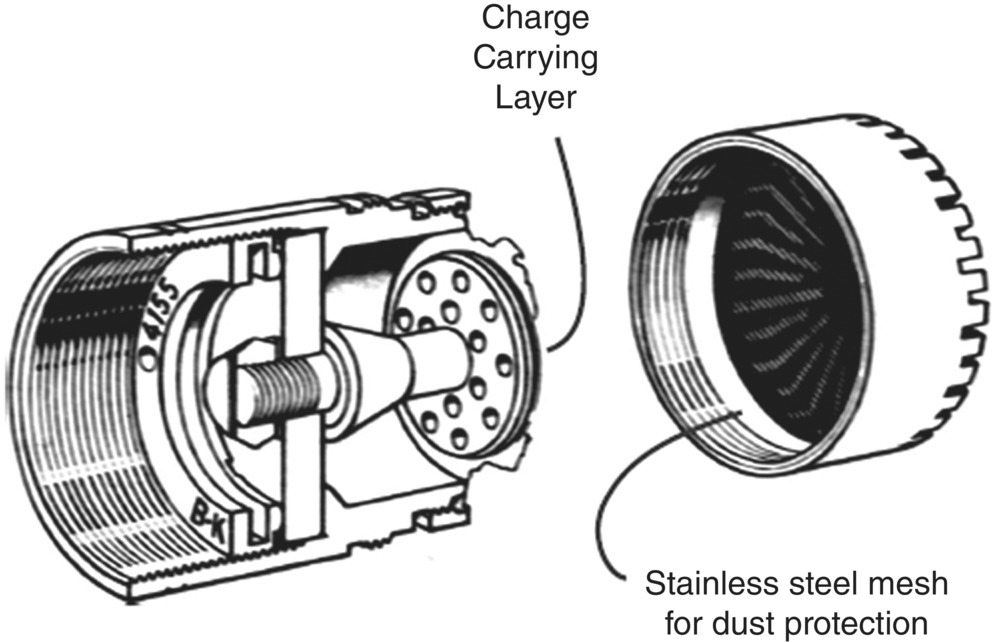
The electret microphone has the following advantages: (i) no polarization voltage needed, (ii) rugged construction, (iii) large capacitance (about 500 pF), and hence, loading is a lesser problem than with the condenser microphone, and (iv) low cost [11, 14, 15].
c) Piezoelectric Microphones
The design and construction of piezoelectric transducers is discussed in Ref. [2] and in Chapters 110 and 112 in Ref. [8] and in varying detail by several other authors [16, 17].
Piezoelectric crystals may be cut and used in many different orientations. If a slice is cut from a piezoelectric crystal and pressures applied to the opposite faces of the slice causing a deformation, then equal and opposite charges are produced on the opposite faces of the slice with an electric potential developed between the faces. Crystals are often directly exposed to liquids (e.g. as hydrophones) where the high mechanical impedance of the liquid is not a disadvantage. In gases, the large acoustical/mechanical impedance mismatch is a disadvantage, and piezoelectric materials are usually used in conjunction with a diaphragm [2].
Figure 7.10 shows a cross‐sectional view of a commercial piezoelectric microphone. Much thicker diaphragms are normally used with piezoelectric than condenser microphones (usually about 50 times greater). This inevitably leads to a lower resonance frequency for the diaphragm (assuming the density of the diaphragm material is the same). To obtain a flat free‐field response, it is necessary to damp this resonance overcritically. Hence the upper frequency response is poorer than with a condenser microphone because the mass‐controlled region is entered at a lower frequency.
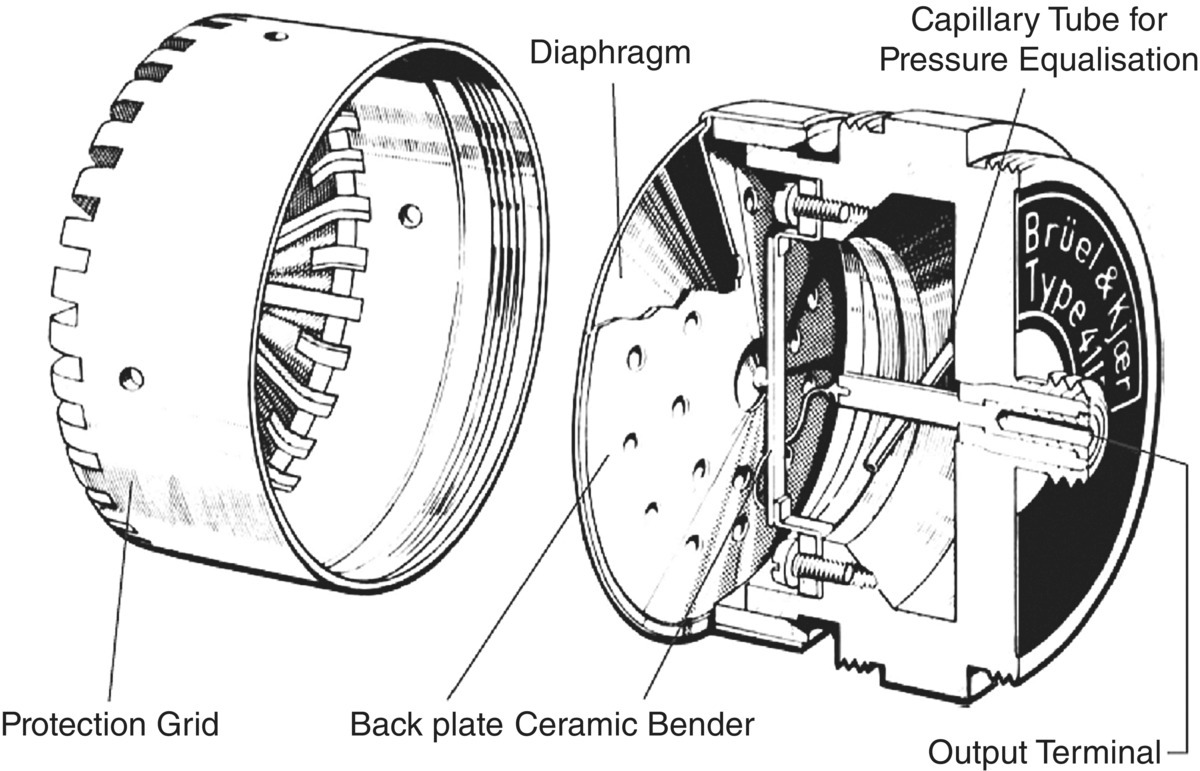
The diaphragm is connected to a ceramic bender element. A bimorph simply supported beam bender element is most often used, although sometimes cantilever benders are used [16, 17]. The force needed to produce a voltage from a crystal or ceramic slice in pure compression is quite large. However, if a thin bar or beam is cut from a crystal in a suitable orientation, a voltage is produced across the beam as it is bent [5].
Metal foil is usually cemented to the outside surfaces of the crystal, and the two foils with the crystal in between form a condenser of the solid dielectric type. It is usual to use two bars in conjunction to produce a bimorph. Electrical connections may be applied in two ways to the bimorph to produce either parallel or series connections [5].
Other microphones are used for many communication purposes but not normally for precision noise measurements. The moving coil microphone has been in use for many years but is less valuable in noise work since its frequency response is not very smooth and is poor at high frequencies. Also, its sensitivity is low. However, it does have some advantages that make it ideal for some applications [2].
Leave a Reply