The magnitude of the frequency response, R(f), of an ideal microphone is given by Eq. (7.2a) as the frequency of the sound pressure p is changed. The magnitude of the frequency response, R(f), or an ideal accelerometer is given by Eq. (7.2b) as the frequency of the vibration a is changed. Figure 7.6 shows the frequency response of an ideal microphone used for noise measurements or an ideal accelerometer used for vibration measurements. In practice, microphones and accelerometers can only approach the ideal frequency response in Figure 7.6. Resonance peaks of the diaphragm of the microphone or the inertial mass of the accelerometer are usually observed in the high‐frequency range. These peaks are normally suppressed by the addition of damping or some other means at the transducer design stage. Note that for some measurements (e.g. explosive blasts with a microphone and shock events with an accelerometer) knowledge of the phase frequency response of the transducer is also important. For such measurements of impulsive phenomena, the additional requirements of zero or linear phase shift with frequency are needed for microphones and accelerometers, respectively.
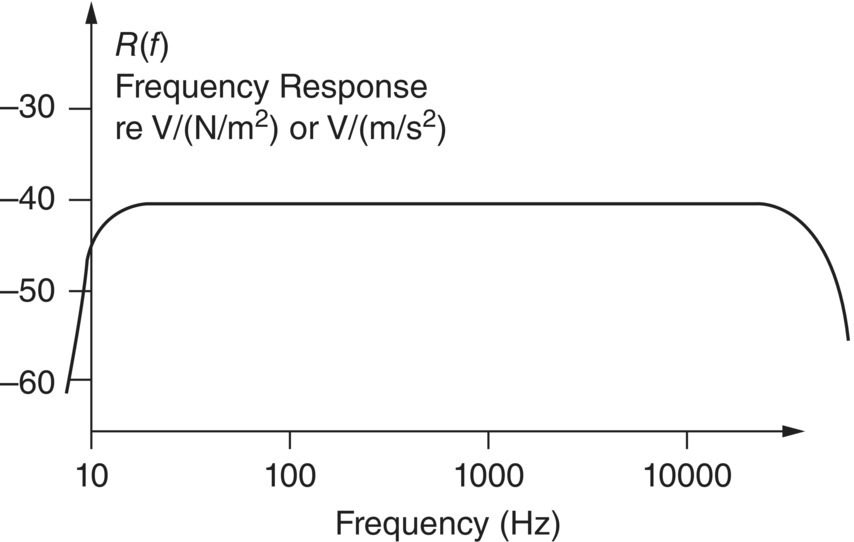
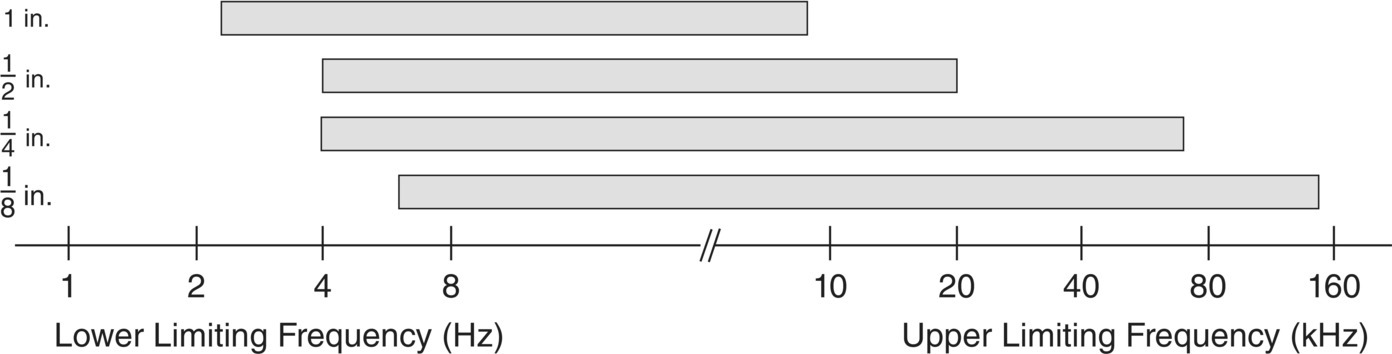
Figure 7.7 shows the frequency response range of four different diameter condenser microphones [6]. It is observed that the smaller diameter microphones have the largest usable frequency range. The 1/8‐in. diameter microphone has a usable range from about 5 Hz to about 150 kHz. The 1‐in. microphone on the other hand has a much more restricted usable frequency range from about 2 Hz to only about 10 kHz.
Leave a Reply