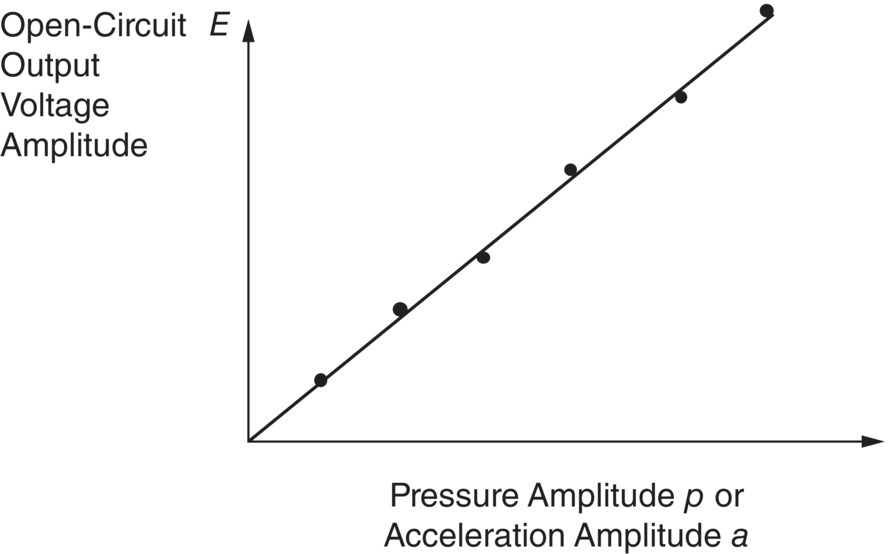
An ideal microphone (or accelerometer) together with its measurement system should have an output voltage amplitude E that is proportional to the exciting pressure amplitude p (or acceleration amplitude a) (see Figure 7.2). The ratio of open‐circuit output voltage to input pressure (or acceleration) is normally called the sensitivity Mp:
(7.1)
The transducer sensitivity [V/(N/m2) or V/(m/s2)] depends on the microphone (or accelerometer) design. (Different types are discussed in Refs. [2, 4] and later in Sections 7.4.1, 7.5.1, and 7.5.2 of this chapter).
In the case of noise measurements with very low sound pressure amplitudes, electrical noise will exceed the voltage signal generated by the microphone, and this will govern the low signal amplitude limit for measurements. With very high sound pressure amplitudes, the diaphragm displacement may become so large that the voltage generated is no longer proportional to the displacement. Nonlinearity then sets the upper amplitude use limit [2]. For sound pressures somewhat above the nonlinear limit, physical damage to the microphone can occur.
The situation is similar for vibration measurements made with seismic mass accelerometers. For very high vibration amplitudes, the accelerometer displacement may become so large that the voltage generated is no longer proportional to the displacement. Nonlinearity again sets an upper use limit. For displacements above the nonlinear limit, physical damage to the accelerometer can occur. Large accelerometers are normally more sensitive than small ones, and this is advantageous in many applications; but large heavy accelerometers cause more mass loading problems to start to occur at a lower frequency than small lightweight accelerometers [5].
If Figure 7.2 is plotted on a logarithmic scale, Figure 7.3 is obtained. The reference voltage Eref is normally taken as 1 V, while the reference sound pressure pref is usually taken as 20 μPa, and the reference acceleration is normally taken as 1 μm/s2.
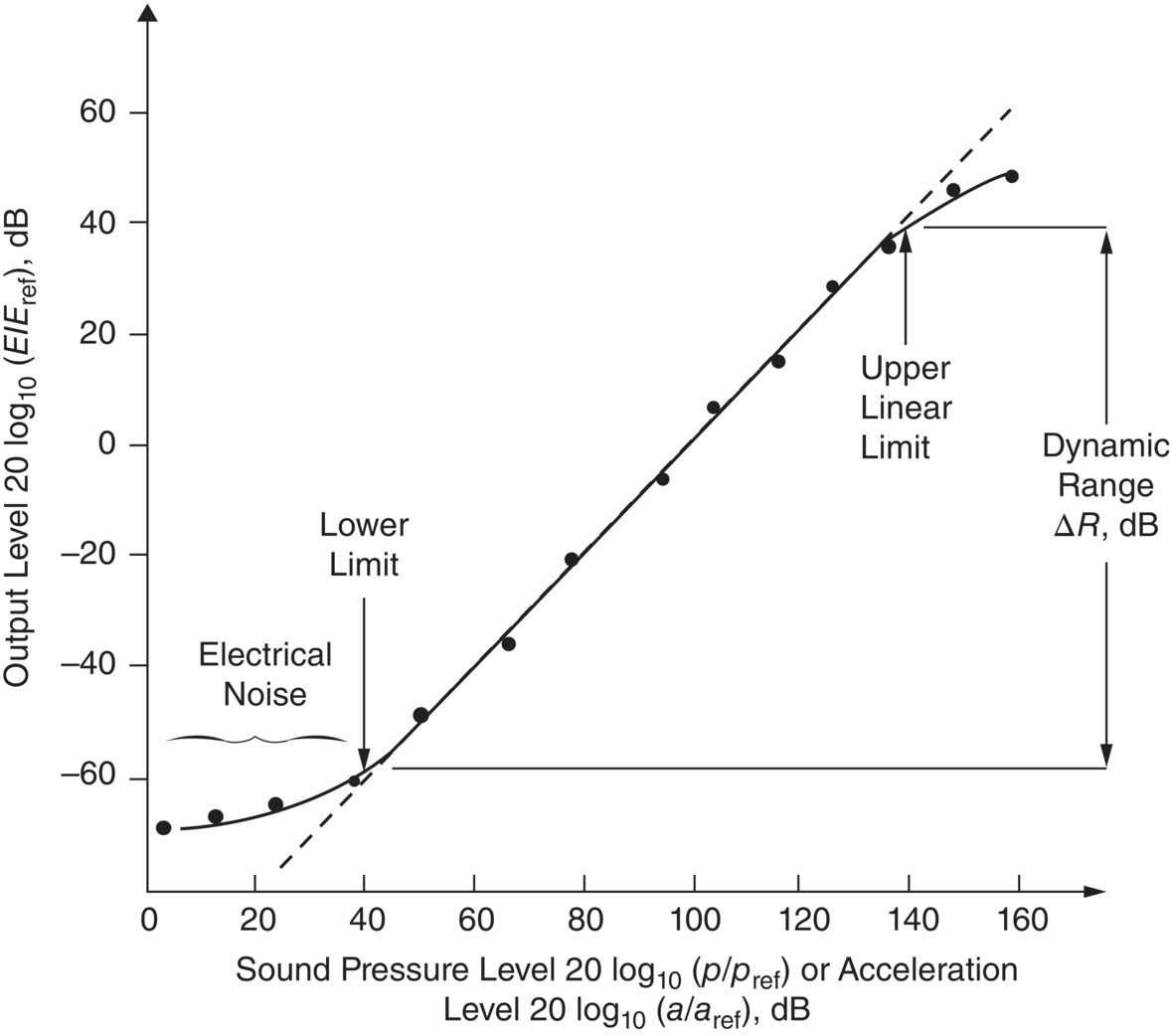
A microphone or accelerometer has a usable range of operation between its upper and lower amplitude limits. Thus, at any frequency the microphone or accelerometer response magnitude is normally given by subtracting the x‐ from the y‐ axis in Figure 7.3, and the range ΔR in which the microphone or accelerometer response R is constant is known as the dynamic range:
(7.2a)
or
(7.2b)
EXAMPLE 7.1
A 1/2 in. microphone has a sensitivity of 12.5 mV/Pa. Calculate the output voltage amplitude produced by a sound pressure level of 74 dB.
SOLUTION
The sound pressure of 74 dB is p = pref × 10Lp/20 = 2×10−5 × 1074/20 = 0.1 N/m2.
Since 1 Pa = 1 N/m2, from Eq. (7.1) we obtain the output voltage as

EXAMPLE 7.2
A 1‐in. microphone has a sensitivity of 50 mV/Pa. What is the sound pressure level that produces an output voltage amplitude of 1 mV?
SOLUTION
From Eq. (7.1): p = E/Mp = 1/50 = 0.02 N/m2. Then, the corresponding sound pressure level is

EXAMPLE 7.3
A sound level meter (SLM) is calibrated to read in decibels (dB) (ref: 20 μPa) when used with a microphone of sensitivity 50 mV/Pa. The microphone is then replaced by an accelerometer, with a sensitivity of 2 mV/m/s2, attached to a vibrating surface. If the reading is 78 dB, what is the rms acceleration of the surface?
SOLUTION
First we determine the equivalent voltage of 78 dB. If the level were a sound pressure level, p = 2 × 10−5 × 1078/20 = 0.16 N/m2, so the output voltage is E = Mp×p = 0.05 × 0.16 = 8 mV. Now, considering the sensitivity of the accelerometer, the corresponding rms acceleration is

Leave a Reply