In some community noise measures, corrections are applied to community noise levels to account for pure‐tone components or impulsive character, seasonal corrections (summer or winter when windows are always closed), type of district (rural, normal suburban, urban residential, noisy urban, very noisy urban), and for previous exposure (such corrections are similar to those for NR).
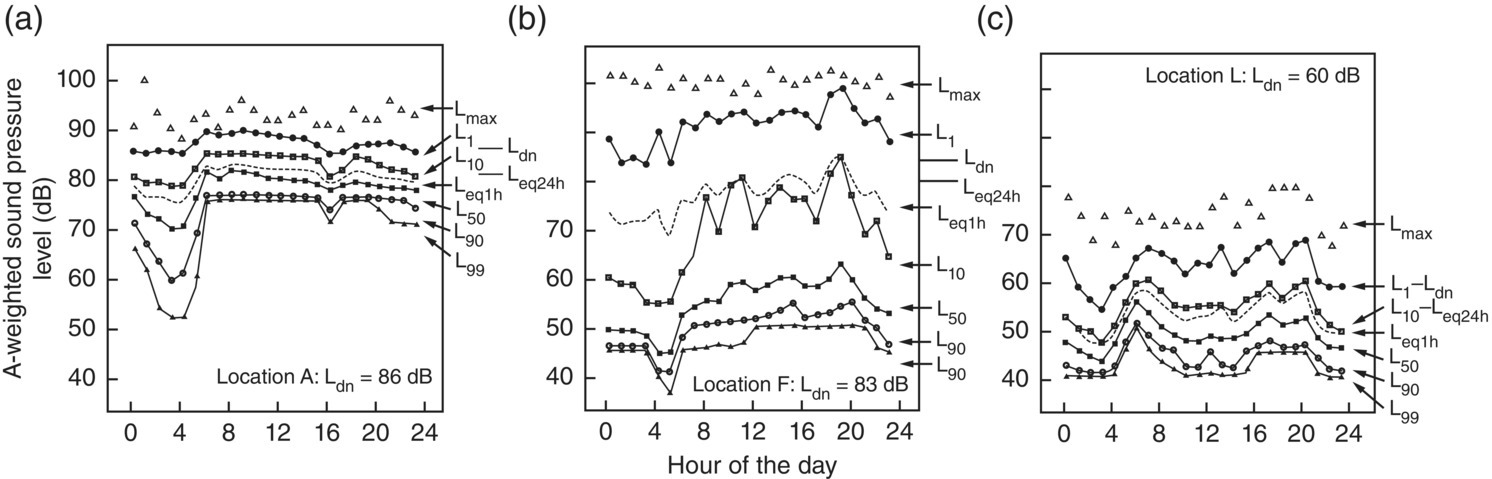
Figure 6.15 gives three examples of the A‐weighted SPLs measured in a community over a 24‐hour period [27]. The triangles in the three figures are the maximum levels read from a graphic level recorder. The continuous lines are percentile levels measured for hour‐long periods throughout the 24 hours. The highest percentile measure L1 does not represent the maximum levels well, which are presumably mostly higher level, short‐duration sounds (occurring less than 1% of the time). It is observed in Figure 6.15a and 6.15b that although the day–night levels Ldn are only 3 dB different (86 and 83 dB), there is a much greater fluctuation in SPL with time in Figure 6.15b. This example is for a location near a major airport, and the fluctuation in level would suggest that the noise environment in location 6 would be much more annoying than in location 1 (near a freeway). Figure 6.15c illustrates another quite different distribution of A‐weighted SPLs with time.
In the United States, the A‐weighted Leq and Ldn are normally used to characterize community noise. However, the Department of Housing and Urban Development (HUD) also recognizes the usefulness of L10 in some instances. In other countries the A‐weighted Leq is mainly used for community noise studies rather than Ldn. International standards on the description and measurement of environmental noise [53] recommend the use of A‐weighted Leq and rating levels (which are A‐weighted Leq values to which tone and impulse adjustments have been made). These standards also recommend that in some circumstances it may be useful to determine the distribution of A‐weighted SPLs by determining percentile levels such as L95, L50, and L5.
In California, some state legislation requires the use of the community noise exposure level (CNEL) rather than the day–night level Ldn. The two descriptors are similar except that the CNEL (LCN) like DENL (Lden) has three periods instead of two. Besides the night penalty of 10 dB, an evening penalty of 5 dB is applied with CNEL. CNEL is defined [54] as
(6.8)
where Ld is the average 12‐hour day HNL (hourly noise level), Le is the average 3‐hour evening HNL, and Ln is the average 9‐hour night HNL.
The hourly noise level is given by
(6.9)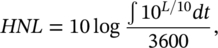
where L is the instantaneous A‐weighted SPL, and t is the time in seconds. The integral is calculated and summed. HNL is usually computed electronically. The CNEL has also been extensively used to evaluate airport noise and assess environmental noise transmission into buildings in California [55].
EXAMPLE 6.10
Determine the CNEL from the 24 one‐hour average sound pressure levels given in Table 6.3.
SOLUTION
In this case the evening penalty of 5 dB is applied to A‐weighted SPLs occurring between 19:00 and 22:00 hours. Thus Ld is now calculated considering measurements 1–12 giving

The evening average level is obtained from measurements 13–15 as

The nighttime average level is calculated considering measurements 16–24 resulting

Inserting the appropriate values in Eq. (6.8) we obtain

Leave a Reply