For noise that fluctuates in level with time it is useful to define the equivalent continuous SPL, LAeq, which is the A‐weighted SPL averaged over a suitable period, T. This average A‐weighted SPL is also sometimes known as the average sound level LAT in ANSI documents, so that LAeq = LAT. The equivalent SPL is defined by
(6.5)
where pA is the instantaneous sound pressure measured using an A‐weighting frequency filter and pref is the reference sound pressure 20 μPa. The averaging time T can be specified as desired to range from seconds to minutes, hours, weeks, months, and so forth. L(t) is the short‐time average. See Figure 6.11a. Li can be a set of short‐time averages for Lp over set periods. If the SPLs, Li, are values averaged over constant time periods such as one hour, then they can be summed as in Eq. (6.5). See Figure 6.11b.
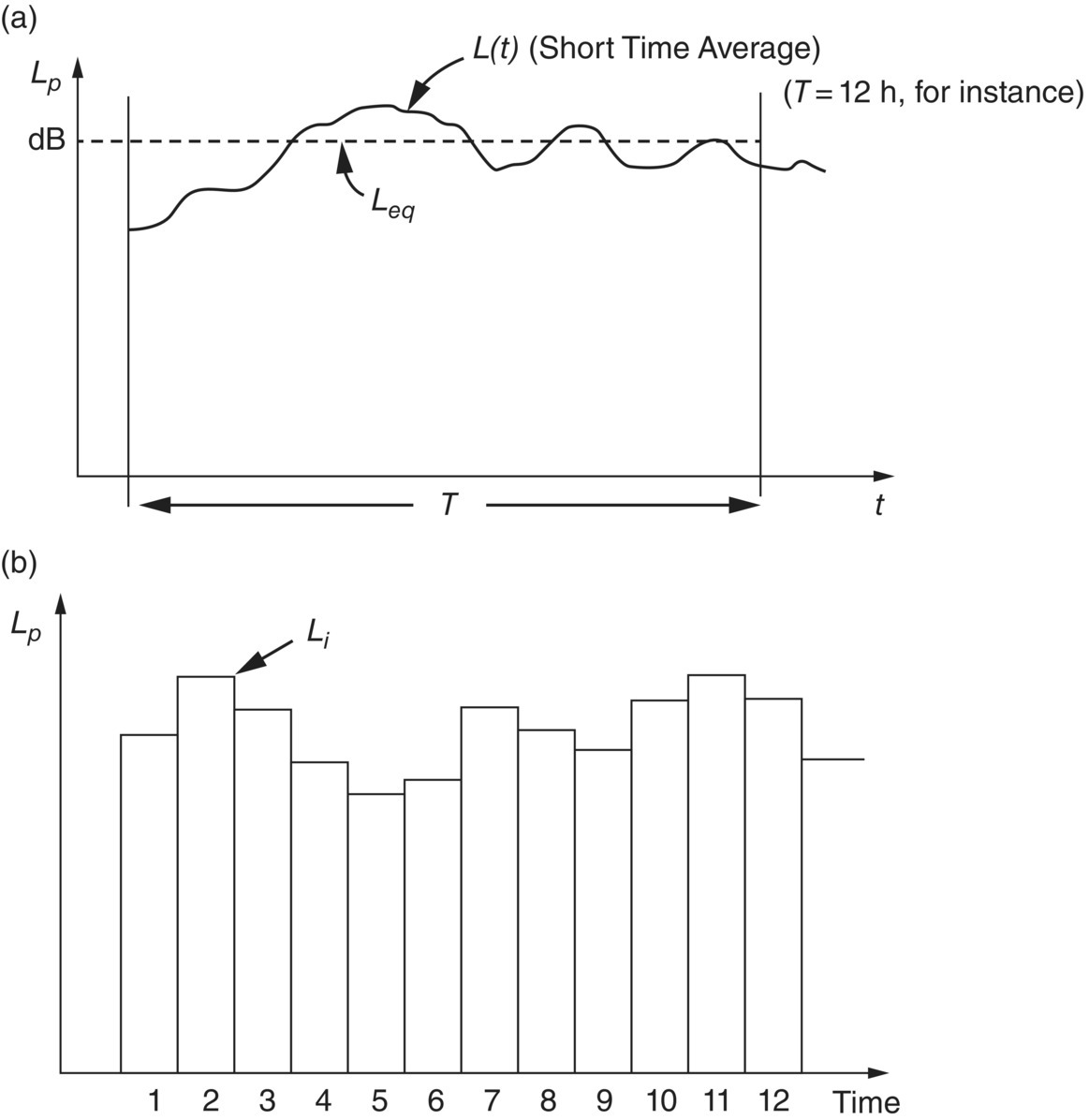
The average SPL (or the equivalent continuous SPL LAeq) can be conveniently measured with an integrating sound level meter or some other similar device. Since it accounts both for magnitude and the duration, LAeq has become one of the most widely used measures for evaluating community (environmental) noise from road traffic, railways, and industry [27–29]. LAeq has also been found to be well correlated with the psychological effects of noise [30, 31]. For community noise, a long‐period T is usually used (often 24 hours). In the literature LAeq is often abbreviated to Leq.
EXAMPLE 6.4
At one employee’s work station, the average A-weighted SPLs, Li = 100, 90, 91, 89, and 90 dB are obtained for five short, equal time intervals. Determine the average SPL LAeq.
SOLUTION
In this case, Eq. (6.5) gives LAeq = 10 × log[(1010 + 109 + 109.5 + 108.9 + 109)/5] = 95 dB.
Leave a Reply