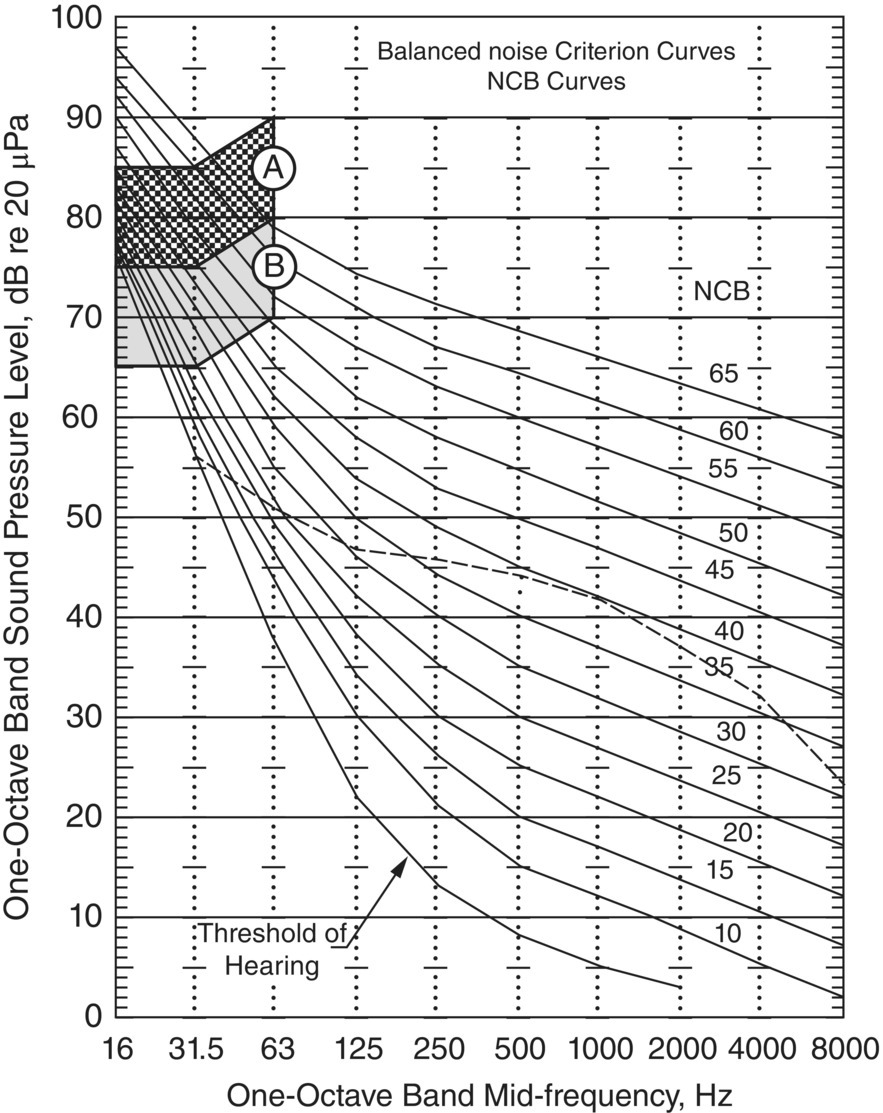
In 1989, Beranek [23, 24] modified the NC curves to include the 16‐ and 31.5‐Hz octave bands and changed the slope of the curves so that it is now −3.33 dB/octave between 500 and 8000 Hz. He also incorporated the A and B regions as specified by Blazier [25] in the RC curves. The rating number of a balanced noise criterion NCB curve is the arithmetic average of the octave band levels with mid frequencies of 500, 1000, 2000, and 4000 Hz. The result is a set of rating curves that are useful to rate air‐conditioning noise in buildings (see Figure 6.10). Recommended categories of NCB curves for different building interior spaces are presented in Section 6.16.1.
EXAMPLE 6.4
As an example of the use of the balanced noise criterion, a background noise spectrum from air-conditioning is plotted (as the dashed curve) in Figure 6.10. Evaluate the acceptability of such a noise spectrum according to the NCB curves.
Solution
The NCB is calculated from the formula NCB = ¼ (44 + 42 + 37 + 33) dB. Thus this background noise spectrum can be assigned a rating of NCB 39 dB. Such a noise spectrum might be just acceptable in a general office, and barely acceptable in a bedroom and living room in a house, but not acceptable at all in a church, concert hall, or theater (see Table 6.4).
Leave a Reply