Acceleration Frequency Weightings
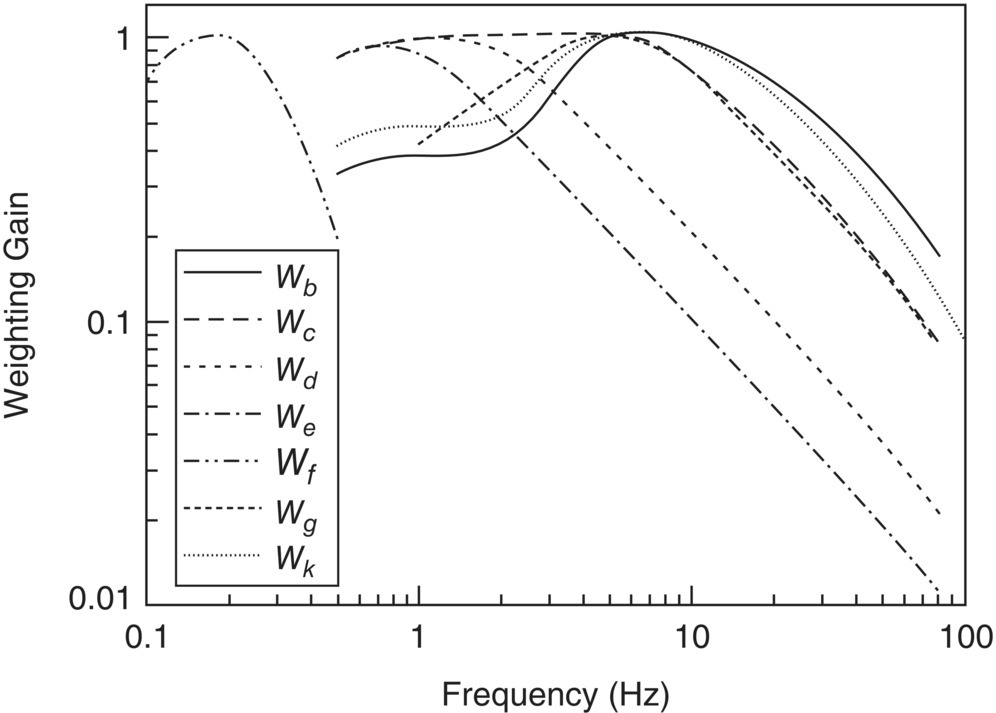
Human beings are more sensitive to some frequencies than to others. As seen in Figure 5.8, each part of the body has a corresponding natural frequency and each part will resonate over a range of exciting frequencies. In addition, this sensitivity depends on the direction in which the vibration is applied. No one person’s vibration sensitivity is exactly the same as any other and hence statistical human responses have been determined. These factors need to be considered when assessing harmful effects of vibration on humans. Therefore, different weighting curves have been proposed to account for frequencies to which the body is most and least sensitive. International and national standards define similar acceleration frequency weighting curves for predicting vibration discomfort. Figure 5.10 shows the frequency weighting curves for human response to whole‐body vibrations [52]. Appropriate weightings are applied to vibration frequency spectra between 0.1 and 100 Hz to assess whole‐body vibration effects. They are designated Wb, Wc, Wd, We, Wf, and Wg. The ISO standard defines an additional weighting curve, Wk, which is almost identical to Wb. The choice of the frequency weighting depends on the standard used, the effect of vibration which is being assessed (health, activity, comfort), the vibration input position on the body (seat, seat back, feet), and the direction of vibration (vertical or horizontal). Probably the most widely used of these frequency weightings is Wb which has been designed to reproduce human sensitivity to vertical motions.
In the case of hand‐transmitted vibration, all current national and international standards use the same frequency weighting (called Wh) over the frequency range from 8 to 1000 Hz (see Figure 5.11). This acceleration weighting is applied to each of the three axes of vibration at the point of entry of the vibration to the hand.
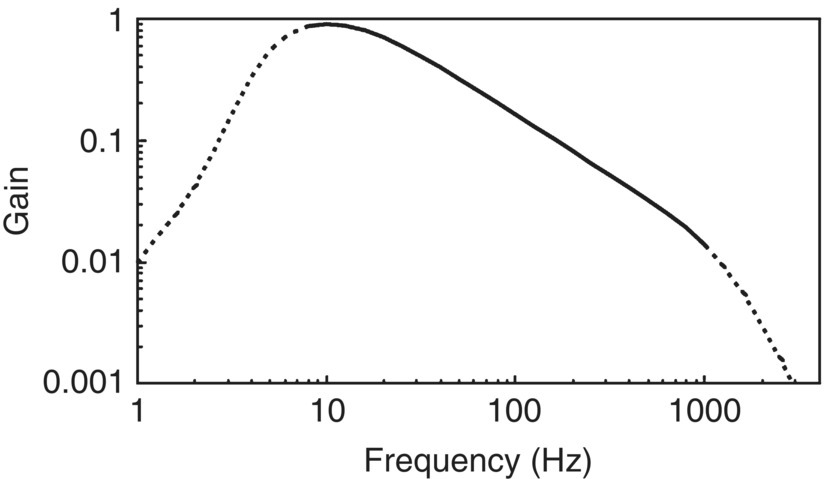
Human response vibration meters are currently available with these various weightings built in. In practice, instantaneous accelerations are recorded and frequency weightings are applied by means of electronic filters. Orthogonal component accelerations are commonly combined by vector additions.
Whole‐Body Vibration Dose Value
Unlike the case of noise exposure, there is no consensus on precise limits needed to avoid the risk of injury expected to occur in the majority of the exposed population. However, some standards have been proposed that provide guidelines as to how to deal with occupational whole‐body vibration exposure using dose values [53–56].
The VDV, is a cumulative exposure‐time domain function which is particularly effective when the acceleration crest factor (peak value divided by the rms value) is larger than three. The VDV has been defined as the fourth root of the time integral of the fourth power of the frequency‐weighted acceleration,
(5.6)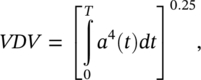
where a(t) is the frequency‐weighted acceleration and T is the duration of the vibration exposure in seconds. Thus, the units of VDV are ms−7/4. It is noted that a 16 times increase in exposure duration requires a halving of the vibration magnitude to maintain the same vibration dose value.
For statistically stationary vibration in which both the frequency‐weighted rms acceleration arms and the exposure duration T are known, an approximation to the VDV may be determined from the empirically estimated vibration dose value , eVDV as
(5.7)
This estimated value is not applicable to cases in which the crest factor is high (transients, shocks, etc.). Values of VDV and eVDV are usually noted with a subscript as to which weighting has been used, e.g. use of Wd would result in VDVd and eVDVd.
EXAMPLE 5.7
Workers in an office close to a subway line are subjected to vibration arising from 20 trains passing during working hours. Vibration measurements are carried out in the office while trains are passing. Each event lasts for 10 seconds and the frequency‐weighted rms acceleration, which is constant during each event, is 0.1 m/s2. (a) Calculate the estimated VDV. (b) If the number of trains could be reduced, how many would be allowed if an estimated VDV less than 0.4 ms−7/4 is recommended to avoid adverse comments?
SOLUTION
- We can use Eq. (5.7):

- If N is the number of trains, Eq. (5.7) is written as

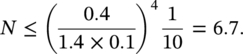
- Therefore, if the number of trains is reduced to six,

The cumulative effects of individual vibration events can be estimated by combining the dose of each individual event VDVi according to the fourth‐power law
(5.8)
Obviously, if there are N identical events each of VDV, the total VDV is VDV × N0.25.
Although no precise limits can be set to prevent disorders caused by whole‐body vibration, the British Standard [53] defines an action level in the region of 15 ms−7/4 for vertical vibration. The ISO standard [54] (also adopted by an ANSI standard [55]) considers that health risks are likely for a VDV greater than 17 ms−7/4, and defines a health guidance caution zone between 8.5 and 17 ms−7/4. On the other hand, an EC directive [56] defines a VDV exposure action level of 9.1 ms−7/4 and an exposure limit value above which the workers shall not be exposed of 21 ms−7/4.
EXAMPLE 5.8
The vibration exposure at a particular location consists of four different events having individual VDVs of 0.01, 0.02, 0.05, and 0.03 ms−7/4. What is the total VDV?
SOLUTION
We use Eq. (5.8):

We observe that the fourth‐power law emphasizes the contribution of the largest of the four individual values.
EXAMPLE 5.9
A sample of the vibration exposure of a forklift operator is measured over a period of 30 minutes. The VDV of the sample is 4.5 ms−7/4. Calculate the exposure over the total working day, of seven hours of duration.
SOLUTION
Assuming that the sample is representative of the entire day, we obtain:

Evaluation of Hand‐Transmitted Vibration
Occupational exposures to hand‐transmitted vibration usually are intermittent and have widely varying daily exposure durations (from a few seconds to many hours). For this, a daily exposure is reported by an energy‐equivalent frequency‐weighted eight‐hour exposure acceleration, A(8), defined as
(5.9)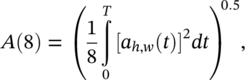
where ah,w(t) is the instantaneous value of the weighted hand‐transmitted acceleration and T is the total duration of the working day in hours. The energy‐equivalent acceleration over any other period T is related to A(8) by
(5.10)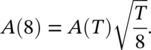
Therefore, if A(4) = 10 m/s2, A(8) =  = 7.07 m/s2.
It has been proposed by Griffin [52] that the number of years of exposure (in the range 1–25 years) required for 10% incidence of white‐finger disease is 30/A(8). The ISO standard [57] states that evidence of HAVS is rare for people exposed to A(8) of less than 2 m/s2 and unreported for values less than 1 m/s2. The EU directive on physical agents [56] defines an 8‐hour equivalent exposure action value of 2.5 m/s2 rms and an 8‐hour equivalent exposure limit value of 5.0 m/s2 rms. However, these values do not define safe exposures to hand‐transmitted vibration. A 10% probability of white‐finger disease is predicted after 12 years at the EU action value and after 5.8 years at the EU exposure limit value. The ANSI standard [58] defines the same action and limit values as the EU directive. The EU directive also states that manufacturers must test and declare vibration levels of their equipment using the action value of 2.5 m/s2 as a reference. The ACGIH has also recommended threshold limit values (TLV) of frequency‐weighted rms acceleration for exposure of the hand to vibration that vary from 4 to 12 m/s2 depending on the duration of the exposure (see Table 5.6).
Table 5.6 ACGIH recommended threshold limit values for hand‐transmitted vibration exposure in either x, y, or z directions [59].
| Total daily exposure duration | Dominant frequency‐weighted component of acceleration which shall not be exceeded (rms) | |
|---|---|---|
| m/s2 | g’s | |
| 4–8 hours | 4 | 0.4 |
| 2–4 hours | 6 | 0.61 |
| 1–2 hours | 8 | 0.81 |
| Less than 1 hour | 12 | 1.22 |
EXAMPLE 5.10
A fettler uses different electric hand tools during a working shift of nine hours making ceramic tiles. The measured frequency‐weighted rms accelerations for exposure times of 2 hours, 2½ hours, and 4½ hours are, respectively, 17, 10, and 9 m/s2. Calculate the equivalent frequency‐weighted acceleration over the nine‐hour period and the eight‐hour equivalent value.
SOLUTION
The total exposure during a working shift is

The eight‐hour equivalent acceleration can be determined from Eq. (5.10):

EXAMPLE 5.11
A worker in a machine shop uses three tools during a working day. The frequency‐weighted rms accelerations and exposure times are measured resulting in: (a) an angle grinder: 4 m/s2 for 2½ hours, (b) an angle cutter: 3 m/s2 for 1 hour, and (c) a chipping hammer: 20 m/s2, for 15 minutes. Determine the daily vibration exposure and assess the situation using the ANSI S2.70 criteria.
SOLUTION
The partial vibration exposures for the three tasks are:
- grinder: A1(8) =
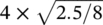 = 2.2 m/s2
 - cutter: A2(8) =
 = 1.1 m/s2
 - chipper: A3(8) =
 = 3.5 m/s2.
The daily vibration exposure is then:

This value is below the 8‐hour equivalent exposure limit value of 5.0 m/s2 but above the exposure action value of 2.5 m/s2. Therefore, some actions should be taken to reduce the risks, for example by decreasing the worker’s daily exposure time or using vibration protecting gloves.
Like noise, if exposure action values are exceeded, measures intended to reduce whole‐body and hand‐transmitted vibrations to a safe level and health surveillance should be implemented according to the local legislation.
There are other specific defined metrics, such as the seat effective amplitude transmissibility (SEAT), the motion sickness dose value (MSDV), the head injury criterion (HIC) that are discussed in detail by Griffin [44, 52] and Brammer [60]. Criteria for human comfort and annoyance for vibration in buildings are discussed in Chapters 6 and 12.
Leave a Reply