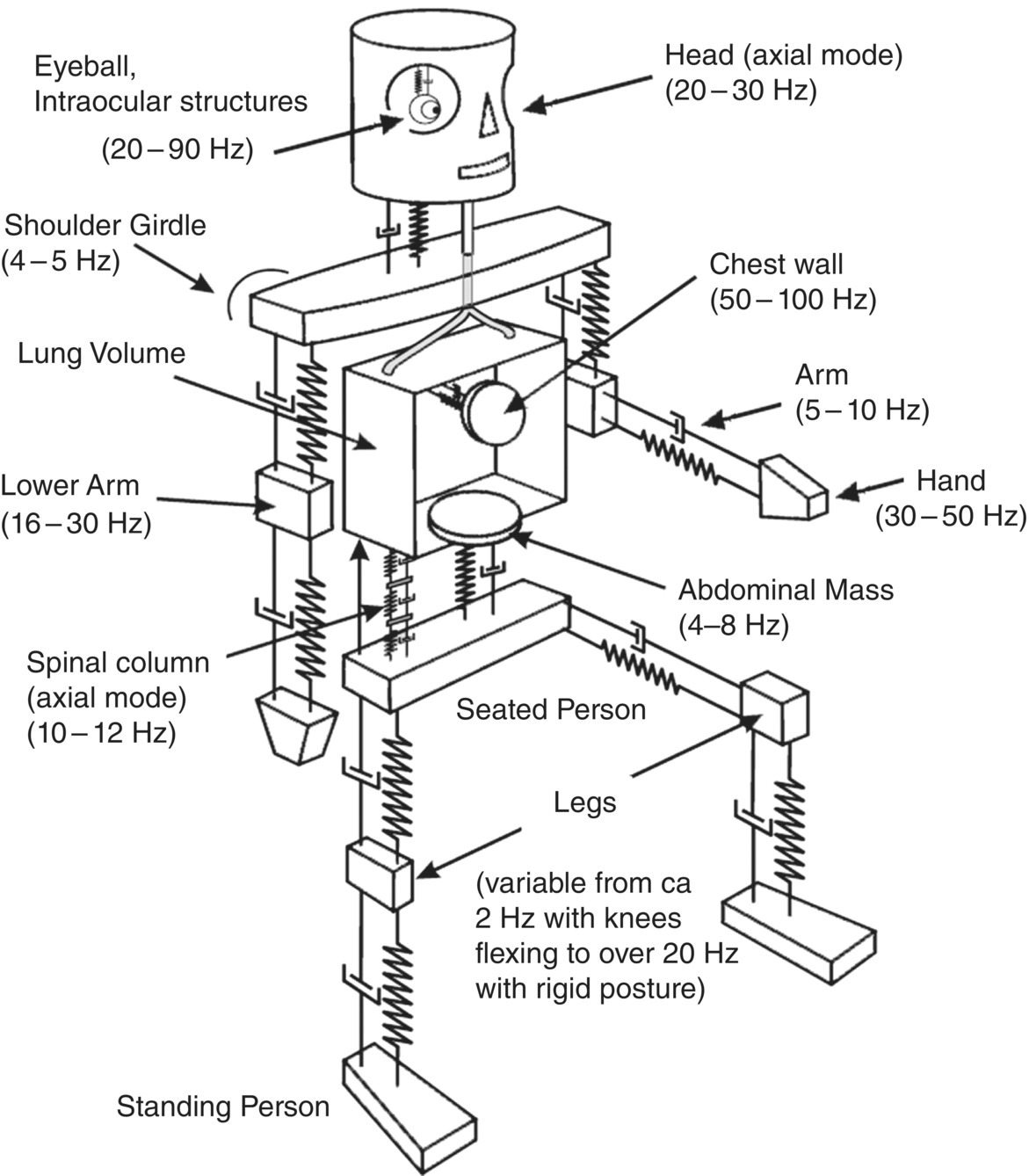
An extensive discussion of the effects of vibration on people is given by Griffin [44]. People seem most responsive to vertical vibration. The human body can be regarded as a complex nonlinear multi‐degree of freedom mechanical system. A simple lumped parameter model of the human body that works well for frequencies below 100 Hz is shown in Figure 5.8. There are relative motions between the body parts that vary with the frequency and the direction of the applied vibration. Several of the human organs have resonances which can produce sensations of pain if exited by vibration or noise at their resonance frequencies. These resonance frequencies are approximately in the range of 5–200 Hz. One important part is the thorax‐abdomen system that has a resonance effect in the 3–6 Hz range. A further resonance effect is found in the 20–30 Hz region which is caused by the head–neck‐shoulder system [46]. Eyeball resonances are found in the region 60–90 Hz and a resonance effect in the lower jaw‐skull system has been determined between 100 and 200 Hz.
In general, it has been shown that vibrations produce both physiological and psychological effects. However, the degree of negative impact of vibration exposure on workers’ health is of less importance than in the case of noise, because vibration exposures are less common. It is extremely difficult to conduct epidemiological studies on the long‐term effects of vibration exposure on human subjects. Although the scientific evidence on the effects of vibration on human health is limited and not completely conclusive, studies report that the main outcomes of vibration exposure on humans are whole‐body effects, hand‐arm effects, motion sickness, effects on vision, and annoyance. These effects depend mostly on the magnitude of vibrations, frequency, duration of exposure, and direction of the motion.
Whole‐body effects are produced when the body is supported on a vibrating surface, i.e. sitting, standing or lying on a vibrating surface. These effects can affect the performance of activities, comfort and human health. Back pain, displacement of intervertebral disks, degeneration of spinal vertebrae, and osteoarthritis may be associated with vibration exposure, although other causes unrelated to vibration exposure, such as bad sitting posture or heavy lifting may be other sources of disorders of the back. Other disorders that have been associated with occupational whole‐body exposure include abdominal pain, digestive disorders, urinary frequency, prostatitis, hemorrhoids, balance, and sleeplessness [44]. Vibration of the whole body is produced by all kinds of transportation and by several types of industrial machinery.
Power tools or workpieces can transmit intense levels of vibration to the hands and arms of their operators. Long‐term exposure to these vibrations can cause significant diseases affecting the blood vessels, nerves, bones, joints, muscles, and connective tissues of the hand and forearm. One of the main recognized diseases produced by hand‐arm vibration exposure is known as “vibration‐induced white finger,” Reynaud’s disease, and more recently as Hand‐Arm Vibration Syndrome (HAVS) [47]. The disease is characterized by intermittent whitening (i.e. blanching) of the fingers because of lack of blood circulation. The effect is amplified in very cold weather. This disease may be common among those workers with long‐term exposed to pneumatic drills, pavement breakers, grinding machines, chain saws, etc. Affected people usually report other associated symptoms such as numbness and tingling. Other effects of hand‐arm vibration that have been reported include decreased grip strength, reduced tactile discrimination, reduced manipulative dexterity, articular disorders, and some other physiological problems at the wrist and shoulders [44].
Motion sickness, also called kinetosis, is caused by real or illusory movements of the body or the environment at low frequency (usually less than 1 Hz). Human reaction to very low frequency vibration is extremely variable and seems to depend on a number of external factors unrelated to the motion. Normal illnesses of people caused by low‐frequency vibration include vomiting, nausea, sweating, dizziness, headaches, and drowsiness. Vertical oscillation is the prime cause of sickness in marine craft but usually not in most road vehicles and some environments.
The effect of vibration on the visual abilities is believed to be caused by the resonances of the eyeball. This effect can be very unsafe for helicopter pilots and other occupations where vision‐focusing abilities are important. The effect can be appreciated when trying to read a book or newspaper in a moving vehicle subjected to high levels of mechanical vibrations. In addition, the effect has sometimes been associated with headaches.
There is little evidence concerning the possible effects of vibration exposure on simple cognitive tasks (unless the vibration directly affects input and output processes) and fatigue‐decreased proficiency.
Vibration has also been reported as a cause of annoyance that includes sleep deprivation, discomfort and interference with activities (e.g. learning, memory, decision making, manual tasks control). Figure 5.9 gives the Reiher‐Meister chart showing human response to vibration [48]. Although this was produced in 1931, later measurements with people have produced somewhat similar subjective results. Comparable results were obtained in a study presented by Dieckmann [49] who extended the frequency range down to 0.1 Hz using higher vibration amplitudes than the Reiher and Meister study. It is rather interesting to note that, for small vibrations, the subjective responses follow constant velocity contours as frequency is changed. For large vibration amplitudes, the responses change to constant acceleration contours with frequency.
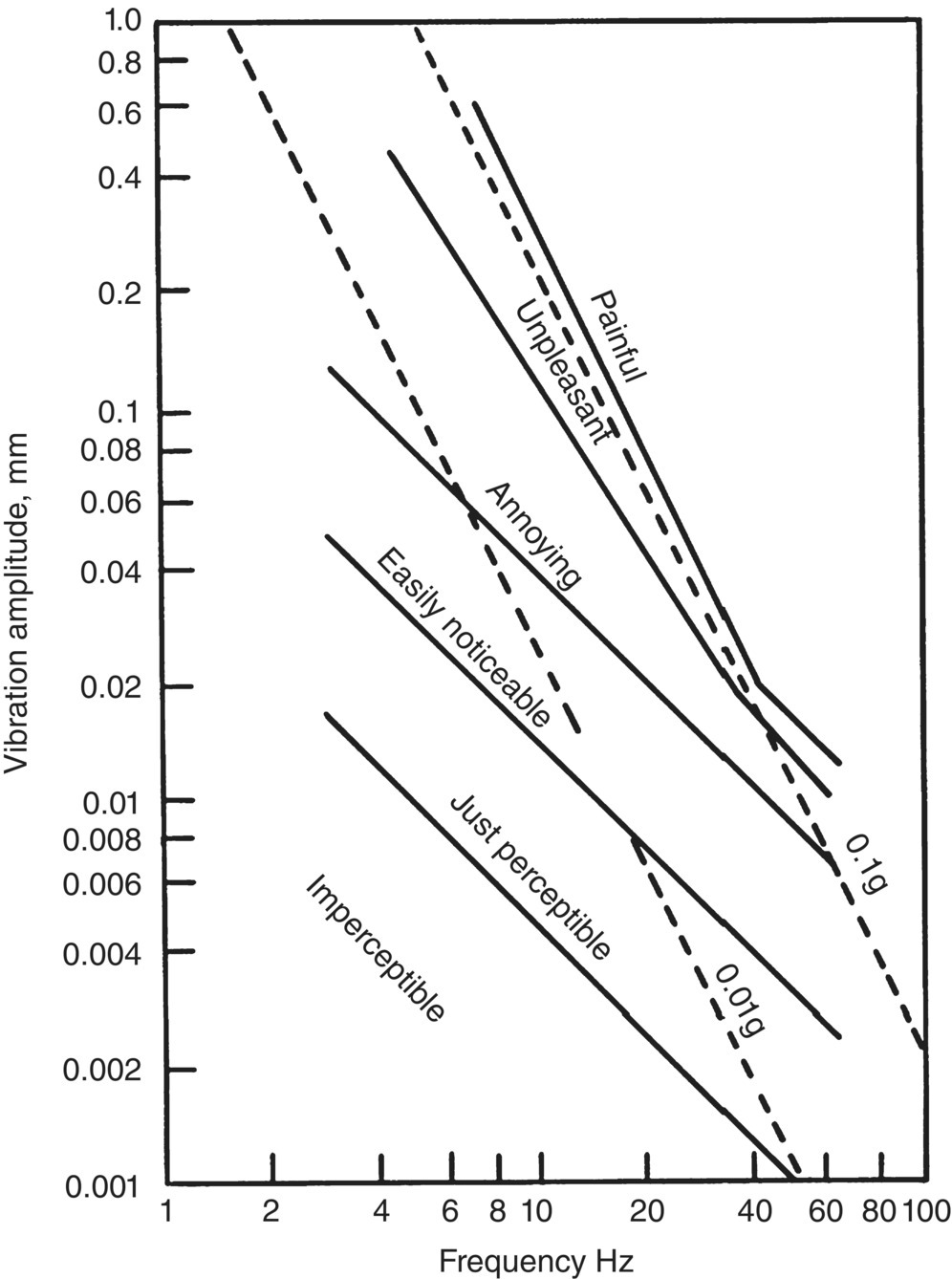
In general, rms acceleration values have been found to correlate well with human response for steady, continuous vibration. In the frequency range of 1–100 Hz, the approximate absolute threshold for the perception of vertical vibration is 0.01 m/s2; a magnitude of 0.1 m/s2 will be easily noticeable; around 1 m/s2 will be uncomfortable and acceleration values over 10 m/s2 are usually dangerous [44]. It has been found that high peak values are often underestimated by rms values. In this case the use of a vibration dose value (VDU) is preferred (see Section 5.10.2).
Vibration is a major source of lost time in occupational environments. It is estimated that about eight million workers in the U.S. are currently exposed to occupational vibration. Of these, an estimated 6.8 million are exposed to whole‐body vibration and the remainder to hand‐arm vibration [50]. Other authors report that 500 000 construction workers are exposed to whole‐body vibration and over 250 000 are exposed to hand‐arm vibration above the current international daily exposure limit values [51]. Construction workers are often one of the largest affected groups by population. However, workers in industries like foundries, shipbuilding, forestry, mining, transportation, and defense are also affected. Unlike noise, there is no OSHA regulation for vibration exposure; although standards, directives and best practice guidelines for identifying workers at risk and for taking steps to mitigate the vibration and reduce risk of injury are currently is use in the U.S.A.
Leave a Reply