High levels of impulsive and impact noise pose special threats to human hearing. These types of noise can also be very annoying. It is well known now that high levels of such noise damage the cochlea and its hair cells through mechanical processes. Unfortunately, there is currently no commonly accepted definition or recognized standard for what constitutes impulsive noise. However, in general an impulse noise has been described as having a rise time ≤1 second in duration, and if repeated, occurring at intervals >1 second. Impulse noise is also characterized by having a broad spectral content.
Impulsive noise damage cannot be simply related to knowledge of the peak sound pressure level. The duration, number of impulsive events, impulse waveform, and initial rise time are also all important in predicting whether impulsive or impact noise is likely to result in immediate hearing damage.
Impulse noise damage also does not seem to correlate with the noise energy absorbed by the ear. It is known that hearing damage caused by a combination of impulsive noise events during steady background noise cannot be judged by simply adding the noise energy contained in each and may indeed be greater than simple addition would suggest.
There is a huge variation in the characteristics of impulsive and impact noise to which people may be exposed. Peak sound pressure levels can be from 100 dB to as much as 185 dB, and impulse durations may vary from as little as a few microseconds to as much as hundreds of milliseconds. Impulses can be comprised of single events or multiple or repeated events. Coles et al. [23] have classified impulse and impact noise into two main types: (i) single non‐reverberant impulses (termed A‐waves) and (ii) reverberant impact noise (termed B‐waves) (see Figure 5.5). Explosions and the blast waves they create (often commonly called Friedlander waves) can be classified as A‐waves in Cole’s system. They can have peak sound pressure levels of over 150 dB. They are really shock waves and are not purely sound waves. Riveting and punch press and forge forming and other machining processes in industry can result in reverberant noise caused by ringing of the manufactured parts. Such ringing noise is classified as B‐waves in this system.
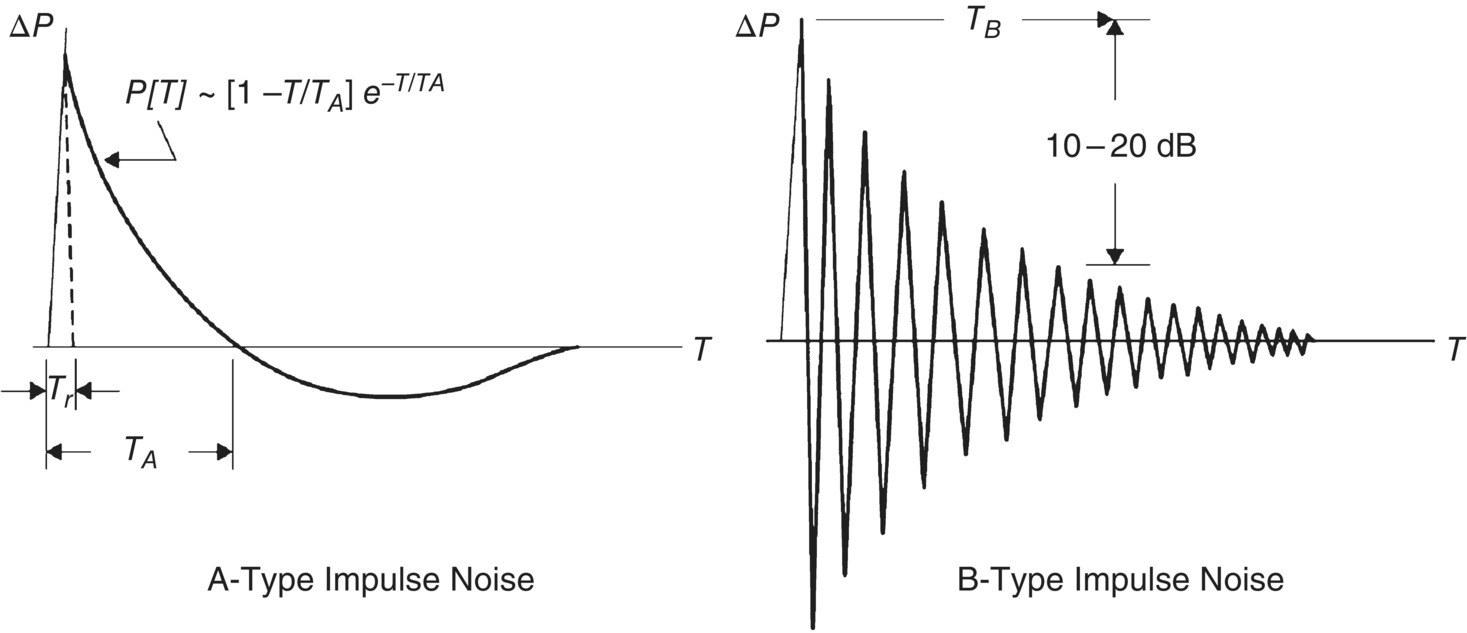
Although Cole’s system includes the effects of peak sound pressure level, duration, and number of impulsive events, it is not completely comprehensive since it neglects the rise times, spectral contents, and temporal patterns of the impulses. Bruel has shown that crest factors (peak value divided by rms value) as high as 50 dB are common in impulsive noises [24]. Unfortunately, there is still no real consensus on how to predict and treat the damaging effects of impulsive noise compared to continuous intense noise. Henderson and Hamernik [25] discuss impulsive and impact noises in more detail.
Leave a Reply