If very intense noise levels of the order of 135 dB or above at any frequency in the hearing range are experienced, immediate hearing damage is likely to result. However, permanent hearing damage is also produced at much lower sound pressure levels if the noise is experienced over much longer periods (weeks, months, or years). This reminds us of the similar phenomenon of metal fatigue where failure can occur at very much lower stress levels than the breaking stress, provided the stress is produced over a sufficiently long time. The problem is that noise‐induced hearing loss, or to give it its longer technical name noise-induced permanent threshold shift (NIPTS) is hard to distinguish from presbycusis (the so‐called natural hearing loss with age, see Chapter 4).
Since we all suffer from presbycusis in industrialized societies, we should like to be able to subtract the effects of presbycusis from those of NIPTS. The only way we can attempt to do this is to study groups of people who are exposed throughout their lives to intense noise and other control groups who are not. Some attempts have been made to do this for several years. Such studies are very useful but still are troubled by the difficulties in eliminating what Glorig [20] has called sociocusis (losses caused by exposure in the military, recreational, and other nonoccupational activities) and the effects of disease and intermittency in jobs.
Despite the fact that the use of A‐weighted sound pressure levels causes problems when noise containing strong pure tones is present, the simplicity afforded is very attractive.
Baughn [21] discusses the construction of risk tables for hearing impairment caused by noise. Here risk is defined as “the difference between the percentage of people with a hearing handicap in a noise‐exposed group and the percentage of people with a handicap in a non‐noise (but otherwise equivalent) group.”
The level needed to produce hearing loss is much lower than the peak impulsive noise levels required to produce immediate damage. Protective mechanisms exist in the middle ear, which reduce the damaging effect of continuous intense noise. These mechanisms, however, only reduce the noise levels received by the cochlea by about 5 dB and are insufficient to protect the cochlea against most continuous intense noise. Hearing loss can be classified into two main types and is normally measured in terms of the shift of the following hearing threshold shifts: (i) Temporary threshold shift (TTS) is the shift in hearing threshold caused by noise that returns to normal after periods of 24–48 hours. (ii) Permanent threshold shift (PTS) is the shift in hearing threshold that is nonrecoverable even after extended periods of rest.
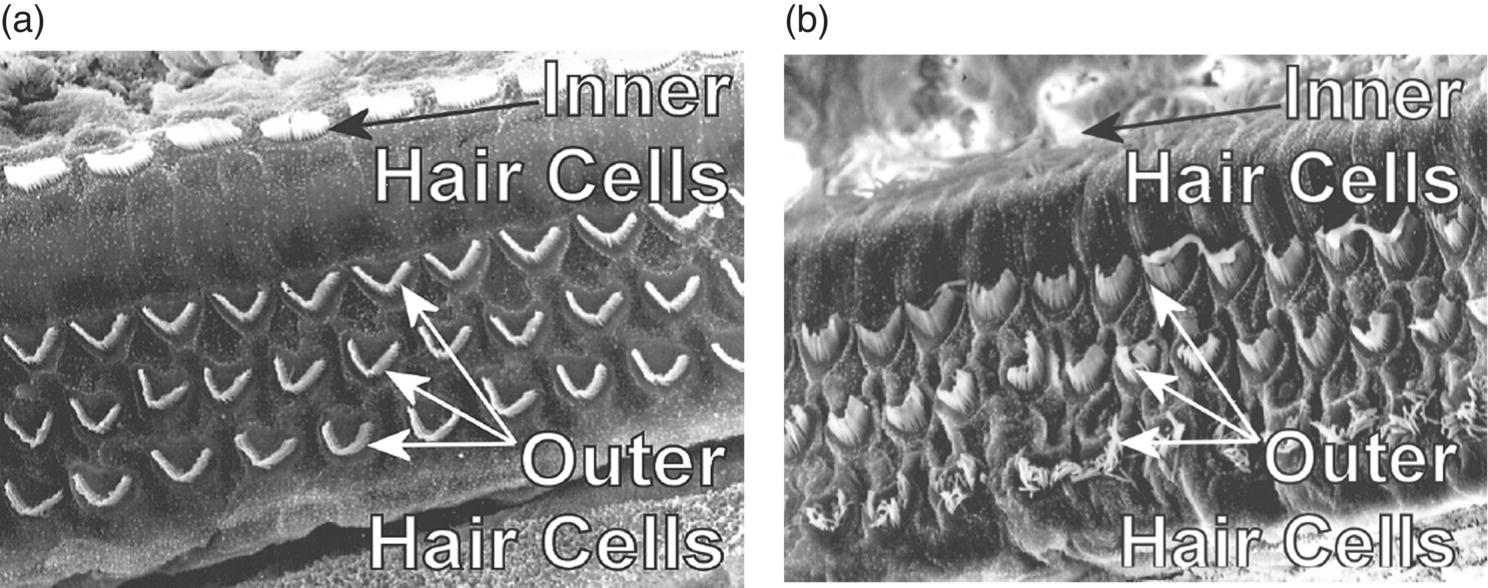
PTS caused by exposure to intense noise over extended periods of time produces permanent irrecoverable damage to the cochlea (see Chapter 4). Figure 5.4 shows the destruction of the hair cells in the cochlea of a rat caused by intense noise.
Some people have hearing mechanisms that are more sensitive than other people’s and are more prone to damage from continuous intense noise and to suffer PTS. Because harmful noise can be quite different in frequency content, often the A‐weighted sound pressure level is used as a measure of the intense noise for the prediction of hearing impairment (PTS). Continuous A‐weighted sound pressure levels above 75 dB can produce hearing loss in people with the most sensitive hearing if experienced for extended periods of some years. As the A‐weighted level increases, an increasing fraction of the workforce experiences PTS. The PTS expected at different levels has been predicted by several organizations including the International Organization for Standardization (ISO), the Environmental Protection Agency (EPA), and the National Institute for Occupational Safety and Health (NIOSH) (see Table 5.2).
Table 5.2 Estimated excess risk of incurring material hearing impairmenta as a function of average daily noise exposure over a 40‐year working lifetimeb
Source: From Ref. [22].
| Reporting Organization | Average Daily A‐weighted Noise Level Exposure (dB) | Excess Risk (%)c |
|---|---|---|
| ISO | 90 | 21 |
| 85 | 10 | |
| 80 | 0 | |
| EPAd | 90 | 22 |
| 85 | 12 | |
| 80 | 5 | |
| NIOSH | 90 | 29 |
| 85 | 15 | |
| 80 | 3 |
a For purposes of comparison in this table, material hearing impairment is defined as an average of the Hearing Threshold Levels for both ears at 500, 1000, and 2000 Hz that exceeds 25 dB.
b Adapted from 39 Fed. Reg. 43802 [1074b].
c Percentage with material hearing impairment in an occupational‐noise‐exposed population after subtracting the percentage who would normally incur such impairment from other causes in an unexposed population.
d EPA = Environmental Protection Agency.
Leave a Reply