In most sound fields, sound propagation occurs in two or three dimensions. The three‐dimensional version of Eq. (3.1) in Cartesian coordinates is
(3.29)
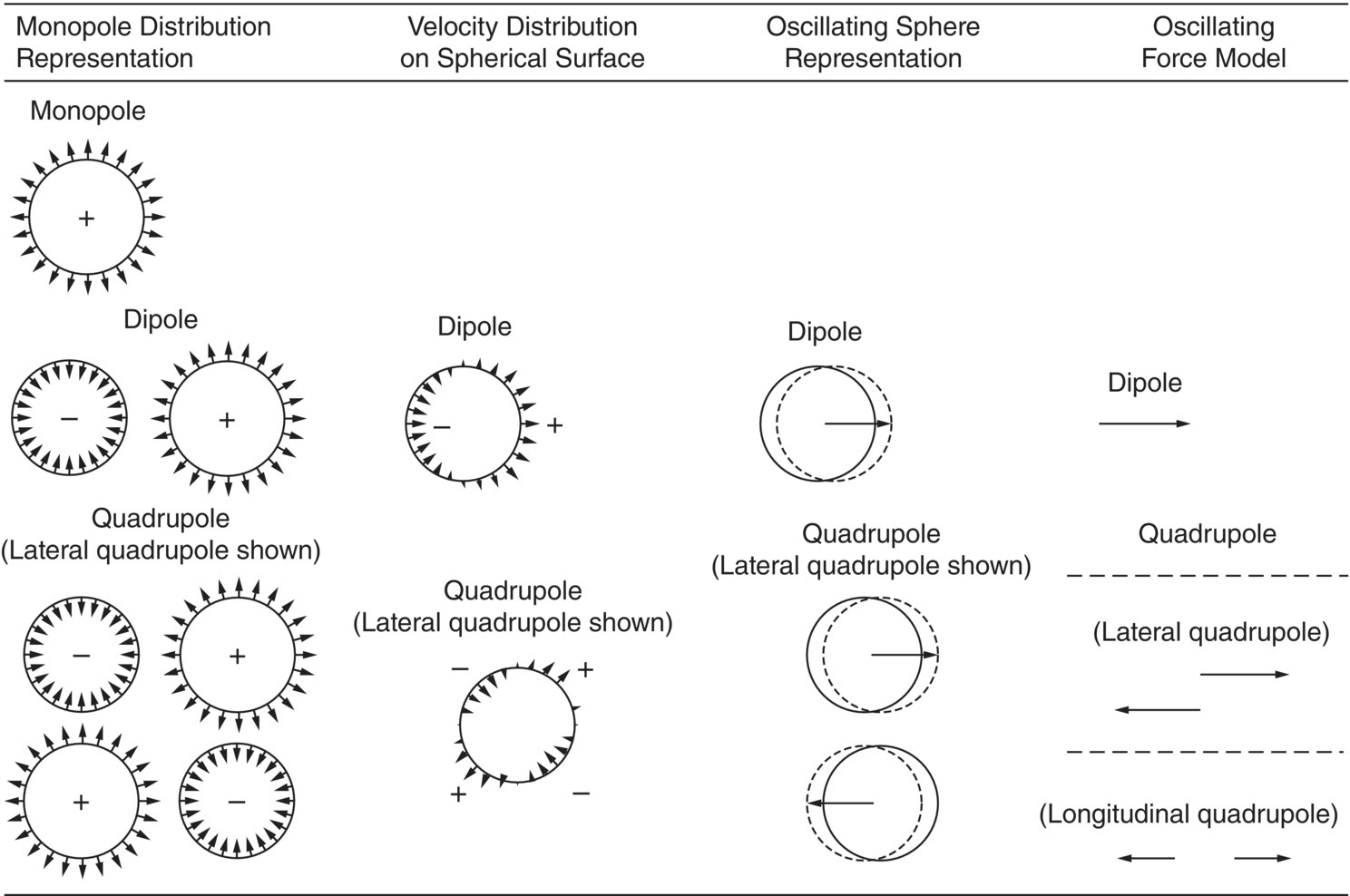
This equation is useful if sound wave propagation in rectangular spaces such as rooms is being considered. However, it is helpful to recast Eq. (3.29) in spherical coordinates if sound propagation from sources of sound in free space is being considered. It is a simple mathematical procedure to transform Eq. (3.29) into spherical coordinates, although the resulting equation is quite complicated. However, for propagation of sound waves from a spherically symmetric source (such as the idealized case of a pulsating spherical balloon known as an omnidirectional or monopole source) (Table 3.1), the equation becomes quite simple (since there is no angular dependence):
(3.30)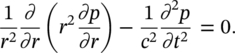
After some algebraic manipulation Eq. (3.30) can be written as
(3.31)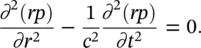
Here, r is the distance from the origin and p is the sound pressure at that distance.
Equation (3.30) is identical in form to Eq. (3.1) with p replaced by rp and x by r. The general and simple harmonic solutions to Eq. (3.30) are thus the same as Eqs. (3.4) and (3.5) with p replaced by rp and x with r. The general solution is
(3.32)
or
(3.33)
where f1 and f2 are arbitrary functions. The first term on the right of Eq. (3.33) represents a wave traveling outward from the origin; the sound pressure p is seen to be inversely proportional to the distance r. The second term in Eq. (3.33) represents a sound wave traveling inward toward the origin, and in most practical cases such waves can be ignored (if reflecting surfaces are absent).
The simple harmonic (pure‐tone) solution of Eq. (3.31) is
(3.33)
We may now write that the constants A1 and A2 may be written as  and
and  , where
  and
and  are the sound pressure amplitudes at unit distance (usually 1 m) from the origin.
Leave a Reply