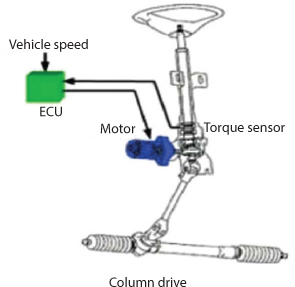
EPS system designs have various components as:
- Electric motor
- Torque sensor
- Angle sensor
- Controller (CAN)
- Vehicle speed and position sensor
- Motor and steering mechanism coupling
1. Electric motors
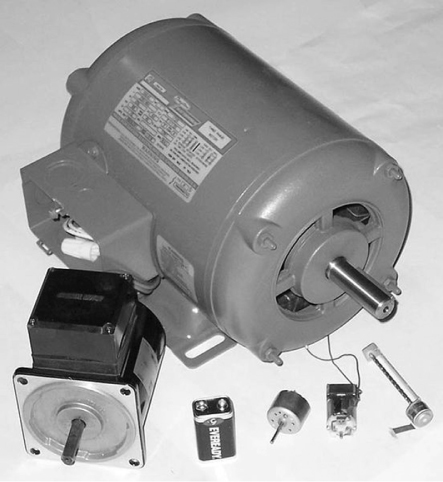
Electric motors are the most common electro-mechanical actuator in automobiles. Virtually every pump, fan and positioner in an automobile employs an electric motor. A typical automobile has about 25 electric motors and this number is growing with each new model. Luxury vehicles can have more than 100 motors.
There are several types of motors including:
DC Motors – Brushed
DC Motors – Brushless
AC Motors – Asynchronous
AC Motors – Synchronous
Stepper Motors
2. Torque Sensor
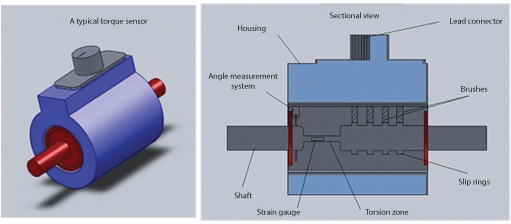
A torque sensor, in general is employed for monitoring the torque on a rotating system by converting torsional input into an electrical signal. Torque is measured by sensing the shaft deflection caused by a twisting force. Strain gauge is one of the most commonly used torque sensors to measure the torque applied to a shaft. Even though strain gauge provides high accuracy, their bulkiness and investment cost limit their application. Also the high levels of maintenance, makes strain gauge unsuitable for mass integration into automobile systems.
As an alternate, proximity and displacement sensors can be used to detect torque by measuring the angular displacement between the ends of the shaft. By fixing two similar toothed wheels at a distance apart on the shaft, the angular displacement can be measured [8].
3. Wheel Speed and Position Sensors (Vehicle)
Wheel Speed Sensors (Vehicle) measure the road-wheel speed and direction of rotation. These sensors provide input to a number of different automotive systems including the antilock brake system and electronic stability control. Wheel speed sensors typically include a toothed (or optically encoded) shaft and a magnetic (or optical) sensor. The sensor counts the rate at which the teeth or marks pass by. Wheel speed sensors may monitor the crankshaft or driveshaft rotation in vehicles that do not need to know the rate at which individual wheels are turning. Otherwise, they monitor the rotation of the axle driving each wheel.
Position sensors
Position sensors are used in automobiles to determine the steering wheel position, pedal positions, seat positions, and the position of various valves, knobs and actuators. There are three main types of position sensors: angular, rotary, and linear.
CAN (Controller Area Network)[9]
CAN originally developed by Robert Bosch GmbH in 1986 as communication protocol between hardware and software for in-vehicle networks in cars. In CAN buses, twisted wire pairs were specially designed to withstand and work perfectly in electromagnetically noisy environments. A CAN bus has a potential to enable microcomputers in a car to communicate with each other without the help for a network host.
4. Rotation Angle Sensor
Rotation sensor converts rotation motion into voltage. The steering angle indicates where the driver wants to go. This information is also used by other systems such as the Electronic Stability Program (ESP), Active Front Steering (AFS), Adaptive Front Lighting (AFL), and so forth.
Coupling
A coupling is used to connect two shafts for the purpose of transmitting power. The main purpose of couplings is to connect two pieces of rotating member while allowing some degree of misalignment or end movement. Shaft couplings are used in machinery to transfer power from one end to another end.
Leave a Reply