The approximate allowance for the analysis of dynamic loading effect can be calculated by using the velocity factor. The dynamic loads on the tooth can be due to the inaccuracies and irregularities of the tooth spacing and tooth profiles respectively. Along with that, the deflections of gear teeth under external loading can also cause dynamic load. A keen approximation to real-world conditions can be made by using equations based on extensive series of experimental tests, as follows:
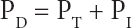
Where, PD represents total dynamic load, PT represents steady load due to transmitted torque, and
Increment load due to dynamic action is denoted by PI.
The increment load (PI) relies upon the pitch line velocity of the gear, the face width, gear material, tangential load acting on teeth and accuracy of the cut made while gear generation. For average conditions, Buckingham equation is used to determine the dynamic tooth load on the helical gears, i.e.

Where, PD = Total dynamic load (N),
PT = Steady transmitted load (N), in determining the dynamic load (PD),
The magnitude of tangential load (PT) may be determined by neglecting the service factor (CS) i.e.
PT = p/v = 1328.1N, where pis in watts and v in m/s.
v = Pitch line velocity in m/s = 26.09m/s (from previous calculations)
b = Face width of gears in mm = 62.5mm (from previous calculations), and
C = Dynamic factor in
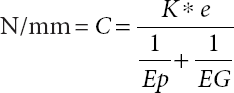
Where K = Factor depending upon the form of the gear teeth.
= 0.111, for 20 ° full depth involute profile.
E = 200 GpaYoung’s modulus (N/mm2)
e = Tooth error action (mm) or module m (mm)
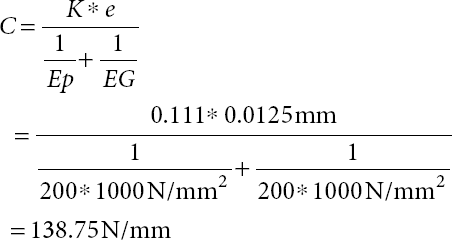
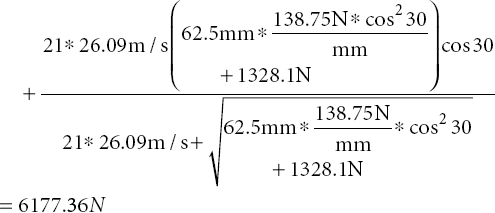
Thus, the dynamic load PD is
PD = 1328.1N
The static tooth load on the tooth is given by
PS = σes*b*π m*y’
Where σes represents the surface endurance strength (cast steel) = 616N/mm2
b = 19mm face width
y’ = 0.152, tooth form factor (from previous results) and
m = 3mm, (module of the gear)
PS = 616N/mm2*19mm*π*3mm*0.152 = 5337N
For heavy shock loading conditions PS > 1.5*PD, So it is safe.
Finally, wear tooth load can be determined by using the relation,
ϕN = normal pressure angle = tan-1(tanϕ*cosα) = tan-1(tan20°*cos30°) = 17.5°
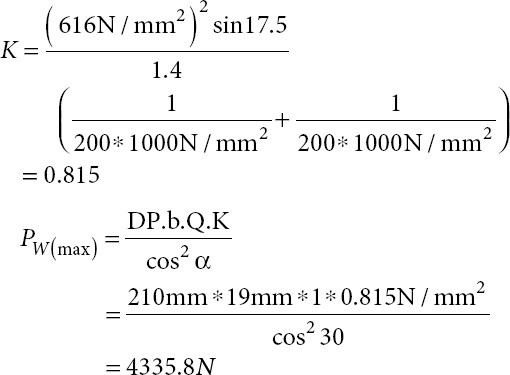
Since the peak load for wear (4335.8N) is greater than the tangential load (600 N) on the tooth,, the design is satisfactory from consideration of wear.
Leave a Reply