The hydraulic pump is used to convert mechanical energy into hydraulic energy. The mechanical action of the pump takes the fluid from the reservoir in to the pump by producing a partial vacuum. This action also forces the fluid in the pump to go into the hydraulic system.
1. Types of pumps:
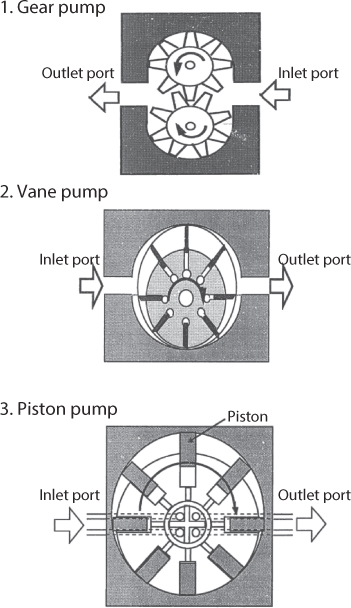
2. Hydraulic line:
Two types of line: high pressure line and low pressure or return line, e.g. Hose, Pipe.
3. Control valve:
A control valve consists of an inner and outer part. An inner part can be a spool, a piston, a ball, or a poppet, an outer part can be a stationary valve housing. The inner part is operated manually, electrically, pneumatically or hydraulically. The relative displacement of the inner part opens some valve ports while other ports are closed. There are different types of valves. Directional control valves are used to start, stop, and reverse cylinders and motors. Volume control valves are used to adjust fluid flow rate or speed of the load. The pressure control valves are used to adjust the force.
4. Power cylinder:
Cylinders are used to take the pressure or the power in a fluid system and convert it to mechanical force or power.
A cylinder consists of a cylinder body, and a rod attached to the piston. The cylinder body ends are sealed with oil seals. A cylinder of power steering system is generally integrated into the steering gear box.
5. Gear:
Rack and pinion gear mechanism and recirculating ball mechanism are commonly used for power steering systems.
Leave a Reply