There are three types of height adjustable suspension which are:
- Mechanical
- pneumatic
- hydraulic system
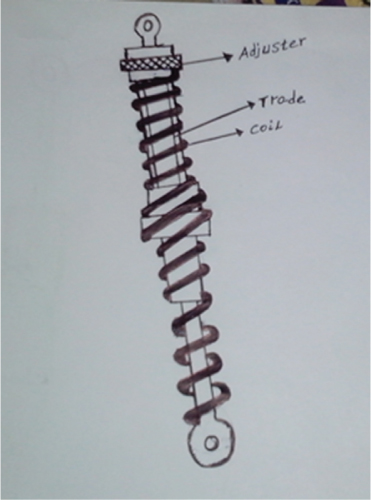
Mechanical System
This system needs manual adjustment to which can be used to vary a vehicle ride height.
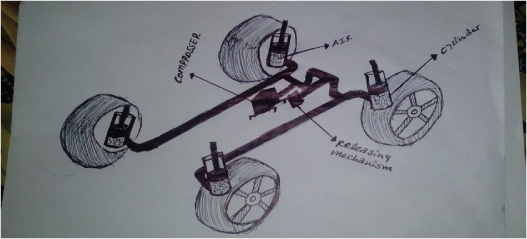
Pneumatic System
Air has been used on vehicles at varying frequencies and with mixed success. Air systems can also be used as a means of achieving height adjustment in the vehicle. Air suspension has an added advantage in that the controller can also perform the task of leveling the car if height sensors are placed in each spring. Existing air springs do have the drawback that they cannot simply replace a coil spring in all their behavioral properties. While the properties of air suit heavy vehicle transport they are not as easily put to work underneath a light automobile. Their lack of popularity within smaller vehicles is also due to their elevated cost when compared to a coil spring.
Hydraulic System
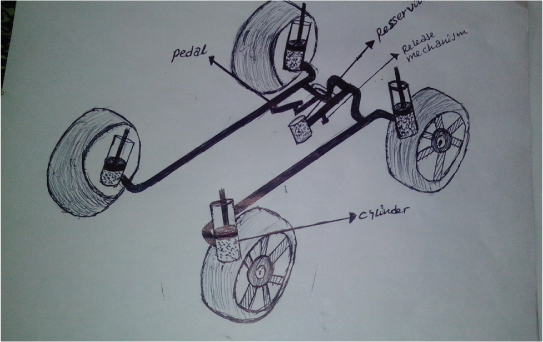
The hydraulic system uses hydraulic to vary the height of the vehicle. The system uses pressurize fluid; due to different mechanism it can be by pump or pedal or other mechanism. Hydraulic system has no leaky seals, no variance with temperature or elevation, and it has no noise since it is free from compression.
This condition makes hydraulic the most appropriate when we compare it with other mechanisms.
Working Principle of Hydraulic Suspension System
When the pedal is pressed repeatedly by the driver, the fluid is sucked from the reservoir tank then pressurized into the main cylinder through the tube. The pressurized fluid pushes the piston, then the vehicle increases ride height from the ground. If the driver needs to decrease the ride height of the vehicle he simply opens the valve then the fluid comeback to the reservoir tank.
Major Parts of Hydraulic Suspension System
- Pedal
- Main cylinder
- Piston
- Actuator cylinder
- Plunger
- Reservoir cylinder
- Spring
- Ball valve
Table 4.1 Concept scoring.
| Concept variant | ||||
| Selection criteria | Hydraulic | Pneumatic | Mechanical | Ref |
| Noiseless | + | – | 0 | 0 |
| Leaky less | + | – | + | 0 |
| Cost | 0 | – | + | 0 |
| Easy | + | + | – | 0 |
| Efficiency | + | 0 | – | 0 |
| Plus | 4 | 1 | 2 | 0 |
| Minus | 0 | 3 | 2 | 0 |
| Same | 1 | 1 | 1 | 0 |
| Net | 4 | -2 | 0 | 0 |
| Rank | 1 | 3 | 2 | 0 |
| Continue | Yes | No | Yes | |
Table 4.2 Concept screening: (based on this table hydraulic system is used).
| Hydraulic | Mechanical | ||||
| Selection criteria | Weight | Rating | Weighted score | Rating | Weighted score |
| Easy to operate | 25% | 5 | 1.25 | 1 | 0.25 |
| Efficiency | 35% | 4 | 1.4 | 3 | 1.05 |
| Time saver | 15% | 5 | 0.75 | 3 | 0.45 |
| Cost | 15% | 2 | 0.3 | 5 | 0.75 |
| Noise less | 5% | 5 | 0.25 | 4 | 0.2 |
| Life time | 5% | 4 | 0.2 | 3 | 0.15 |
| Total score rank | 4.15 | 2.85 | |||
| Rank | 1 | 2 | |||
| Continue | Yes | No | |||
Leave a Reply