In the case of the pure tone a useful quantity to determine is the mean square value, i.e. the time average of the signal squared 〈x2(t)〉t [8]
(1.7)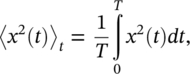
where 〈〉t denotes a time average.
For the pure tone in Figure 1.2a then we obtain
(1.8)
where A is the signal amplitude.
The root mean square value is given by the square root of 〈x2(t)〉t or
(1.9)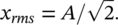
For the general case of the complex pure tone in Eq. (1.1) or (1.2) we obtain:
(1.10)
or
(1.11)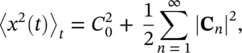
since  . The mean square value then is the sum of the squares of all the harmonic components of the wave weighted by a constant of 1/2.
EXAMPLE 1.4
Determine the mean square and rms values of the signal in Figure 1.3.
SOLUTION
We can use Eq. (1.7) to determine its mean square value,

The same result is obtained from its Fourier series representation using Eq. (1.10):


Recalling that the root mean square value is given by the square root of the mean square value, the rms value of this saw tooth signal is  . Note the difference between the rms value obtained in this example and that in Eq. (1.9) for a sine wave.
Leave a Reply