The motion of vibrating systems such as parts of machines, and the variation of sound pressure with time is often said to be simple harmonic. Let us examine what is meant by simple harmonic motion.
Suppose a point P is revolving around an origin O with a constant angular velocity ω, as shown in Figure 2.1.
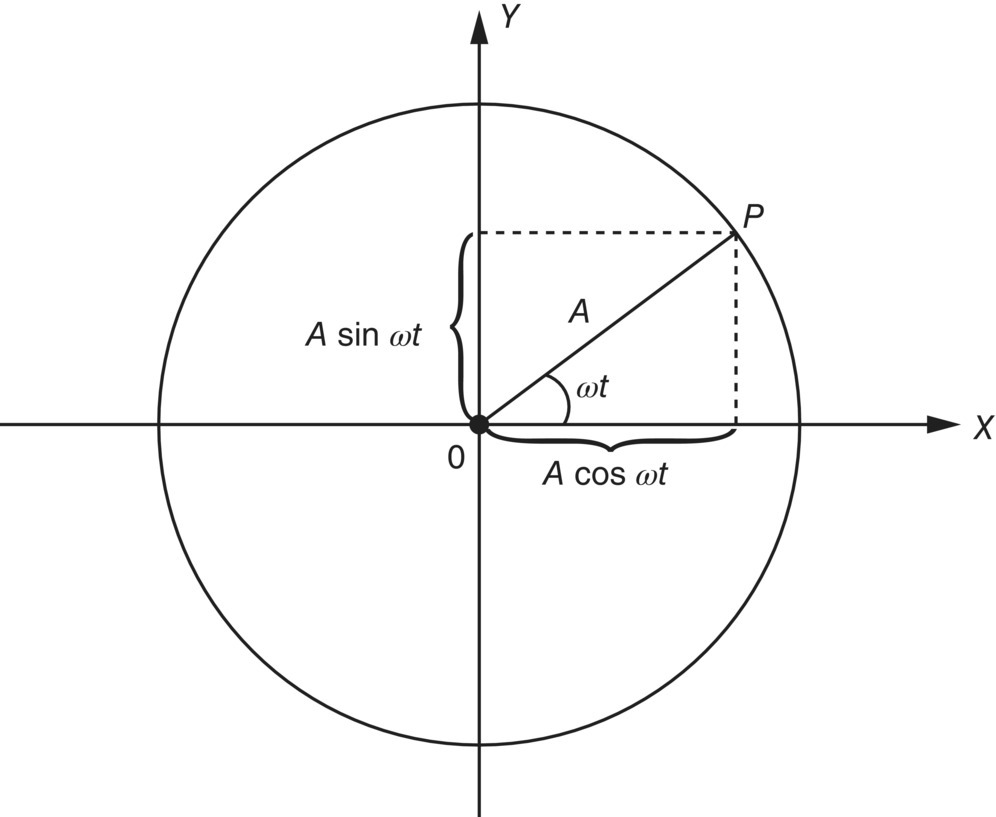
If the vector OP is aligned in the direction OX when time t = 0, then after t seconds the angle between OP and OX is ωt. Suppose OP has a length A, then the projection on the X‐axis is A cos(ωt) and on the Y‐axis, A sin(ωt). The variation of the projected length on either the X‐axis or the Y‐axis with time is said to represent simple harmonic motion.
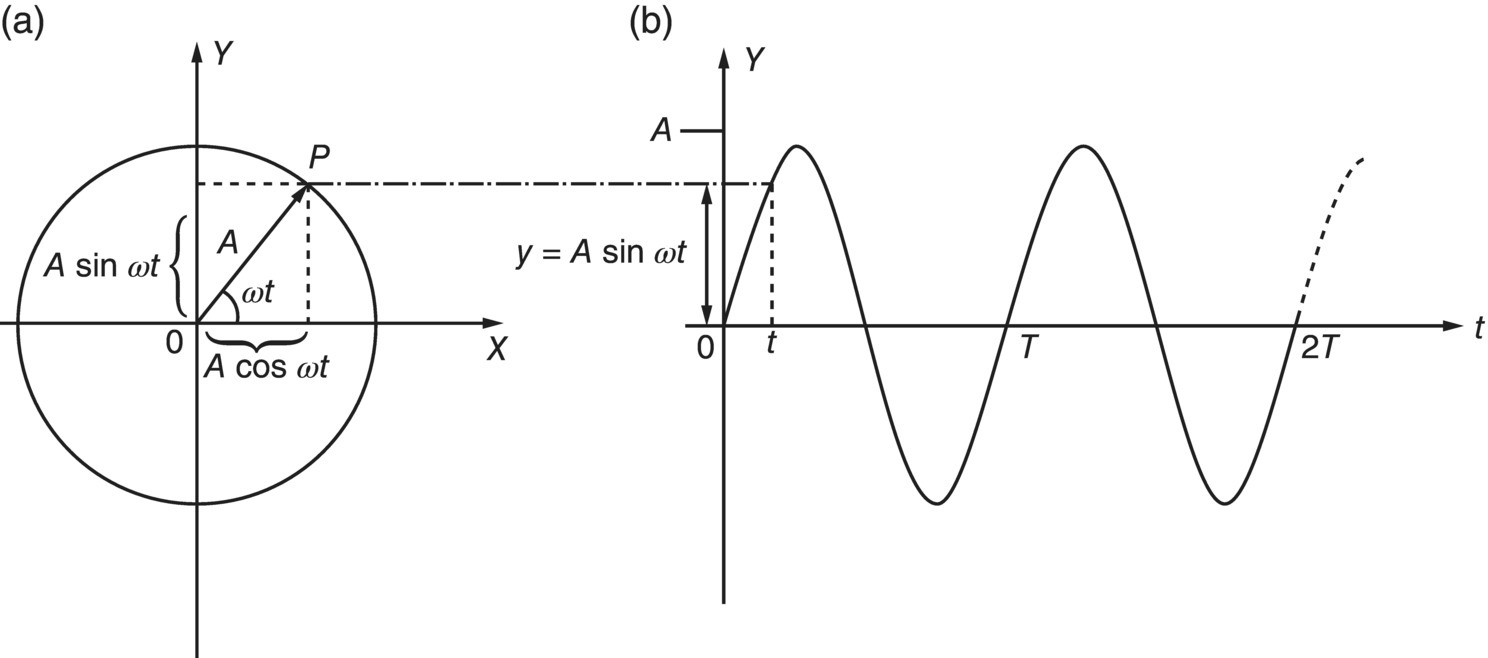
It is easy to generate a displacement vs. time plot with this model, as is shown in Figure 2.2. The projections on the X‐axis and Y‐axis are as before. If we move the circle to the right at a constant speed, then the point P traces out a curve y = A sin(ωt), horizontally. If we move the circle vertically upwards at the same speed, then the point P would trace out a curve x = A cos(ωt), vertically.
2.2.1 Period, Frequency, and Phase
The motion is seen to repeat itself every time the vector OP rotates once (in Figure 2.1) or after time T seconds (in Figures 2.2 and 2.3). When the motion has repeated itself, the displacement y is said to have gone through one cycle. The number of cycles that occur per second is called the frequency f. Frequency may be expressed in cycles per second or, equivalently in hertz, or as abbreviated, Hz. The use of hertz or Hz is preferable because this has become internationally agreed upon as the unit of frequency. (Note cycles per second = hertz.) Thus
(2.1)
The time T is known as the period and is usually measured in seconds. From Figures 2.2 and 2.3, we see that the motion repeats itself every time ωt increases by 2π, since sin(0) = sin(2π) = sin(4π) = 0, and so on. Thus ωT = 2π and from Eq. (2.1),
(2.2)
The angular frequency, ω, is expressed in radians per second (rad/s).
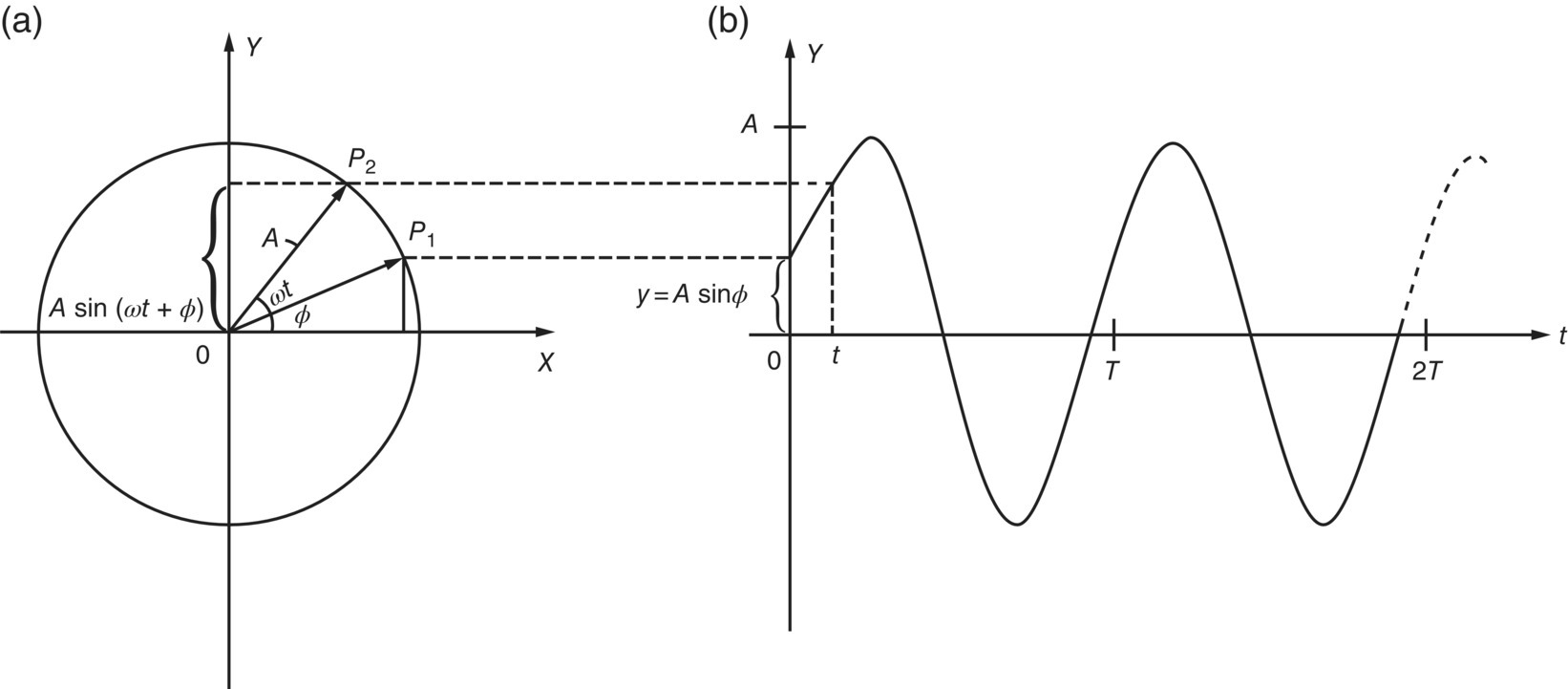
The motion described by the displacement y in Figure 2.2 or the projection OP on the X‐ or Y‐axes in Figure 2.2 is said to be simple harmonic. We must now discuss something called the initial phase angle, which is sometimes just called phase. For the case we have chosen in Figure 2.2, the phase angle is zero. If, instead, we start counting time from when the vector points in the direction OP1, as shown in Figure 2.3, and we let the angle XOP1 = ϕ, this is equivalent to moving the time origin t seconds to the right in Figure 2.2. Time is started when P is at P1 and thus the initial displacement is Asin(ϕ). The initial phase angle is ϕ. After time t, P1 has moved to P2 and the displacement
(2.3)
If the initial phase angle ϕ = 0°, then y = A sin(ωt); if the phase angle ϕ = 90°, then y = A sin(ωt + π/2) = A cos(ωt). For mathematical convenience, complex exponential notation is often used. If the displacement is written as
(2.3a)
and we remember that A ejωt = A[cos(ωt) + j sin(ωt)], we see in Figure 2.1 that the real part of Eq. (2.3a) is represented by the projection of the point P onto the x‐axis, A cos(ωt), and of the point P onto the Y‐ (or imaginary axis), A sin(ωt). Simple harmonic motion, then, is often written as the real part of A ejωt, or in the more general form y = Aej(ωt + ϕ). If the constant A is made complex, then the displacement can be written as the real part of y = A ejωt, where A = Aejϕ.
2.2.2 Velocity and Acceleration
So far we have examined the displacement y of a point. Note that, when the displacement is in the OY direction, we say it is positive; when it is in the opposite direction to OY, we say it is negative. Displacement, velocity, and acceleration are really vector quantities in mathematics; that is, they have magnitude and direction. The velocity v of a point is the rate of change of position with time of the point x in m/s. The acceleration a is the rate of change of velocity with time. Thus, using simple calculus:
(2.4)
and
(2.5)
Equations are plotted in Figure 2.4.
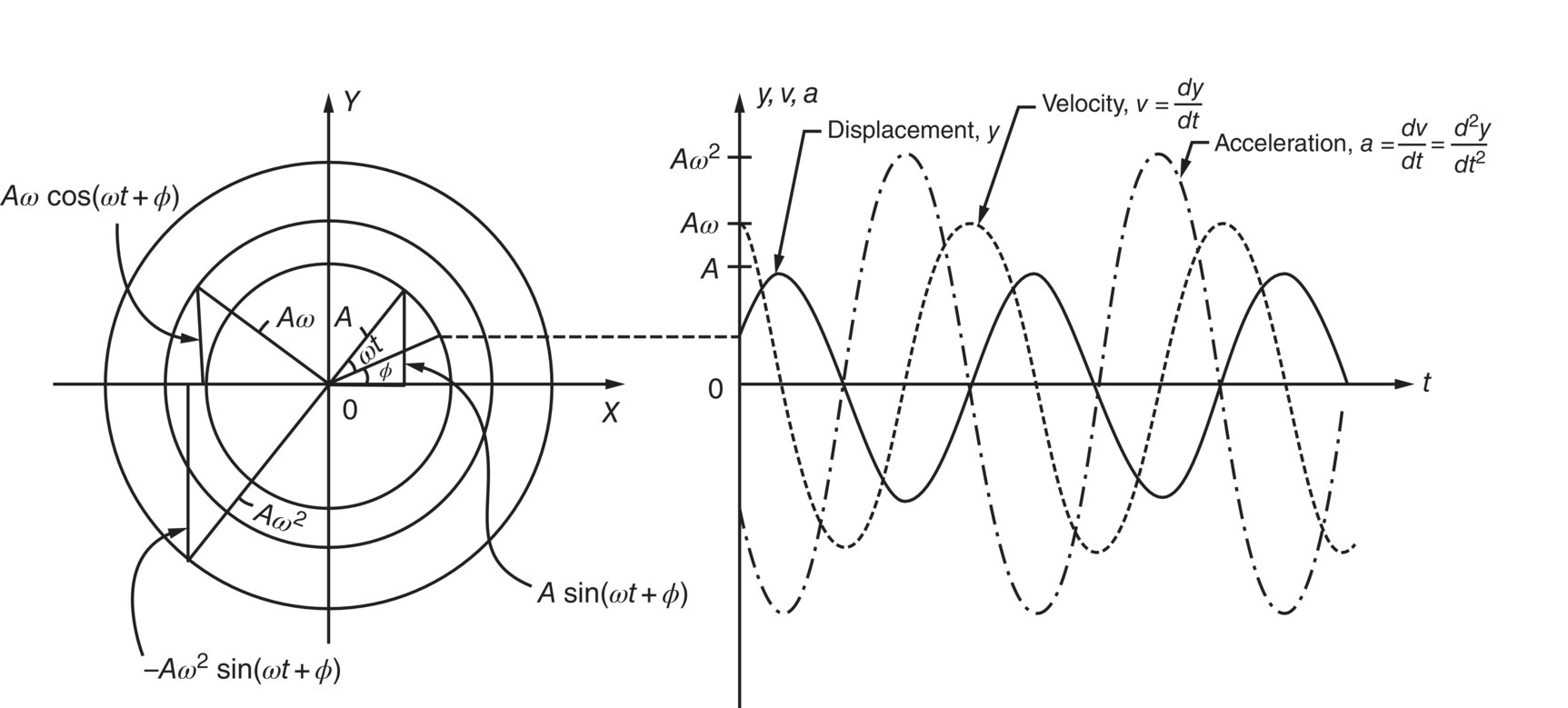
Note, by trigonometric manipulation we can rewrite Eqs. (2.4) and (2.5) as (2.6) and (2.7):
(2.6)
and
(2.7)
and from Eq. (2.3) we see that a = −ω2 y.
Equations tell us that for simple harmonic motion the amplitude of the velocity is ω or 2πf greater than the amplitude of the displacement, while the amplitude of the acceleration is ω2 or (2πf)2 greater. The phase of the velocity is π/2 or 90° ahead of the displacement, while the acceleration is π or 180° ahead of the displacement.
Note we could have come to the same conclusions and much more quickly if we had used the complex exponential notation. Writing

then

and

EXAMPLE 2.1
In a simple harmonic motion of frequency 10 Hz, the displacement amplitude is 2 mm. Calculate the maximum velocity amplitude and maximum acceleration amplitude.
SOLUTION
Since ω = 2πf = 2π(10) = 62.83 rad/s. The velocity amplitude is calculated as
ν = ω × 2 = 62.83 × 2 = 125.7 mm/s and the acceleration amplitude is a = ω2 × 2 = (62.83)2 × 2 = 7896 mm/s2.
Leave a Reply